Supreme Court expresses its reservations over Marxist interpretation of the wealth redistribution model
June 9, 2026
  • Read Ecopy
  • Circulation
  • Advertise
  • Careers
  • About Us
  • Contact Us
Android AppiPhone AppArattai
Organiser
  • ‌
  • Bharat
    • Assam
    • Bihar
    • Chhattisgarh
    • Jharkhand
    • Maharashtra
    • View All States
  • World
    • Asia
    • Europe
    • North America
    • South America
    • Africa
    • Australia
  • Editorial
  • International
  • Opinion
  • RSS @ 100
  • More
    • Op Sindoor
    • Analysis
    • Sports
    • Defence
    • Politics
    • Business
    • Economy
    • Culture
    • Special Report
    • Sci & Tech
    • Entertainment
    • G20
    • Azadi Ka Amrit Mahotsav
    • Vocal4Local
    • Web Stories
    • Education
    • Employment
    • Books
    • Interviews
    • Travel
    • Law
    • Health
    • Obituary
  • Subscribe
    • Subscribe Print Edition
    • Subscribe Ecopy
    • Read Ecopy
  • ‌
  • Bharat
    • Assam
    • Bihar
    • Chhattisgarh
    • Jharkhand
    • Maharashtra
    • View All States
  • World
    • Asia
    • Europe
    • North America
    • South America
    • Africa
    • Australia
  • Editorial
  • International
  • Opinion
  • RSS @ 100
  • More
    • Op Sindoor
    • Analysis
    • Sports
    • Defence
    • Politics
    • Business
    • Economy
    • Culture
    • Special Report
    • Sci & Tech
    • Entertainment
    • G20
    • Azadi Ka Amrit Mahotsav
    • Vocal4Local
    • Web Stories
    • Education
    • Employment
    • Books
    • Interviews
    • Travel
    • Law
    • Health
    • Obituary
  • Subscribe
    • Subscribe Print Edition
    • Subscribe Ecopy
    • Read Ecopy
Organiser
  • Home
  • Bharat
  • World
  • Operation Sindoor
  • Editorial
  • Analysis
  • Opinion
  • Culture
  • Defence
  • International Edition
  • RSS @ 100
  • Magazine
  • Read Ecopy
Home International Edition News

Supreme Court expresses its reservations over Marxist interpretation of the wealth redistribution model

Striving to create a proper balance between wealth distribution objectives and property rights, a nine-member bench headed by DY Chandrachud of the Supreme Court is aiming to use and explore Article 39 (b) mentioned in the Directive Principles of State Policy (DPSP) in Constitution of India to achieve their motive after deep research

Vedika ZnwarVedika Znwar
Apr 29, 2024, 08:30 pm IST
in News, Bharat, India
Follow on Google News
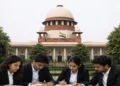
Supreme Court of India

Supreme Court of India

FacebookTwitterWhatsAppTelegramEmail

Amidst the escalating political rhetoric revolving around the wealth redistribution concept, the apex court is striving to maintain a balance between redistribution goals and property rights. The SC aims to delve deeper and explore the broader implications of Article 39 (b) and its alignment vis a vis the principles of social justice and equitable distribution of resources.

The bench reiterated that keeping in mind the reflections of the social and economic conditions prevalent during the framing of the Constitution, the relevance of Article 39 (b) fosters social transformation and facilitates in addressing the societal demands for welfare measures.

In a recent hearing, the apex court engaged in a significant discussion regarding the interpretation of wealth redistribution, pertaining to the private property and its relation to the common good.

The nine-judge bench, led by Chief Justice DY Chandrachud, including and Justices Hrishikesh Roy, B V Nagarathna, S Dhulia, J B Pardiwala, Manoj Misra, R Bindal, S C Sharma, and A G Masih delved into the nuanced understanding of whether privately-owned resources could be considered as “material resources of the community” under Article 39(b) of Directive Principles of State Policy in the Constitution.

The CJI drew a divergence from Justice VR Krishna Iyer’s 1977 interpretation of Article 39(b) of the Constitution, which has heavily influenced by Marxist ideology of Article 39(b) of the Indian Constitution.

Apex court inferred that that there are two extreme views: first dimension is the Marxist socialist angle which views that everything belongs to the state and the community. On the other hand, the capitalist view states that individual rights must be prioritised and then there is the Gandhian philosophical anarchist view who view holding resources in trust for protecting inter-generational equity.

The bench stated that there must be a line drawn between assets of the community held in trust by the present generation for future generations and property that is privately owned. The CJI discussed diverse perspectives on community property, including Marxist socialist, capitalist, and Gandhian perspectives.

The CJI further added that community property includes natural resources like forests, lakes, mines etc. Even if they are held privately, they would constitute community resources and thus benefits augmented through them cannot be hampered by invoking individual rights. The CJI referred to historical reforms such as the abolition of ‘Zamindari’ and outlined contrasting perspectives on property ownership, ranging from capitalist exclusivity to socialist commonality.

According to Advocate T Srinivasa Murthy, the essence of Articles 38 and 39 of the DPSP lies on the foundation of social and economic justice. It is aimed at making citizens active participants in nation’s economic progress and maintain their individual dignity as well. The objectives of the Articles is to make citizens as cohorts and not some mere applicants and beneficiaries.

In a nutshell, the notion of absolute equality that Grand Old party is advocating is misconstrued and a utopian idea. Only an egalitarian society can exist where each member of the society would be provided a fair chance to seek basic liberties and rights. Consequently, it endorses equality of opportunity, status and facilities and not the equality of results.

Article 39(b) is not a land acquisition provision. If the government wishes to acquire a  land for a housing project for the poor, then it must be ensured that the rightful compensation is presented to the current owners.

However, the interpretation of Article 39(b) should not be extended to the point where seizing someone else’s private property for distribution is advocated. The bench concurred that Article 39(b) was not a vehicle for acquiring community resources but advanced an objective anticipated by the Constitution writers.

The arguments put forth during the proceedings were presented by various parties including the Property Owners Association (POA) of Mumbai. They have vehemently argued against the notion that private properties could be seized by state authorities under constitutional schemes such as Articles 39 (b) and 31 C. The bench, however, heeded caution against an extreme interpretation that excludes private property from being considered as material resources of the community.

The deliberations on this complex legal question remained inconclusive and are set to continue. This signifies a vital judicial inquiry to untangle the interplay of private property rights and the common good.


 

Topics: CJIIndian ConstitutionDPSPArticle 39 (B)Supreme Court
ShareTweetSendShareSend
✮ Subscribe Organiser YouTube Channel. ✮
✮ Join Organiser's WhatsApp channel for Nationalist views beyond the news. ✮
Previous News

Jammu and Kashmir: The Journey from Terrorism to Tourism

Next News

India’s future to be determined by space industry, drones, semi-conductors, says EAM Jaishankar

Related News

Supreme Court remarks have revived the UAPA bail debate, with supporters citing national security concerns

UAPA Bail Debate: Striking a delicate balance between individual liberty and national security

Supreme Court invokes Article 142, issues strict timelines to curb delay in High Court judgments

Supreme Court invokes Article 142, orders strict timelines for High Court judgments to end delays in justice delivery

A Cow

Know the constitutional position and laws on ‘cow’ protection

SIR and Article 324: Supreme Court strengthens the constitutional spine of Indian Democracy; Reaffirms ECI’s authority

Andhra Pradesh cancels Pastor Anand’s SC certificate following Apex Court’s verdict on SC/ST Act on Christian converts

Supreme Court - DMK leader MK Stalin

Tamil Nadu: After reserving judgment, SC Bench recuses from delivering verdict in Stalin’s 2011 Kolathur election case

Load More

Latest News

Accused Nida Khan reportedly admits taking victim for religious instruction, teaching Islamic rituals

Nashik TCS Corporate Jihad: ‘I taught her how to do namaz,’ says Nida Khan; victim pressured to observe 30 ramzan roza

Germany: Sri Ganesha temple opens in Berlin: Europe’s largest Hindu Mandir reflects India’s cultural & dharmic spirit

Rajasthn | RSS centenary journey embodies dedication to nation-building: Dr Ramesh Agrawal

Decades of illegal infiltration from Bangladesh have driven profound demographic shifts in Assam, fundamentally altering its religious, linguistic, and political landscape

Unnatural demographic change: The termite threat

The Rs 200-crore MAHA Water Mission seeks to boost water security and democratise research funding in India

From Rigveda to Research Labs: How ANRF’s Rs 200 crore water mission is securing India’s future

(Right) Prakhar Shrivastava, Senior Consulting Editor and Anchor at Delhi Doordarshan Kendra at a Narada Jayanti programme in Guwahati (Left) Prakahar Srivastava addressing the gathering

Narada Jayanti by VSK Assam: “Half-truths more dangerous than lies,” says senior journalist Prakhar Shrivastava

Everest Survivor being taken to the hospital on a stretcher

Everest Survivor ICU Interview: BBC under fire for interviewing Sherpa without family’s consent

Phillipines Earthquake: 7.8 magnitude deadly earthquake leaves 15 dead, 200 injured; Rescue operation underway

Shamli Conversion Case: 'I studied Islam on YouTube,' says Ayush Malik as family alleges grooming

Shamli Conversion Case: ‘I studied Islam on YouTube,’ says Ayush Malik, now Mohammad Ali, as family alleges grooming

RSS functionaries on the stage at samapan samaroh of Sangh Shiksha Varg and Karyakarta Vikas Varg–Pratham at Sambalpur.

Awakening of Lokshakti is essential for building a glorious Bharat: Dr Gopal Prasad Mahapatra

Load More
  • Privacy
  • Terms
  • Cookie Policy
  • Refund and Cancellation
  • Delivery and Shipping

© Bharat Prakashan (Delhi) Limited.
Tech-enabled by Ananthapuri Technologies

  • Home
  • Search Organiser
  • Bharat
    • Assam
    • Bihar
    • Chhattisgarh
    • Jharkhand
    • Maharashtra
    • View All States
  • World
    • Asia
    • Africa
    • North America
    • South America
    • Europe
    • Australia
  • Editorial
  • Operation Sindoor
  • Opinion
  • Analysis
  • Defence
  • Culture
  • Sports
  • Business
  • RSS @ 100
  • Entertainment
  • More ..
    • Sci & Tech
    • Vocal4Local
    • Special Report
    • Education
    • Employment
    • Books
    • Interviews
    • Travel
    • Health
    • Politics
    • Law
    • Economy
    • Obituary
  • Subscribe Magazine
  • Read Ecopy
  • Advertise
  • Circulation
  • Careers
  • About Us
  • Contact Us
  • Policies & Terms
    • Privacy Policy
    • Cookie Policy
    • Refund and Cancellation
    • Terms of Use

© Bharat Prakashan (Delhi) Limited.
Tech-enabled by Ananthapuri Technologies