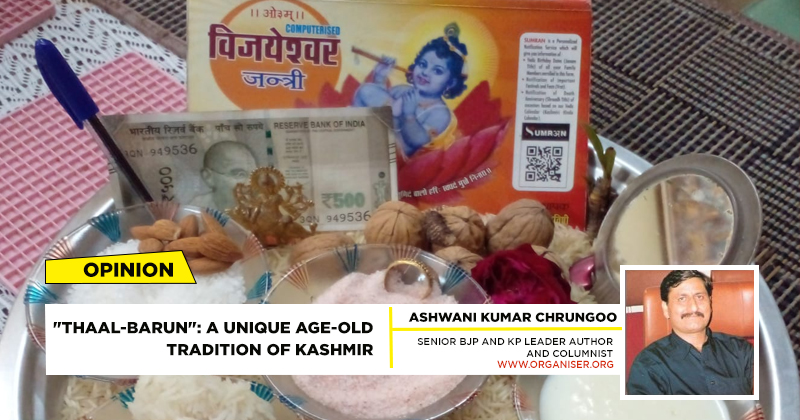
On the auspicious occasion of “Sonth” this year on March 14 2024, the Kashmiri Pandit community observed the unique tradition of “Thaal-Barun” on the eve of the auspicious day on March 13 2024. The Hindus of Kashmir (Kashmiri Pandits) have a unique and wonderful tradition of thousands of years of “Thaal-Barun” that they observe on the last day of the year (both Solar as well as the Lunar year). The next morning, that is the first day of the new year (both solar and lunar), the first thing they do is have the ‘Darshan’ of this “Thaal”. It is considered auspicious and deeply connected with our daily daily life requirements and obligations.
The preparation for this “Thaali” is called “Thaal-Barun”, which is done one day before New Year’s Day in the late evening so that it is ready for ‘darshan’ the next morning. All important things that are used in daily life are symbolically decorated on a ‘thali’ filled with rice. This “Thaal-Barun” is done on two occasions, so it is important to understand the correlation of Thaal-Barun on these two occasions, i.e., “Sonth” & “Navreh”.
South is the first day of the new year (Hindu calendar-Solar), which starts from the first of Chaitra month. It used to be the first day of the new year officially and administratively, up to the Maharaja’s regime in the Jammu and Kashmir state and even after that, it was 1957. The first day of the solar calendar month is also known as Sankrant (Sankranti). So, March 14 2024, was the “Sonth” this year.
Sonth (Chaitra-Sankranti) begins the Vasant (spring) and the New Year’s Day of the Nanakshahi calendar. It might be a pleasant surprise for many of us that the tradition of “Thal-Barun” is also observed by several Kashmiri Sikh families and the non-Kashmiri-speaking Hindu families of Kashmir. Some photographs of such a “Thaal” have been forwarded to this author, this time by some of these families from Jammu and the Kashmir valley.
“Navreh” is the first day of the new year (Hindu calendar-Lunar), starting from ‘Nav-Varsha Pratipada’, Chaitra Shukla-Pratipada. Kashmiri Pandits, in particular, observe this day also as First Vasant-Navratra. We already know that this year Navreh (Nav-Varsha Pratipada) falls on April 9 2024. Therefore, the Navratas will also begin on the same day. During the Navratras (nine-day festival of the Goddess of supreme energy), starting from Navreh, people observe a completely vegetarian life followed by fasts during the Navratras and feasts at the end of the day of Ramnavmi. It would be prudent to debate the significance of the Navratas in a historical and cultural context.
The Indian subcontinent, comprising the areas from Kandahar and Kabul to Dacca and Rangoon and from Tibet to Sri Lanka, is a hub of the world’s greatest and most prosperous civilisation. It is invariably a unique chunk of land with its own existence, history, and geography. While its history dates back to around ten thousand years, there are more than five thousand years of documented and written history of this civilisation.
From time immemorial, India (Bharat) has been the centre of the civilisational and cultural flow of the whole subcontinent. The documented history, traditions, and customs form a significant part of the cultural and civilisational aspects of the land’s history. Using people’s almanack (calendar) plays a significant role in this context.
India has one of the oldest calendars (almanac) in the world. It is called the Yugabd Samvat and was started immediately after the Mahabharata War. It is commensurate with the change of era (Yug-Parivartan i e., the start of Kaliyug). On April 9, Yugabd Samvat-5126 will begin. However, in the Kashmir valley, the scholars and rishis of the land found an indigenous almanack 26 years after the Yugabd Samvat. This almanack is known as the “Saptrishi Samvat” and is 26 years younger than the Yugabd Samvat. On the same day, April 9 2024, the “Saptrishi Samvat-5100” will also begin. These two Samvats (Yugabd Samvat and Saptrishi Samvat) are the oldest contemporary almanacks in the world. This narration of facts also recognises the importance of Kashmir as the centre of knowledge, culture, civilisation, astronomy and tradition.
Besides the two oldest almanacks that have been in vogue for the last five thousand years, two other functional almanacks are also in use. They are the Vikrami Samvat and the Shalivahan-Shaka Samvat. The first day of the year of all these almanacks is called the first Navratra. The first Navratra is called Navreh (the new flame) in Kashmir. Kashmir has a distinct tradition of Navreh, celebrated with the pious sight (darshan) of “Thaal” early in the morning.
The Indian subcontinent has fifty-two Shakti-sthal/Shaktipeeths (centres of supreme divine energy) dedicated to the Goddess Shakti. They are Kamakhya in Assam, Hinglaj Mata in Baluchistan, Jwala Devi in Himachal, Dacceyshwari in Dacca, Bagalamukhi in Nepal, and so on. These centres of the Goddess Shakti in various manifestations are where various physical parts of the Goddess Sati fell. There is one such divine centre in Jammu and Kashmir as well. It is called Chichi-Mata and is situated on a small hillock on the national highway in the district of Samba.
However, Kashmir valley had its own Shakti-steals (seats of divine energy), which were perceived to be very sacred, pious, full of divinity, and great spiritual inspiration and satisfaction. All these temples and shrines have a great devotional aura attached to them. The main Shakti-steals of Kashmir valley comprise the following:
- Hari Parbat, Srinagar
- Kheerbhawani, Tullamulla
- Jwala Devi, Khrew
- Bala Tripursundari, Balahama
- Shailputri, Baramulla
- Jeshtha Devi, Zabarwan
- Kheerbhawani, Taekkar
- Kulvageyshwari, Kulgam
- Bhadrakali, Kupwara
- Bargshakha, Mattan
- Kheerbhawani, Devsar, Khanabaran
- Bhuvneshwari, Chandpura, Srinagar
- Mahakali, Gainkhan, Srinagar
- Umanagri, Brariangan, Anantnag
- Durga, Durganag, Srinagar
- Kheerbhawani, Manzgam
- Raginya Bhagwati, Logripura
- Shiva Bhagwati, Akingam
Navratas are dedicated to the nine manifestations of Maha-Durga. The Nine manifestations of the Goddess worshipped on each of Navaratri are nine incarnations of Goddess Shakti. The nine goddesses worshipped are Shailaputri, Brahmacharini, Chandraghanta, Kushmanda, Skanda Mata, Kantyayani, Kala Ratri (Kaalratri), Maha Gouri and Siddhidayini (Sidhadatri). Each of these goddesses has her seat in the Kashmir valley. The first manifestation, Shailputri, is seated on the banks of the Vitasta (Jehlum) river in Baramulla, considered a very high seat of divine energy. For several reasons, this shrine is in a dilapidated condition nowadays. Thanks to the shrine’s management and Government support, renovation work has started and is monitored very well.
Mata Raginya (Kheer Bhawani) has a very special place among the Kashmiri Pandit community, and so are her shrines and temples all over the Kashmir valley, Tullamulla being the main seat of the Goddess. The Sharika Mandir on the Hari Parbat is also significant among the Shakti steals of Kashmir valley. All families of Kashmiri Pandits are especially attached and dedicated to one of the following Isht-Devis among the Shakti steals of Kashmir valley. These are, Sharika Mata-Hari Parbat, Jwala Mata-Khrew, Raginya Mata-Tullamulla and Bala Devi Mata of Balahama. It needs to be mentioned here that Bala Devi Mata, Balahama has a very special significance among the Khetriya-Rajputs of Jammu and Kashmir since it has also been the Isht-Devi of their clan for the last thousands of years. Unfortunately, most of them lost their connection with the shrine after 1947.
The next (lunar) year, which begins on ‘Navreh’ (Nav-varsh pratipada), will also be the completion of 5,100 years of the indigenous almanack of Kashmir called “Saptrishi-Samvat”. On April 9, 2024, the new year, “Saptrishi-Samvat:5100”, will commence, a significant event in Kashmir’s history and civilisation. The primary responsibility to observe and celebrate the “Saptrishi-Samvat:5100” rests upon the Kashmiri Hindu (Pandit) community as the inheritors of the ancient Civilisation of Kashmir. On the auspicious occasion of this Navreh, both the inheritors and followers of the Civilisation of Kashmir are humbly appealed to take concrete and positive steps to celebrate the “Saptrishi Samvat:5100” in the most befitting manner on April 9, 2024, and onwards during the full year ahead. “Thaal-Barun” should also invariably reflect this!