
CAA: Redressing Historical Injustice
August 24, 2026
  • Read Ecopy
  • Circulation
  • Advertise
  • Careers
  • About Us
  • Contact Us
Android AppiPhone AppArattai
Organiser
  • ‌
  • Bharat
    • Assam
    • Bihar
    • Chhattisgarh
    • Jharkhand
    • Maharashtra
    • View All States
  • World
    • Asia
    • Europe
    • North America
    • South America
    • Africa
    • Australia
  • Editorial
  • International
  • Opinion
  • RSS @ 100
  • More
    • Op Sindoor
    • Analysis
    • Sports
    • Defence
    • Politics
    • Business
    • Economy
    • Culture
    • Special Report
    • Sci & Tech
    • Entertainment
    • G20
    • Azadi Ka Amrit Mahotsav
    • Vocal4Local
    • Web Stories
    • Education
    • Employment
    • Books
    • Interviews
    • Travel
    • Law
    • Health
    • Obituary
  • Subscribe
    • Subscribe Print Edition
    • Subscribe Ecopy
    • Read Ecopy
  • ‌
  • Bharat
    • Assam
    • Bihar
    • Chhattisgarh
    • Jharkhand
    • Maharashtra
    • View All States
  • World
    • Asia
    • Europe
    • North America
    • South America
    • Africa
    • Australia
  • Editorial
  • International
  • Opinion
  • RSS @ 100
  • More
    • Op Sindoor
    • Analysis
    • Sports
    • Defence
    • Politics
    • Business
    • Economy
    • Culture
    • Special Report
    • Sci & Tech
    • Entertainment
    • G20
    • Azadi Ka Amrit Mahotsav
    • Vocal4Local
    • Web Stories
    • Education
    • Employment
    • Books
    • Interviews
    • Travel
    • Law
    • Health
    • Obituary
  • Subscribe
    • Subscribe Print Edition
    • Subscribe Ecopy
    • Read Ecopy
Organiser
  • Home
  • Bharat
  • World
  • Operation Sindoor
  • Editorial
  • Analysis
  • Opinion
  • Culture
  • Defence
  • International Edition
  • RSS @ 100
  • Magazine
  • Read Ecopy
Home Bharat

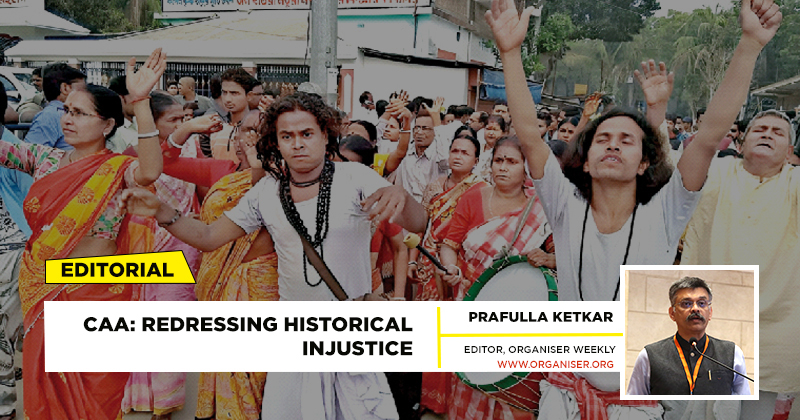
CAA: Redressing Historical Injustice

Prafulla KetkarPrafulla Ketkar
Mar 18, 2024, 02:00 pm IST
inBharat, Editorial
Follow on Google News
Facebook
Twitter
WhatsAppTelegramEmail

“I would like to tell the Scheduled Castes who happen to be impounded inside Pakistan to come over to India by such means as may be available to them. The second thing I want to say is that it would be fatal for the Scheduled Castes, whether in Pakistan or Hyderabad, to put their faith in Muslims or the Muslim League. It has become a habit with the Scheduled Castes to look upon the Muslims as their friends simply because they dislike Hindus. This is a mistaken view.” –Dr Babasaheb BR Ambedkar, The Free Press Journal, November 28, 1947. Cited in Dr Ambedkar: Life and Mission, Dhananjay Keer, p. 399

The much-awaited rules for the Citizenship Amendment Act (CAA), 2019 have been finally notified by the Union Government. As per the Citizenship Amendment Rules, 2024 will fast-track the process of granting citizenship to persecuted minorities who fled from Pakistan, Bangladesh, and Afghanistan and entered Bharat before December 31, 2014. The tragedy of Partition, mastered by the colonisers and executed by the Islamists, did not just divide the land but also the people. Many of them who continued to face the brunt of historical injustice due to the nature of the theocratic state in the neighbouring countries had to take refuge in their natural homeland that is Bharat. Even after discussions and clarification, the misinformation campaign continues in some States and communities. Instead of making political fearmongering based on vote-bank considerations, why was CAA a necessity to redress the historical injustice incurred on a section of the population, and what are the other ways to heal the horrors of Partition?

The logic that CAA is against “secularism” as it does not mention ‘Muslims’ is the most outdated and ridiculous argument. Are Muslims a persecuted community in Islamic countries, namely Pakistan, Bangladesh, and Afghanistan, like the Hindus, Sikhs, Buddhists, Christians, Jains, and Parsis are? The Nehru-Liaquat pact of 1950 was a guarantee by both the Bharat and Pakistan Governments to ensure complete equality of citizenship, irrespective of religion, and a complete sense of security regarding life, culture, property and personal honour to the minorities throughout its territory. Mere numbers tell the tragic story. It is estimated that minorities, predominantly Hindus, constituted around 20 per cent of the population of what is now Pakistan is now reduced to three per cent. Similarly, in today’s Bangladesh, the Hindu population was around 30 per cent, which has declined to eight per cent.

On the contrary, Bharat’s Muslim population, around 9.8 per cent in 1951, increased to 14.2 per cent in 2011. While Bharat adhered to the Nehru-Liaquat pact in letter and spirit, Pakistan and Bangladesh have introduced systemic religious persecution based on discriminatory laws and practices, intimidation and violence, economic marginalisation and social pressures. The trauma and stateless syndrome created by the unnatural and unplanned Partition have deprived almost three generations of any citizenship rights. Muslims from the neighbouring countries can opt for the other route to seek citizenship but not the fast-track route meant for the persecuted minorities.

The argument that granting citizenship to these persecuted families would be an additional burden to our economy is also misguided and mischievous. People who entered Bharat from August 15, 1947 to December 31, 2014, are entitled to this provision. Now, with access to education and other rights, they will be in a better position to contribute to the nation constructively.

The social character of these persecuted communities is also shocking. During the Partition, when Hindus of East and West Pakistan chose to take refuge in Bharat, a large number of Dalit Hindus were forcibly held back from crossing the borders. Even now, Dalits are still forced to do menial jobs in Pakistan and Bangladesh. They have been the worst victims of discrimination, abduction, rape, blasphemy and poverty. Of the total three million Hindu population of Pakistan, Dalits constitute around 80-85 per cent, mainly from Bhil, Meghwal, Odh and Kohli castes. In Bangladesh, the Hindu population is calculated as around 14 million, of which more than 50 per cent are from Scheduled Castes. The Matuas and Rajbanshis, forced to migrate to West Bengal, will be the biggest beneficiaries of this act. Hence, the CAA is an act of social justice for the marginalised sections.

Dr Ambedkar was well aware of the “exclusivist idea called Pakistan”. Hence, he issued the call for Scheduled Castes in Pakistan to return to India first in 1947 through a statement and then in September 1951 during a public meeting in Mumbai. The notification of CAA fulfils the promise our Constitution makers had given to the minorities in the partitioned areas. It is a humanitarian provision for dignity and social justice. All of us should support and facilitate the process of redressing historical injustice so that the horrors of Partition can be healed to some extent.


Topics: MuslimsWest BengalCitizenship Amendment Acttragedy of PartitionPakistan and BangladeshHindu population
Prafulla Ketkar
Prafulla Ketkar
Prafulla Ketkar, is the Editor, Organiser (Weekly) since 2013. He has a experience of over 20 years in the fields of research, media and academics. He is also Advisory Committee School of Journalism, Delhi University. He has been writing on issues related to International politics and foreign policy, with special reference to China and Democracy, Hindutva, and Bharatiya Civilisation. He was also a member of the Editorial team of the recently published Complete Works of Pt Deendayal Ji in 15 Volumes. He has 2 books, 29 academic articles, 2 entries in Encyclopedia of India and numerous articles to his credit. [Read more]
Share41
Tweet
SendShareSend
✮ Subscribe Organiser YouTube Channel. ✮
✮ Join Organiser's WhatsApp channel for Nationalist views beyond the news. ✮
Previous News

PM Modi counters Rahul Gandhi’s ‘Shakti’ comment; electoral face-off locked for June 4

Next News

Indian Navy’s INS Kolkata, MARCOS victoriously ‘liberate’ cargo ship MV Ruen from Somali pirates

Related News

Home Minister Amit Shah holds a review meeting on the security situatinon in Siliguri Corridor

Home Minister Amit Shah outlines Siliguri strategy; Calls for inter-departmental synergy to foster national security

Asphulla Mallik created his AI image and projected himself as a Mujahideen on social media

Karnataka: Suspected TTP operative Asphulla Mallik arrested in Bengaluru; Police probe reveal terror links

National Women Commission Conclave in West Bengal: Women could be key entrepreneurs in pharma sector

Taslima Nasrin returns to Kolkata

The Return of Taslima Nasrin to Kolkata: The story of exile and belonging

Muslim League anchored planned atrocities against Hindus on Direct Action Day in Calcutta

Decoding the horrors of Direct Action Day; Revisiting the forgotten lessons from the streets of Calcutta

August 14 is observed as Partition Horrors Remembrance Day

From Crushing 1857 Jihad to Muslim Appeasement: British and Gandhi’s policies that helped partition India

Load More

Latest News

India’s Semiconductor Revolution: Building the ecosystem to lead the global chip race

Representative Image

India’s Emerging Military Challenge: Air campaign alone cannot replace boots on the ground

Lum Sohpetbneng- sacred peak of the Khasi people. They believe it to be the "Navel of Heaven"

Decoding Northeast: Celebrating ‘shared values’

Abdul El-Sayed

Who Is Abdul El-Sayed? Michigan’s Bid for America’s first Muslim Senator and How is he linked to Bin Laden & Al-Qaeda?

19th Foundation Day of GBU | Mission ShakthiSAT inaugurated; CM Yogi urges youth to embrace ‘Nation First’ spirit

Join hands against the US’ unilateral tariff pressures

A Clarion Call Against Global Hinduphobia: Organizations unite to oppose USCIRF’s anti-India agenda

Book Review: Young, innovative, still eternal

Are we losing the UPI Freedom

PM Modi interacts with space startup CEOs

National Space Day: PM Modi urge startups to revolutionise India as global space power & solve grassroot challenges

Load More
  • Privacy
  • Terms
  • Cookie Policy
  • Refund and Cancellation
  • Delivery and Shipping

© Bharat Prakashan (Delhi) Limited.
Tech-enabled by Ananthapuri Technologies

  • Home
  • Search Organiser
  • Bharat
    • Assam
    • Bihar
    • Chhattisgarh
    • Jharkhand
    • Maharashtra
    • View All States
  • World
    • Asia
    • Africa
    • North America
    • South America
    • Europe
    • Australia
  • Editorial
  • Operation Sindoor
  • Opinion
  • Analysis
  • Defence
  • Culture
  • Sports
  • Business
  • RSS @ 100
  • Entertainment
  • More ..
    • Sci & Tech
    • Vocal4Local
    • Special Report
    • Education
    • Employment
    • Books
    • Interviews
    • Travel
    • Health
    • Politics
    • Law
    • Economy
    • Obituary
  • Subscribe Magazine
  • Read Ecopy
  • Advertise
  • Circulation
  • Careers
  • About Us
  • Contact Us
  • Policies & Terms
    • Privacy Policy
    • Cookie Policy
    • Refund and Cancellation
    • Terms of Use

© Bharat Prakashan (Delhi) Limited.
Tech-enabled by Ananthapuri Technologies