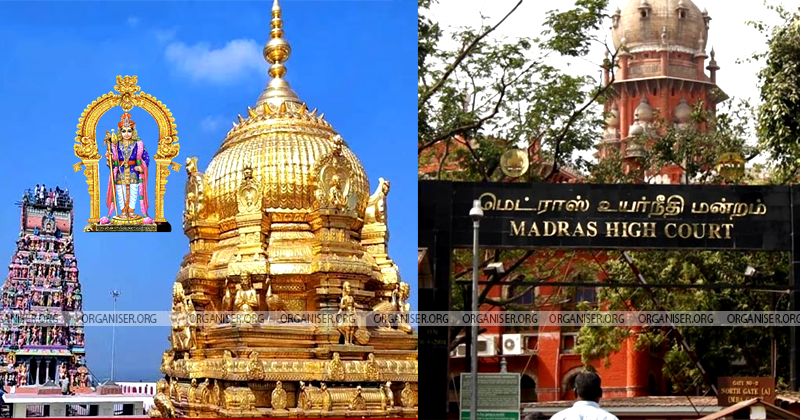
The Madras High Court has ruled that the Palani temple is not a picnic spot and that non-Hindus are not allowed to enter beyond the flagpole area without a written undertaking. The court said that temples are places of worship and that non-Hindus should not be allowed to enter beyond the flagpole area as it is considered to be the sacred part of the temple. The court also said that non-Hindus can visit the temple if they have faith in the deity and are willing to follow the temple’s customs and traditions.
In response to a petition filed by Senthil Kumar, urging restrictions on non-Hindu entry into the Pazhani hilltop Murugan temple premises, the Madurai bench of the Madras High Court, Justice S Srimathy, has issued a comprehensive ruling with broader implications for all Hindu temples in Tamil Nadu. The 57-page order directs authorities to allow only Hindus into the hilltop temple premises and its sub-temples, further instructing the display of corresponding boards at all entrances.
The petitioner, running a “Shashti Toy Shop” in Adivaram Pazhani and organising the Pazhani Hill Temple Devotee Organisation, cited an incident where non-Hindus with tickets were denied entry. The petitioner emphasised the need for clear directives after a confrontation at the Winch Station, where non-Hindus argued that the temple was a tourist spot and banners should be displayed if restrictions applied.
Justice Srimathy recounted the incident, noting the devotees’ support for temple employees and their condemnation of the temple authorities for initially failing to display banners prohibiting non-Hindus. The banners, installed during the renovation for the temple’s Kumbabishekam, were removed, sparking speculation of external pressure on the authorities. Social media posts by atheists and Islamists fueled these speculations.
The judge highlighted incidents in other temples, such as Muslims consuming non-vegetarian food in the Brihadeeswara Temple in Thanjavur and eating meat in the Hampi Temple complex. Notably, a Muslim youth’s arrest in Uttar Pradesh for offering namaz in a Hindu temple raised concerns about respecting the sanctity of Hindu places of worship.
The ruling underscores the importance of preserving the sacred nature of Hindu temples and maintaining the integrity of religious practices. Justice Srimathy’s order calls for a uniform approach across all Hindu shrines in Tamil Nadu, emphasising the cultural and theological significance attached to these places of worship. The directive aims to prevent non-Hindus from entering the premises without written undertakings, addressing concerns raised by the petitioner and echoing broader sentiments among devotees.
Responding to a petition filed by Senthil Kumar, the judge declared that the order, initially pertaining to the Pazhani hilltop Murugan temple, should now be applied uniformly across all temples in Tamil Nadu.
The judge drew parallels with the practices observed at Muslim mosques, emphasising that just as non-Muslims are restricted from certain areas within mosques, non-Hindus should similarly be prohibited from specific zones within Hindu temples. The ruling underscores the significance of maintaining the spiritual ambiance of Hindu temples, encompassing areas from the Gopuram (Tower) to the GarbaGraham (Sanctum Santorum).
Addressing the ancient origins and enduring ethics of Hinduism, Justice Srimathy highlighted the religion’s ability to adapt to changing times while preserving its core values. She emphasised that Hindu temples serve as sacred spaces for worship, and allowing non-Hindus into certain areas would contradict the fundamental purpose of temple entry.
Rejecting the DMK government’s plea to limit the order to the Palani Dhandayuthapani Swamy temple alone, Justice Srimathy insisted on the broader application of the ruling to encompass all temples in Tamil Nadu. The judge directed the government and the Hindu Religious and Charitable Endowment (HR and CE) department to install notice boards at temple entrances, near the Kodimaram, and at prominent locations inside the temple, explicitly stating, “Non-Hindus are not allowed inside the temple after Kodimaram.”
Furthermore, the court instructed authorities not to permit entry to non-Hindus who do not believe in Hindu religion. If a non-Hindu expresses a desire to visit a particular deity within the temple, the respondents must obtain a written undertaking from the individual, confirming their faith in the deity and willingness to adhere to Hindu customs and practices. Such approved entries are to be recorded in a register maintained by the temple.
The comprehensive order emphasises the importance of strict adherence to the agamas, customs, and practices of each temple, reiterating the need to preserve the spiritual integrity of these sacred spaces. The ruling aims to strike a balance between religious freedom and the preservation of cultural and religious traditions.
The court highlighted incidents at the Arulmighu Brahadeeswarar Temple and the Arulmighu Meenakshi Sundareswarar Temple in Madurai, where individuals from other religions treated temple premises as picnic spots and engaged in non-vegetarian food consumption and prayers near the sanctum sanctorum. The court deemed these incidents a violation of the fundamental rights guaranteed to Hindus.
Asserting the right of Hindus to freely profess and practice their religion, the court underscored the duty of the Hindu Religious and Charitable Endowment Department to protect temples from such unwanted intrusions. While the court maintained that non-Hindus are generally barred from entering temples, it noted that exemptions could be granted if their faith in Hinduism is established.
The judgement stressed the importance of maintaining temple premises with reverence and according to agamas, discouraging the use of these sacred spaces as picnic or tourist spots. The court acknowledged the diversity within Hindu temples, citing instances like the shrine for “Bibi Nachiyar” in Arulmighu Ranganathaswamy Thirukovil Srirangam, which demonstrates inclusive practices where even non-Hindus participate in worship rituals. The counsel for the respondents argued for secular governance, urging the protection of citizens’ rights without hurting religious sentiments.
The court acknowledged the diversity within Hindu temples, citing instances like the shrine for “Bibi Nachiyar” in Arulmighu Ranganathaswamy Thirukovil Srirangam, which demonstrates inclusive practices where even non-Hindus participate in worship rituals. The counsel for the respondents argued for secular governance, urging the protection of citizens’ rights without hurting religious sentiments.
The judgement prompted reactions, including one from T.R. Ramesh, who had filed an impleading petition in the case. He expressed satisfaction with the court’s decision, referring to it as his “4th CONSECUTIVE Victory in Pazhani Temple matters by HIS Krupa!” The response highlights the significance of the ruling in the ongoing discourse surrounding temple access and religious rights.
Great news regarding Sri Dhandayuthapani Swamy Temple, Pazhani !
This is the ancient Sri Subramanya Temple which draws the maximum crowd of devotees in Tamil Nadu – Devotees come in large numbers from Kerala, Srilanka, Malaysia and Singapore.
The @tnhrcedept in violation… pic.twitter.com/SC0bxDIYnr
— trramesh (@trramesh) January 30, 2024
As the judgement resonates, it is expected to impact the broader conversation on religious inclusivity and the delicate balance between preserving cultural traditions and upholding constitutional rights. The court’s emphasis on protecting the sanctity of Hindu temples while recognising the diversity within them adds nuance to the ongoing debates on religious practices in India. The coming days may witness further discussions and potential developments regarding the implementation and reception of this judicial directive.