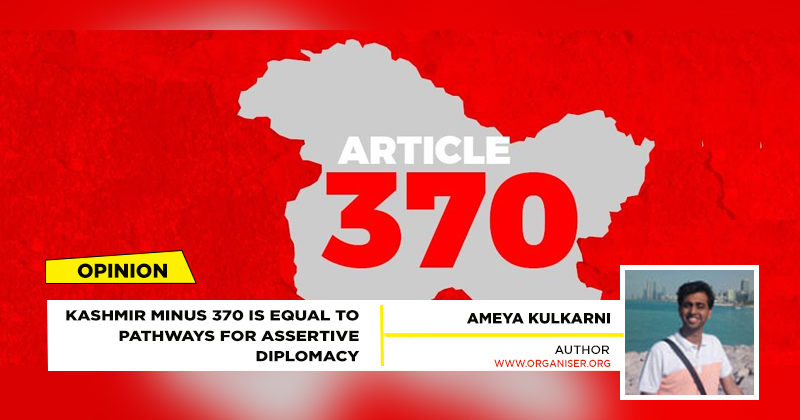
A process that started on August 5, 2019 finally culminated on December 11, 2023 when the Supreme Court placed its seal of approval on the Narendra Modi government’s decision to revoke Article 370 of the Constitution. On 5 August 2019, Home Minister Amit Shah announced in parliament the scrapping of Article 370, which had exempted Jammu and Kashmir from the Indian Constitution (except Article 1 and Article 370 itself) and permitted the state to draft its own Constitution. The state was bifurcated into two Union Territories – Ladakh without a legislature, and Jammu and Kashmir with a legislature. It was a transformative move and predictably generated strong passions across the political spectrum, leading to challenges in court. Since August, the constitution bench of the Supreme Court had taken up nearly 23 petitions challenging the government’s decision.
Underlining that the abrogation of Article 370 was a “culmination of the process of integration” of Jammu and Kashmir with the Union, the Supreme Court declared that there was no malafide intention in declaring this article inoperative. The Constitution bench upheld the power of the President of India to unilaterally dilute special status accorded to the former state of Jammu and Kashmir per Article 370. The highest court of the land made it clear that Jammu and Kashmir “surrendered” its sovereignty “full and final” when a proclamation was issued for the state on 25 November 1949, and that Article 370 was a temporary provision – an interim arrangement due to war conditions in the state.
The Supreme Court’s judgment, validating the abolition of Article 370 for Jammu and Kashmir and the separation of Ladakh from it — legislated by Parliament on August 5, 2019 — will make one big difference to the geopolitics of Kashmir.
It ends Delhi’s prolonged defensive strategic orientation on Kashmir that emerged at the turn of the 1990s when independent India was at one of its most vulnerable moments. The legal clarity provided by the Supreme Court — that India’s “internal” relationship with Kashmir is not open for “external” negotiation — does provide a good basis to launch a new phase in India’s Kashmir strategy.
The status quo on Kashmir had become unsustainable long back. It was only the political and policy inertia that was keeping Indian policymakers from challenging that. The so-called problem in Jammu and Kashmir has always been a bilateral matter between the people of the state and the rest of the country. The rest of India has been living with one set of policies vis-a-vis Jammu and Kashmir for the last seven decades and the results have been underwhelming. Just as the people of Jammu and Kashmir have a stake in the rest of India, the rest of India too has a stake in the state. The Modi government had underlined that it is not only serious about consolidating India’s frayed peripheries but is also cognizant of the aspirations of a state, which, despite its resources, has become a cesspool of violence and degenerative politics.
While critics in India continue to crib about government measures, their seriousness of intent is well-appreciated by India’s adversaries. After all, one of the reasons China upped the ante in Ladakh was in recognition of the fact that these measures can fundamentally alter India’s strategic periphery to China’s long-term detriment. India is finally making its intent clear and that is bound to unnerve those who were comfortable with the status quo.
Question of Legitimacy
The task of the NDA government, which pushed hard to change the terms of engagement at home and abroad on Kashmir over the last decade, is not done. The domestic legal closure on the question of India’s full sovereignty over Kashmir does not automatically end the external meddling in Kashmir.
The resolution of that challenge depends on growing India’s comprehensive national power, enhancing the capacity to deter Pakistan and China from adventurism on the borders of Kashmir, and diminishing the salience of other international factors in Kashmir. Above all, it depends on constructing a sustainable new political compact in Kashmir.
Neither Pakistan nor China will accept the Supreme Court’s decision as relevant in any way to their long-standing policies on Kashmir. The international political interest and diplomatic positions on Kashmir, whether in the Islamic world or the West, are also unlikely to change soon.
Whether they accept it or not, the rest of the world will note that the Indian state — basking in a high degree of political self-assurance and rising weight in the international system — has rallied round to a new and tougher position on Kashmir.
US-China-Pakistan pressure
Pakistan’s full-throated military, political and diplomatic support to the insurgency in Kashmir came amidst the breakdown of the old economic order in India, the collapse of one-party rule and the rise of weak national coalitions, fires all along India’s periphery from Punjab to the North East and Tamil Nadu, and the Mandal versus Mandir politics in the heartland.
The collapse of the Soviet Union in 1991 convinced Pakistan and the insurgents that a visibly weakened Indian state could be brought down in Kashmir. All it needed was a big strategic push. Internal insurgency backed by cross-border terrorism was matched by a massive global campaign to mobilise international support for Kashmir’s secession from India.
This was reinforced by the Clinton administration’s South Asia policy after the Cold War that questioned the accession of Kashmir to India, focused on the human rights situation in the state, and sought to promote a peace process between India and Pakistan devoted to resolving the Kashmir question.
The series of military crises around Kashmir — in 1987, 1990, 1999, and 2001-02 — saw the international community intervene to prevent India and Pakistan from coming to nuclear blows and pushing for a dialogue on Kashmir.
India’s Strategic Reversal
In navigating this storm at one of India’s most dangerous moments, Delhi, to its credit, did not give away the store on Kashmir. However, successive governments since the 1990s had to signal political flexibility on Kashmir to manage the international pressures. Three signals stood out.
One was to put Kashmir back on the negotiating table with Pakistan. Another was to suggest that there might be room to negotiate on the nature of the institutional relationship between Delhi and Kashmir. A third was to lend credence to Islamabad’s claim that the “people of Kashmir” must be the “third party” to the negotiations with India by engaging with the pro-Pakistan militant groups and facilitating their travel across the border.
‘New Kashmir’, New Diplomacy
The US now has other fish to fry in Asia, and Kashmir is no longer the obsession in Washington’s South Asia policy. The positive transformation of India’s relations with the United Arab Emirates and Saudi Arabia has prevented Pakistan from mobilising the Islamic world against Delhi’s Kashmir actions.
Given the expansive mood of optimism that envelops Delhi today, it is quite easy to forget the enormous difficulties India had in managing the international dynamic in Kashmir over the last three decades. The gathering crisis in Kashmir during the 1980s culminated in the massive insurgency that broke out in 1989. Pakistan, bursting with confidence from its success in driving the Soviet Union out of Afghanistan, seized the moment.
Equally consequential has been the dramatic shift in the balance of power between India and Pakistan. Thanks to India’s sustained economic growth and Pakistan’s slowdown, India’s GDP at 3.7 trillion dollars is ten times larger than Pakistan’s. If the current trends persist, the gap between the two will continue to widen in the coming years.
While the support from the West and the Islamic world is very welcome, Delhi is acutely conscious that few of them have given up on the notion that there is a Kashmir dispute between India and Pakistan. A restive Kashmir will continue to reinforce the old perceptions. Building peace and prosperity in Kashmir, then, is key to permanently transforming international attitudes.
For the rest of the world, which was already engaging with India as a rising economic and geopolitical player, the Supreme Court verdict will further reinforce the sense that Prime Minister Modi is in sync with the wider mood in the country and that the Kashmir issue is no longer the key lens through which to view either India or the government. By burying Article 370, the government has buried one of most serious challenges that Indian foreign policy faced on the global stage for the more than seven decades.
While Pakistan has weakened as a strategic actor in relation to India, its capacity to create trouble in Kashmir remains intact. Pakistan’s deepening partnership with China continues to present challenges to India in Kashmir. Notwithstanding these two negative factors, the international environment has never been as favourable to India as it is today in building a “New Kashmir”.