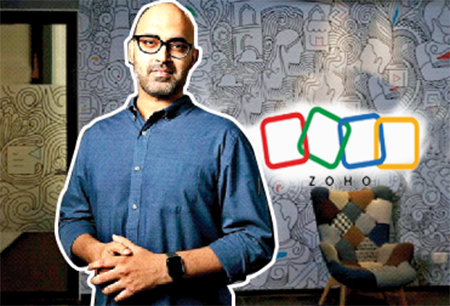
Bharat is Zoho’s third-largest as well as the fastest-growing market. The company saw a 37 per cent growth in the country in 2022. In this background, Praval Singh, Vice President, Marketing of Zoho Corp, talked to Organiser’s Kunti Surender. He said that Zoho has crossed $1B in annual revenue in 2021 and has steadily built its cloud portfolio into a 55+ product-strong suite that is used by businesses in more than 180 countries. Excerpts:
How did AdventNet turn into Zoho in the US and what made you travel to and settle in Bharat, that too in a rural area like Tankesi of Tamil Nadu?
Zoho has had a hub office in Tenkasi since 2011, well before Sridhar Vembu moved to the town from the US (in 2019). The idea to start offices in rural and sub-urban areas in India and build technology solutions from there first came when we realised that most of our employees hailed from tier 2/3 towns and villages outside of Chennai. We wanted to reverse this trend of rural-to-urban talent migration, and instead create jobs where the talent is. Back then, we were looking for a town of about 1 lakh people along the Western Ghats with basic infrastructure facilities, and that’s how our first rural office came about in Tenkasi. In 2016, we also globally launched Zoho Desk, our helpdesk software entirely built in the town. Today, we have more than 700 employees belonging to our various product teams working out of Tenkasi, and also a Zoho Schools of Learning branch (School of Technology) to train high school and diploma students.
Around the time Sridhar Vembu relocated from the US to Tenkasi, Zoho also adopted the strategy of transnational localism, a growth approach wherein the company’s growth is locally rooted through on-ground efforts and globally connected via shared culture and knowledge. This approach allows for wealth distribution across regions and correct problems that come with global imbalances. As part of this approach as well as to provide employees the option to work out of an office space near their home towns during the pandemic, Zoho scaled its office-opening efforts across rural and sub-urban India. We currently have around 30 such offices in India. Additionally, this has allowed us to better nurture rural talent for high-paying jobs.
What are the advantages and challenges in Bharat for companies like Zoho operating in rural areas, literally beyond major metros?
Choosing to open an office and operate out of tier 2/3 cities and towns can serve businesses well in multiple ways and also assure a longer runway for businesses. For instance, Zoho has several offices in rural and sub-urban areas and we can vouch for the vast talent pool that exists in these places. If companies are open to investing in long-term talent nurturing and skill development in these areas, they will have access to a much broader pool of candidates, many of whom would have been overlooked by traditional hiring models that focus on credentials.
Moreover, the GDP potential of smaller cities and towns is huge, and with proper workforce skilling and high-value job opportunities, it is possible to unlock a higher GDP growth rate in tier 2/3 cities. This can, in turn, help stimulate community progress and infrastructure development, and the benefits that companies can realise from this kind of overall growth are significant, such as sustained profitability in the long run.
From a challenge perspective, a major roadblock that we see is the young worker mindset. Years and years of urban supremacy have given us this misconception that migrating to a metro city allows us to access better job opportunities and a high-quality lifestyle. Earlier, this might have been true to an extent. However, things are quickly changing and we have adequate jobs, knowledge-sharing networks, infrastructure facilities, and tech employers in tier 2/3 cities. Similarly, the mindset also needs to change amongst our young population and their parents in rural areas.
Is your current journey on the predicted lines? In terms of market value, investment and software exports?
Zoho being a private company, we do not disclose numbers or share a lot of these details but the company is profitable and has grown significantly over the years. For instance, the company crossed $1B in annual revenue in 2021 and has steadily built its cloud portfolio into a 55+ product-strong suite that is used by businesses in more than 180 countries.
Did you find any policy gaps and if yes, how is the nation addressing them and what is Zoho’s contribution to it?
More than Government support, we need more private companies to take the initiative and set up offices in and around tier 2/3 cities, towns, and rural villages so that we can create more jobs for retaining the local talent, which can, in turn, empower rural revitalisation. We need to also promote more deep-tech R&D so that we can build these capabilities and know-how in India.
What is the impact of your operations in nearby rural areas, in terms of the economy and employment connected with Zoho?
While most of our rural and sub-urban offices have been opened only in the past 3-4 years, our Tenkasi office has been around since 2011. In 2021, to determine the kind of effect our office had had on the town in the past decade, we carried out a socio-economic impact assessment study in Tenkasi. The study helped us understand the positive impact our presence has had in Tenkasi over the years, such as an increase in overall income, high-tech skill development and employment opportunities for youth, empowered women with greater agency, and significant contributions to the community’s socio-economic progress.
Can Bharatiya companies go beyond metros to build and sustain their operations?
Of course. While opportunities may not be distributed today, talent has always been. Thanks to better internet connectivity via broadband and LTE, companies can now set up operations using a business setup that’s a lot more distributed today than 15 years ago. While most companies have preferred or still prefer hiring from metros, some are starting to understand and leverage the benefits of a distributed presence. This is a lot easier for digital roles, but it opens up opportunities for other businesses in the vicinity. What we’ve done in Tenkasi in the last 10-12 years is a good example of that!
What is the future vision and suggestion for the upcoming generation from your side?
As a country that has more than 50 per cent of its population below the age of 25 and more than 65 per cent below the age of 35, our future as a nation depends on how our youth taps into the opportunity that the country has. And for that to happen, we need to create a mindset of building capabilities (the know-how) and products (via R&D). Both these require a long-term approach and are hard to achieve when the focus isn’t set right. I’d encourage our youth to look at things with a long-term lens and commit to building something with perseverance, because that’s what helps build a business; and a nation too.