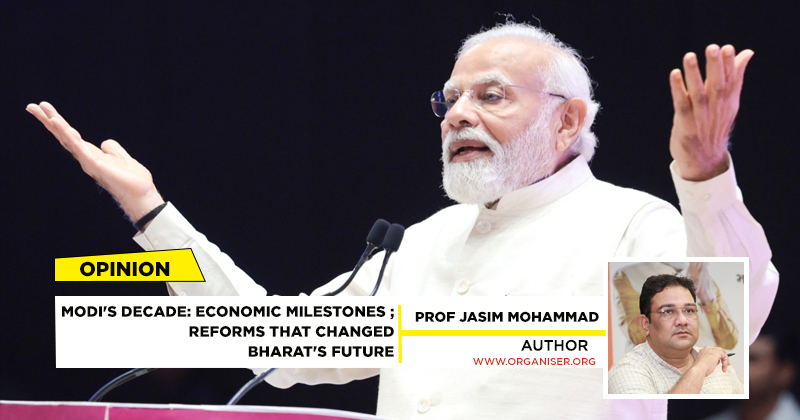
Modi's Decade: Economic Milestones; reforms that changed Bharat's future
September 14, 2026
  • Read Ecopy
  • Circulation
  • Advertise
  • Careers
  • About Us
  • Contact Us
Android AppiPhone AppArattai
Organiser
  • ‌
  • Bharat
    • Assam
    • Bihar
    • Chhattisgarh
    • Jharkhand
    • Maharashtra
    • View All States
  • World
    • Asia
    • Europe
    • North America
    • South America
    • Africa
    • Australia
  • Editorial
  • International
  • Opinion
  • RSS @ 100
  • More
    • World Hindu Congress 2026
    • Op Sindoor
    • Analysis
    • Sports
    • Defence
    • Politics
    • Business
    • Economy
    • Culture
    • Special Report
    • Sci & Tech
    • Entertainment
    • G20
    • Azadi Ka Amrit Mahotsav
    • Vocal4Local
    • Web Stories
    • Education
    • Employment
    • Books
    • Interviews
    • Travel
    • Law
    • Health
    • Obituary
  • Subscribe
    • Subscribe Print Edition
    • Subscribe Ecopy
    • Read Ecopy
  • ‌
  • Bharat
    • Assam
    • Bihar
    • Chhattisgarh
    • Jharkhand
    • Maharashtra
    • View All States
  • World
    • Asia
    • Europe
    • North America
    • South America
    • Africa
    • Australia
  • Editorial
  • International
  • Opinion
  • RSS @ 100
  • More
    • World Hindu Congress 2026
    • Op Sindoor
    • Analysis
    • Sports
    • Defence
    • Politics
    • Business
    • Economy
    • Culture
    • Special Report
    • Sci & Tech
    • Entertainment
    • G20
    • Azadi Ka Amrit Mahotsav
    • Vocal4Local
    • Web Stories
    • Education
    • Employment
    • Books
    • Interviews
    • Travel
    • Law
    • Health
    • Obituary
  • Subscribe
    • Subscribe Print Edition
    • Subscribe Ecopy
    • Read Ecopy
Organiser
  • Home
  • Bharat
  • World
  • Operation Sindoor
  • Editorial
  • Analysis
  • Opinion
  • Culture
  • Defence
  • International Edition
  • RSS @ 100
  • Magazine
  • Read Ecopy
Home Bharat

Modi’s Decade: Economic Milestones; reforms that changed Bharat’s future

From the successful implementation of the GST to the digital revolution ushered in by UPI and India Stack, these measures have not only transformed India's economic landscape but also positioned it as a global leader in digital governance

Prof. Jasim MohammadProf. Jasim Mohammad
Oct 8, 2023, 07:00 pm IST
inBharat, Opinion
Follow on Google News
Facebook
Twitter
WhatsAppTelegramEmail

As Bharat reflects on nearly a decade under the leadership of Prime Minister Narendra Modi, it becomes apparent that his tenure has left an indelible mark on the nation’s economy. With opinions sharply divided between staunch supporters and ardent critics of “Modinomics” ,there is no denying that Modi’s tenure has been marked by a relentless pursuit of economic reforms and a commitment to ushering in change.

One of the hallmark achievements of Modi’s economic agenda was the successful implementation of the Goods and Services Tax (GST). This monumental reform aimed to simplify Bharat’s complex tax structure by unifying various State and central taxes into a single, comprehensive tax. While the GST faced initial challenges and resistance, it has proven to be a significant success. Since its inception, the taxpayer base has nearly doubled, and tax collections have shown consistent growth.

In April, GST collections soared to an all-time monthly high of Rs 1.87 lakh crore, marking a 12 per cent increase from the previous year. Furthermore, a majority of large States reported impressive GST growth rates exceeding 20 per cent. This data suggests a broad-based economic growth across sectors and regions. Additionally, the generation of 90 million e-way bills in March 2023, an 11 per cent increase from the preceding month, underscores the growing economic activity facilitated by the GST.

Narendra Modi’s tenure witnessed an unparalleled integration of technology into governance and financial systems. The Unified Payment Interface (UPI), introduced by his Government, revolutionised Bharat’s economy by enabling digital payments even in remote villages. Behind this digital payments infrastructure lies Bharat Stack, a set of open APIs and digital public goods that harness the economic potential of identity, data, and payments on a massive scale. Key components of Bharat Stack include Aadhaar, UPI, Digilocker, and the CoWin Vaccination Platform.

The core principle of Bharat Stack is to reduce transaction costs, ensuring that Bharat’s vast population gains access to crucial services, both public and private. UPI, in particular, has empowered private sector innovation based on digital payments. Bharat’s tech-enabled governance is now a global exemplar, with the International Monetary Fund (IMF) acknowledging its role in supporting the formalisation of the Indian economy and reducing leakages through digital platforms like Aadhaar.

Another game-changing initiative under Modi’s leadership has been the Direct Benefits Transfer (DBT) scheme. This program leveraged the “JAM” trinity (Jan Dhan, Aadhar, Mobile) to transfer subsidies directly to beneficiaries’ bank accounts. This approach tackled the age-old problem of leakage and delay in subsidy disbursement.

Before DBT, it was estimated that only 15 paise of every rupee allocated by the Union Government reached the intended beneficiaries. DBT’s efficient and transparent process has not only saved the 85 paise that used to go missing but also increased financial inclusion in Bharat. The Government reported saving $27 billion through DBT across key Union Government schemes, highlighting its impact in reducing corruption and enhancing efficiency.

The Insolvency and Bankruptcy Code (IBC) introduced in 2016 brought about a paradigm shift in resolving bankruptcy cases in Bharat. Previously, companies in bankruptcy proceedings could languish for years without resolution. The IBC provided a market-linked, time-bound mechanism for addressing stressed assets, enabling efficient loan recovery for banks.

While the IBC has improved overall institutional capacity, some challenges persist. Delays in the resolution process have increased due to legal disputes and a shortage of tribunal benches. According to data from the Insolvency and Bankruptcy Board of India (IBBI), cases resolved under the IBC until December 2022 took, on average, 482 days, exceeding the stipulated maximum of 270 days for corporate bankruptcy resolution. Despite these challenges, the IBC has significantly enhanced the efficiency of debt recovery mechanisms.

The Production-Linked Incentive (PLI) Scheme, initiated during Modi’s tenure, aims to boost domestic production in sectors where Bharat has a comparative advantage. This strategic move seeks to strengthen domestic manufacturing, create resilient supply chains, enhance competitiveness, and increase export potential. The PLI Scheme is expected to drive production and employment growth, benefitting not only large industries but also the micro, small, and medium-sized enterprises (MSMEs) ecosystem.

When Modi launched the “Make in India” program in 2014, skeptics doubted Bharat’s ability to become a manufacturing powerhouse. However, the PLI Scheme, coupled with Bharat’s growing manufacturing capabilities and evolving geopolitical dynamics, is now attracting global companies like Apple to set up manufacturing units in Bharat. This underscores the country’s potential as a manufacturing hub.

Bharat’s logistics costs have traditionally been high, constituting 13 per cent of GDP compared to 8 per cent in developed economies. To enhance Bharat’s global competitiveness, Modi’s Government has initiated a comprehensive logistics policy aimed at reducing these costs. The National Logistics Policy seeks to improve logistics efficiency, align with global benchmarks by 2030, and create a data-driven decision support mechanism.

Investments in infrastructure, technology, and soft and hard infrastructure have already begun to yield results. Bharat climbed six places in the World Bank’s Logistic Performance Index 2023, ranking 38 out of 139 countries, up from 44 in 2018. This indicates that India’s logistics sector is becoming more efficient, enhancing its global trade prospects.

Prime Minister Narendra Modi’s economic initiatives and reforms have undeniably left a profound impact on Bharat’s economy. From the successful implementation of the GST to the digital revolution ushered in by UPI and India Stack, these measures have not only transformed India’s economic landscape but also positioned it as a global leader in digital governance. Also, initiatives like DBT, the IBC, PLI, and logistics transformation have contributed to increased efficiency, transparency, and competitiveness in the Indian economy.

While these initiatives have garnered both praise and criticism, there is no denying that Modi’s commitment to economic reforms has been unwavering. As Bharat looks ahead, these reforms will continue to shape the country’s economic trajectory, offering promise and potential for a brighter future.

Topics: Narendra ModiBharatPM ModiDigital revolution
Share4
Tweet
SendShareSend
✮ Subscribe Organiser YouTube Channel. ✮
✮ Join Organiser's WhatsApp channel for Nationalist views beyond the news. ✮
Previous News

Cooperative Bank Scam in Kerala

Next News

Sanatan Dharma empowers every living thing and is not a threat to humanity

Related News

Prime Minister Narendra Modi arrives at Bharat Mandapam on Day 2 of the BRICS Summit 2026

BRICS Summit: PM Modi warns against weaponisation of critical minerals; Pushes early warning system amid global risks

Prime Minister Narendra Modi, along with Chinese President Xi Jinping, Russian President Vladimir Putin and other world leaders, poses for a picture at a joint tree plantation initiative during the BRICS Summit

BRICS Summit 2026: India as the voice of Global South, shared responsibilities & scripting inclusive world order

Chinese President Xi Jinping and Prime Minister Narendra Modi

BRICS Summit 2026: PM Modi hold talks with President Xi; Stresses border peace & tranquility as key to India-China ties

(From Left to Right): Russian President Vladimir Putin, PM Modi & Chinese President Xi Jinping

BRICS New Delhi Declaration | Key Takeaways: Cross-border payment, counter-terrorism to tech ties & supply resilience

BRICS Summit 2026: New Delhi Declaration unanimously adopted; PM Modi pitches regional peace & Global South prosperity

BRICS Summit 2026: Troika, seafarers support network & UNSC reforms; PM Modi pitches Global South as “rule shaper”

Load More

Latest News

RSS Akhil Bharatiya Sah-Bauddhik Shikshan Pramukh Deepak Vispute addressing the gathering

‘Nation First’ should be the guiding principle for every individual, regardless of their Field: Deepak Vispute

‘India was not poor; it was made poor’: The truth re-emerges through Jema Ferrer’s perspective

Six years after talent manager Disha Salian was found dead, her father Satish Salian on September 11 recorded a detailed statement with the Central Bureau of Investigation (CBI), naming Shiv Sena (UBT) leader Aaditya Thackeray, actors Dino Morea and Sooraj Pancholi, and others.

Disha Salian Murder Case: Father names Aaditya Thackeray in CBI statement; Lawyer claims gang rape, murder cover-up

Release of a book at Vishwa Bandhutva Diwas programme that was organised in Ujjain

Bharat’s youth rooted in sacrifice, service & discipline can give new direction to World: Parag Abhyankar

AI Generated Representative Image

“Let Go” — But only when it suits you? Exposing the double standards of Kashmir’s political leadership

Bharatiya Kisan Sangh distributed free school uniforms, notebooks, pen bundles, bags to 7,000 students in flood-affected areas of Assam

Assam: Bharatiya Kisan Sangh distributes free school uniforms, notebooks & bags to 7,000 flood-affected students

Chinmoy Prabhu

When a Bengali Hindu suffers in Bangladesh, where does ‘Bangali-Prem’ go?

AI Generated Representative Image

BRICS Summit: Not de-dollarisation, but derisking from dollar; India scripts pragmatic shield against external shocks

RSS Sarsanghchalak Dr Mohan Bhagwat, attended the 37th annual prize distribution ceremony ‘Swaraj’ at L.K. Singhania Education Centre

Education must go beyond livelihood and focus on holistic human development: Dr Mohan Bhagwat

(Left) Prime Minister Narendra Modi and Russian President Vladimir Putin (Right) Prime Minister Narendra Modi and Chinese President Xi Jinping in the backdrop of the Rameshwaram temple corridor in the backdrop of the BRICS 2026 summit

Bharat’s civilisational pride at BRICS 2026: Rameswaram temple corridor frames world leaders

Load More
  • Privacy
  • Terms
  • Cookie Policy
  • Refund and Cancellation
  • Delivery and Shipping

© Bharat Prakashan (Delhi) Limited.
Tech-enabled by Ananthapuri Technologies

  • Home
  • Search Organiser
  • Bharat
    • Assam
    • Bihar
    • Chhattisgarh
    • Jharkhand
    • Maharashtra
    • View All States
  • World
    • Asia
    • Africa
    • North America
    • South America
    • Europe
    • Australia
  • Editorial
  • Operation Sindoor
  • Opinion
  • Analysis
  • Defence
  • Culture
  • Sports
  • Business
  • RSS @ 100
  • Entertainment
  • More ..
    • Sci & Tech
    • Vocal4Local
    • Special Report
    • Education
    • Employment
    • Books
    • Interviews
    • Travel
    • Health
    • Politics
    • Law
    • Economy
    • Obituary
  • Subscribe Magazine
  • Read Ecopy
  • Advertise
  • Circulation
  • Careers
  • About Us
  • Contact Us
  • Policies & Terms
    • Privacy Policy
    • Cookie Policy
    • Refund and Cancellation
    • Terms of Use

© Bharat Prakashan (Delhi) Limited.
Tech-enabled by Ananthapuri Technologies