IOR: Chinese Navy dispatches vessel ‘Shi Yan-6’ to analyse Indian naval waters for future submarine deployment
June 6, 2026
  • Read Ecopy
  • Circulation
  • Advertise
  • Careers
  • About Us
  • Contact Us
Android AppiPhone AppArattai
Organiser
  • ‌
  • Bharat
    • Assam
    • Bihar
    • Chhattisgarh
    • Jharkhand
    • Maharashtra
    • View All States
  • World
    • Asia
    • Europe
    • North America
    • South America
    • Africa
    • Australia
  • Editorial
  • International
  • Opinion
  • RSS @ 100
  • More
    • Op Sindoor
    • Analysis
    • Sports
    • Defence
    • Politics
    • Business
    • Economy
    • Culture
    • Special Report
    • Sci & Tech
    • Entertainment
    • G20
    • Azadi Ka Amrit Mahotsav
    • Vocal4Local
    • Web Stories
    • Education
    • Employment
    • Books
    • Interviews
    • Travel
    • Law
    • Health
    • Obituary
  • Subscribe
    • Subscribe Print Edition
    • Subscribe Ecopy
    • Read Ecopy
  • ‌
  • Bharat
    • Assam
    • Bihar
    • Chhattisgarh
    • Jharkhand
    • Maharashtra
    • View All States
  • World
    • Asia
    • Europe
    • North America
    • South America
    • Africa
    • Australia
  • Editorial
  • International
  • Opinion
  • RSS @ 100
  • More
    • Op Sindoor
    • Analysis
    • Sports
    • Defence
    • Politics
    • Business
    • Economy
    • Culture
    • Special Report
    • Sci & Tech
    • Entertainment
    • G20
    • Azadi Ka Amrit Mahotsav
    • Vocal4Local
    • Web Stories
    • Education
    • Employment
    • Books
    • Interviews
    • Travel
    • Law
    • Health
    • Obituary
  • Subscribe
    • Subscribe Print Edition
    • Subscribe Ecopy
    • Read Ecopy
Organiser
  • Home
  • Bharat
  • World
  • Operation Sindoor
  • Editorial
  • Analysis
  • Opinion
  • Culture
  • Defence
  • International Edition
  • RSS @ 100
  • Magazine
  • Read Ecopy
Home Bharat

IOR: Chinese Navy dispatches vessel ‘Shi Yan-6’ to analyse Indian naval waters for future submarine deployment

Under the garb and pretext of scientific research, the PLAN (Chinese Navy) is intriguingly studying sea mapping and obtaining hydrographic data for easy, suitable deployment of its submarines in the Indian naval waters as it has been doing since 2019

WEBDESKWEBDESK
Oct 6, 2023, 03:30 pm IST
in Bharat, Defence
Follow on Google News
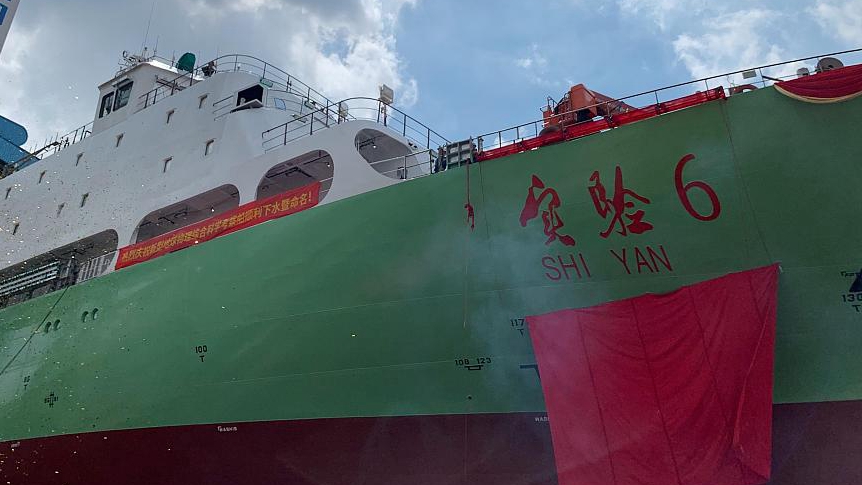
Chinese Scientific Vessel: Shi Yan-6

Chinese Scientific Vessel: Shi Yan-6

FacebookTwitterWhatsAppTelegramEmail

The latest Chinese scientific ship to venture into the expanded Indian Ocean is the Shi Yan-6. It is currently headed to Hambantota Port. The Chinese Media has referred to it as a ‘Scientific Research Vessel” operated by a crew of 60 people. The Ship is equipped to conduct various operations, such as experiments in oceanography, marine geology, and marine ecology.

Costing over 500 million Yuan (approximately 77 million USD), the Shi Yan-6 is recognised as a key asset among China’s 3000-tonne deep ocean research vessels.

What will the ship study?

This three-month voyage driven by multi-disciplinary seeks to gather extensive fundamental data It aims to study and uncover how dynamic processes impact the bio-geochemical cycles, ecosystems, and sedimentary processes in the region, elucidate the geographical patterns of biodiversity, understand the response of biological communities to physical processes and gain insights to paleoclimate changes.

This expedition is expected to enhance scientific research collaboration with nations along the Maritime Silk Road (A component of the Chinese Belt and Road Initiative), contributing to the integration of science and education support of the BRI, according to China.

Why is India closely monitoring these vessels?

According to Commodore Anil Jai Singh of the Indian Navy, “These are primarily civilian ships and not military vessels, so there is no objection to their presence on the high seas.” The Naval officer is also the Vice-President of the National Maritime Foundation (NMF).

This essentially means that as long as these vessels remain outside Indian waters, China or any other nation can carry out their activity research without issues. While conducting maritime research in international waters is not restricted under the UNCLOS (United Nations Convention on Law of Sea), states are required to seek permission six months in advance for the research in the Exclusive Economic Zone (EEZ) or Continental Shelf.

“With the People Liberation Army Navy (PLAN-Chinese Navy) expanding its presence in the Indian Ocean Region (IOR), Chinese research vessels frequently make trips to the region, primarily in the Indian Ocean Region (eastern IOR). In 2019, they have encroached into India’s Exclusive Economic Zone and have prompted the intervention of the Indian Navy,” Commodore Singh said.

“Since then, they have stayed out of Indian waters but continue to operate in the eastern part of the Indian Ocean Region (IOR), conducting seemingly benign activities such as seabed mapping and resource assessment. However, their actual focus lies in collecting hydrographic data, temperature, pressure, and salinity profiles, which is crucial for submarine operations,” he said.

Importance of Hydrographic Data

The understanding of the hydrographic data enables better deployment of submarines and determining optimal deaths and operating conditions. “Given the opaqueness of the underwater domain, limited knowledge includes its workings. Therefore, the more information that you possess about the underwater realm, the more you can operate your submarines,” Commodore Singh said.

Hydrographic data goes through various changes daily, such as fluctuation in the velocity of sea, especially in the deep-sea areas. “Even naval forces regularly monitor hydrographic profile. The information guides decisions like whether the submarine is ready for attack mode, optimal depth concerning other ships, and suitable depth for hiding depending upon the sea profile of the day. Any understanding of the underwater environment enhances a submarine’s official capability. Likewise, for India, the more China learns about hydrographic profiles, the harder it becomes for India to detect Chinese submarines since they can hide optimally.

Sea Mapping

Apart from hydrographic know-how, seabed mapping is vital not only for resource exploration but also helps the submarine in assessing the feasibility of submarine bottoming, which is a technique employed by the navies to hide their submarines on sea beds when necessary. These Chinese research ships also collect underwater minerals and metals for laboratory research.

They monitor the movements and operational profiles of Indian ships, including formations and deployments, and can intercept telemetry data from rockets and missiles, which aids in tracking trajectories and ranges.

Overall, the presence of these Chinese research vessels does away with the element of surprise for India, noted Commodore Singh, as the Chinese gather intelligence on Indian naval activities and can anticipate and respond to India’s strategic moves tactically.

Topics: indian NavyPLANShi Yan-6Commodore Anil Jai SinghHydrographySea Mapping
Share5TweetSendShareSend
✮ Subscribe Organiser YouTube Channel. ✮
✮ Join Organiser's WhatsApp channel for Nationalist views beyond the news. ✮
Previous News

NewsClick peddled false narratives in lieu of crores of illegally routed foreign funds: Delhi Police

Next News

Bihar: “Humare Baap ho…” JD(U) MLA Gopal Mandal abuses journalists after his picture holding a pistol went viral

Related News

Outgoing Chief of the Naval Staff Dinesh K. Tripathi

Naval Chief underscores inseperable link between maritime & energy security; Assures safe passage of tankers via Hormuz

INS Sagardhwani concludes Malaysia visit, strengthens India–Malaysia maritime cooperation

Japan proposes joint production of the Mogami class frigates with India

From Maritime Hesitation to Strategic Assertion: Bharat’s naval rise in an era of strategic flux and evolving warfare

India’s 800 km BrahMos ushers in a new era of naval dominance, pushing Pakistan’s key ports within precise, high-speed strike range.

BrahMos 800 km boost expands India’s naval strike reach, squeezes Pakistan’s maritime space in Arabian sea

Abdul Majid Hakim Elahi, the representative of Iran’s Supreme Leader in India

Iran rejects Pakistan mediation claim, urges India & global powers to play role in restoring peace in West Asia

INS Taragiri commissioned into Indian Navy at Vishakapatnam

Stealth frigate INS Taragiri & indigenous nuclear submarine INS Aridaman commissioned into Indian Navy

Load More

Latest News

A representative image

The Middle Class Story: How governance reforms are powering India’s next growth engine

From Armenia and Greece to Cyprus, India's defence diplomacy is creating new pressure points for Turkey

How India’s Mediterranean Push and Indo-Pacific rise unsettle Turkey’s strategic calculus

Gadag seer enters 33-day Shiva Yoga Samadhi for world peace and welfare

Karnataka: Sri Rachoteshwara Shivacharya Mahaswamiji begins rare 33-day sealed Shiva Yoga Samadhi in Gadag

Indian surgeon conducts world’s longest cardiac telesurgery; Made-in-India robot echoes indigenous medical prowess

Pro-Khalistan slogans raised, Bhindranwale posters displayed at Sri Akal Takht Sahib

Operation Blue Star Anniversary: Pro-Khalistan slogans raised, Bhindranwale posters displayed at Sri Akal Takht Sahib

Inspired by Bhagwan Shiva's teachings, this ancient breathing practice helps calm the mind and reduce stress

Ancient Yogic Breathing for Modern Stress: How the Shiva method cultivates peace & self-awareness

The Vedic age saw remarkable women sages, known as Rishikas, who composed hymns and shaped India's spiritual and philosophical heritage

Rishikas of Vedic Age: How Gargi, Maitreyi & other women shaped ancient India’s spiritual and philosophical tradition

Police in AAP-Ruled state of Punjab lathi charge sit-in protesters

Punjab: ITI candidates seeking jobs lathi-charged outside PSPCL HQ; opposition slams AAP Govt over police action

From constables to DGP, India's police system follows a structured chain of command that governs law enforcement across the country

From Constable to DGP: Understanding India’s police hierarchy, powers & recruitment system

The terracotta dice that challenges historical assumptions and highlights India's millennia-old civilisational heritage

How a 4,500-year-old terracotta dice is reviving the debate on India’s civilisational continuity & Vedic heritage

Load More
  • Privacy
  • Terms
  • Cookie Policy
  • Refund and Cancellation
  • Delivery and Shipping

© Bharat Prakashan (Delhi) Limited.
Tech-enabled by Ananthapuri Technologies

  • Home
  • Search Organiser
  • Bharat
    • Assam
    • Bihar
    • Chhattisgarh
    • Jharkhand
    • Maharashtra
    • View All States
  • World
    • Asia
    • Africa
    • North America
    • South America
    • Europe
    • Australia
  • Editorial
  • Operation Sindoor
  • Opinion
  • Analysis
  • Defence
  • Culture
  • Sports
  • Business
  • RSS @ 100
  • Entertainment
  • More ..
    • Sci & Tech
    • Vocal4Local
    • Special Report
    • Education
    • Employment
    • Books
    • Interviews
    • Travel
    • Health
    • Politics
    • Law
    • Economy
    • Obituary
  • Subscribe Magazine
  • Read Ecopy
  • Advertise
  • Circulation
  • Careers
  • About Us
  • Contact Us
  • Policies & Terms
    • Privacy Policy
    • Cookie Policy
    • Refund and Cancellation
    • Terms of Use

© Bharat Prakashan (Delhi) Limited.
Tech-enabled by Ananthapuri Technologies