Bharat or India: Questioning the colonial Indian mindset
December 14, 2025
  • Read Ecopy
  • Circulation
  • Advertise
  • Careers
  • About Us
  • Contact Us
Android AppiPhone AppArattai
Organiser
  • ‌
  • Bharat
    • Assam
    • Bihar
    • Chhattisgarh
    • Jharkhand
    • Maharashtra
    • View All States
  • World
    • Asia
    • Europe
    • North America
    • South America
    • Africa
    • Australia
  • Editorial
  • International
  • Opinion
  • RSS @ 100
  • More
    • Op Sindoor
    • Analysis
    • Sports
    • Defence
    • Politics
    • Business
    • Economy
    • Culture
    • Special Report
    • Sci & Tech
    • Entertainment
    • G20
    • Azadi Ka Amrit Mahotsav
    • Vocal4Local
    • Web Stories
    • Education
    • Employment
    • Books
    • Interviews
    • Travel
    • Law
    • Health
    • Obituary
  • Subscribe
    • Subscribe Print Edition
    • Subscribe Ecopy
    • Read Ecopy
  • ‌
  • Bharat
    • Assam
    • Bihar
    • Chhattisgarh
    • Jharkhand
    • Maharashtra
    • View All States
  • World
    • Asia
    • Europe
    • North America
    • South America
    • Africa
    • Australia
  • Editorial
  • International
  • Opinion
  • RSS @ 100
  • More
    • Op Sindoor
    • Analysis
    • Sports
    • Defence
    • Politics
    • Business
    • Economy
    • Culture
    • Special Report
    • Sci & Tech
    • Entertainment
    • G20
    • Azadi Ka Amrit Mahotsav
    • Vocal4Local
    • Web Stories
    • Education
    • Employment
    • Books
    • Interviews
    • Travel
    • Law
    • Health
    • Obituary
  • Subscribe
    • Subscribe Print Edition
    • Subscribe Ecopy
    • Read Ecopy
Organiser
  • Home
  • Bharat
  • World
  • Operation Sindoor
  • Editorial
  • Analysis
  • Opinion
  • Culture
  • Defence
  • International Edition
  • RSS @ 100
  • Magazine
  • Read Ecopy
Home Bharat

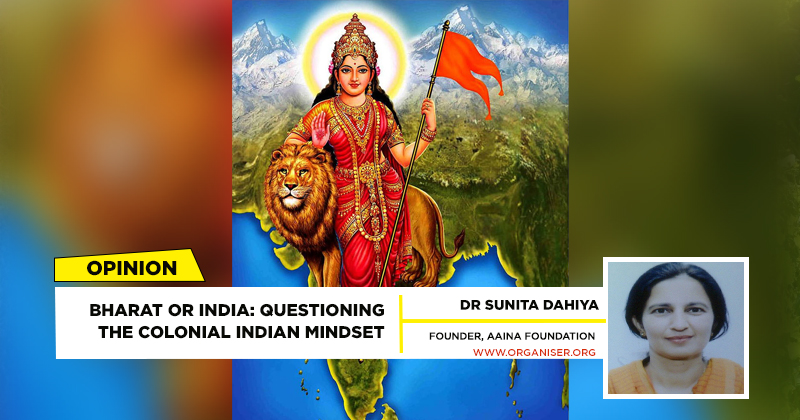
Bharat or India: Questioning the colonial Indian mindset

During British colonial rule, the subcontinent was officially referred to as "India" as part of the  colonial administration's efforts to categorise and govern the diverse regions and people under  its control. However, this naming was essentially an external imposition, arriving with the  baggage of colonial exploitation, subjugation, and cultural erasure. Many Indian nationalists  viewed the name "India" as a symbol of this colonial legacy

Dr Sunita DahiyaDr Sunita Dahiya
Sep 24, 2023, 08:00 pm IST
in Bharat, Opinion
Follow on Google News
FacebookTwitterWhatsAppTelegramEmail

In 440 BCE, Herodotus, often referred to as the Father of History, ventured to offer a  comprehensive account of India and its inhabitants in his third book. In his words, “Eastward of  India lies a tract which is entirely sand. Indeed, of all the inhabitants of Asia, concerning whom  anything is known, the Indians dwell nearest to the east and the rising of the Sun.” These  insights provided early glimpses into India’s significance in ancient times.

The term “India” itself has a storied history. The Greeks bestowed this name upon the  subcontinent, tracing it back to the Indus River. Its initial usage can be traced to the era of  Alexander the Great and later adopted by the Romans. By the time European explorers  embarked on their voyages and eventually made inroads into the Indian subcontinent, it had  already been established as “India” to the world. The moniker “India” was deeply entrenched,  with historical roots stretching back to antiquity, as it appeared in various forms in Sanskrit and  Persian texts. This familiarity with the term “India” firmly secured its identity on the international  stage.

Upon the arrival of European powers on Indian shores, they encountered a region teeming with  diversity and cultural richness, and they referred to it as “India.” This adoption further cemented  the name’s status in the global consciousness, strengthening its identity as “India” rather than its  traditional name, “Bharat.”

However, the origins of “Bharat” as a name have deep historical roots that predate the Greek  renaming of the subcontinent. “Bharat” holds a special place in the hearts of millions in India,  signifying more than just a word—it’s a symbol of the nation’s rich and diverse heritage. Even  though “Bharat” is now one of the official names of the country, its roots can be traced back to

the ancient foundations of Indian civilisation, particularly within the Rig Vedic texts.

Hindu mythology offers various narratives that give rise to the name “Bharat.” In the Rig Veda’ s 18th hymn of the seventh book, the epic battle of ten kings near the river Ravi in Punjab led to  the rise of King Sudasa and the identification of the people with the Bharata tribe. This  connection made “Bharata ” synonymous with their land. Another legend attributes the name to  Emperor Bharata, son of King Dushyanta and Queen Sakuntala, who united a vast territory into  a single political entity called “Bharatvarsha” in his honor, as recounted in the Mahabharata  Text. In yet another perspective, the Vishnu Purana links “Bharat” to ascetic practices, where a  father entrusted his kingdom to his son, Bharata, before embarking on a spiritual journey,  creating a legacy tied to the name “Bharat.”

During British colonial rule, the subcontinent was officially referred to as “India” as part of the  colonial administration’s efforts to categorise and govern the diverse regions and people under  its control. However, this naming was essentially an external imposition, arriving with the  baggage of colonial exploitation, subjugation, and cultural erasure. Many Indian nationalists  viewed the name “India” as a symbol of this colonial legacy.

In contrast, “Bharat” held deep-rooted historical and cultural significance in Indian mythology  and ancient texts. It was seen as an indigenous name reflecting the country’s rich heritage. The  Rig Veda and the Mahabharata, for instance, mention “Bharat” as a prominent term, connecting  it to the land and its rulers. Advocates for using “Bharat” argued that it was a name resonating  with India’s ancient identity and cultural continuity.

The recent opposition to changing the name from India to Bharat after the G20 Summit also  reflects a certain level of rigidity in how people identify themselves. For many, being called  “Indians” has become a fundamental part of their national identity, and they feel a strong  attachment to the name despite its colonial origins. This sentiment highlighted the complexity of  national identity and how it was shaped by historical and contemporary factors. Despite the  historical and cultural significance of “Bharat,” there was resistance to changing the official  name of the country from “India” to “Bharat.” This resistance stemmed from practical  considerations, global recognition, and the inertia of colonial-era administrative systems.  Changing the country’s name would have had wide-ranging implications, from legal and  bureaucratic adjustments to international diplomatic matters.

The ongoing debate surrounding the names “India” and “Bharat” encapsulates the ongoing  struggle in post-colonial societies to reconcile their colonial past with their indigenous heritage.  While “Bharat” carried deep cultural and historical significance, the continued use of “India”  reflected the complexities of identity, practicality, and the enduring legacy of colonialism. The  debate serves as a reminder of the multifaceted nature of our national identity and the enduring  impact of colonial rule on the citizen’s of our country.

Topics: BharatColonialism
ShareTweetSendShareSend
✮ Subscribe Organiser YouTube Channel. ✮
✮ Join Organiser's WhatsApp channel for Nationalist views beyond the news. ✮
Previous News

‘Samatva Garbhagriha’: A facet of assault on Sanatana Dharma

Next News

Jammu and Kashmir: Terror module busted in Kulgam, five LeT terrorists held

Related News

(Left) Italy's Deputy Prime Minister and Foreign Minister Antonio Tajani (Right) External Affairs Minister S Jaishankar

Jaishankar calls Italy ‘one of India’s closest partners’ as both nations push joint initiative against terror financing

AI and technology driven Indian Army

Digitalisation 3.0 and the rise of an AI-ready Indian Army: A civilisational shift in national security

Message of environmental harmony in Vande Mataram

Environmental harmony in the verses of Vande Mataram

Civilizational Science of India

Civilizational science of Hindutva

Mahatma Gandhi and Dr. Keshav Baliram Hedgewar

Gandhi and Hedgewar, From power to service, An inspiring journey of national vision

Bharat is a testament to resilience, inclusiveness & cultural continuity

Bharat: A legacy of unity, resilience and cultural brilliance

Load More

Comments

The comments posted here/below/in the given space are not on behalf of Organiser. The person posting the comment will be in sole ownership of its responsibility. According to the central government's IT rules, obscene or offensive statement made against a person, religion, community or nation is a punishable offense, and legal action would be taken against people who indulge in such activities.

Latest News

More than 5 lakh people came together to chant Bhagwad Gita

Kolkata’s Chorus of the Gita: Five lakh voices, one eternal message

Representative Image

MUDA Scam in Karnataka: ED probe reveals former commissioner took Rs 22.47 crore bribe for illegal plot allotments

NCERT introduces Vasudhaiva Kutumbakam chapter in Class 7

NCERT introduces Vasudhaiva Kutumbakam chapter in Class 7 social science curriculum

US lawmakers warn Trump towards irrational tariffs on India

Trump tariffs on India mounts pressure on American workers & consumers; US lawmakers move resolution to repeal tariffs

Representative image

SIR in West Bengal: Election Commission to reverify over one crore entries after discovering anomalies

Official logo of Magh Mela 2026

Magh Mela 2026: CM Yogi Adityanath unveils logo depicting confluence of Ganga-Yamuna, Saraswati & 14 phases of moon

Draft SOP prepared for inventory of Ratna Bhandar at Puri Jagannath Temple by SJTA Niti Sub-Committee

Odisha: Draft SOP prepared for inventory of Ratna Bhandar at Puri Jagannath Temple; Approval process underway

Sheikh Mujibur Rahman

Superficial bonhomie between Bangladesh & Pakistan set to break: Rawalpindi labels Sheikh Mujibur Rahman as ‘traitor’

The hidden agenda behind the 2023 visit of Rahul Gandhi to Pangong Tso, Ladakh

The Soros & Pakistan link to the Ladakh trip of Rahul Gandhi; Decoding the nexus behind visit to sensitive Pangong Tso

Union Home Minister Amit Shah at closing ceremony of Bastar Olympics in Jagdalpur, image courtesy Newson Air

Chhattisgarh: Union Home Minister Shah attends closing ceremony of Bastar Olympics, reiterates resolve to end Naxalism

Load More
  • Privacy
  • Terms
  • Cookie Policy
  • Refund and Cancellation
  • Delivery and Shipping

© Bharat Prakashan (Delhi) Limited.
Tech-enabled by Ananthapuri Technologies

  • Home
  • Search Organiser
  • Bharat
    • Assam
    • Bihar
    • Chhattisgarh
    • Jharkhand
    • Maharashtra
    • View All States
  • World
    • Asia
    • Africa
    • North America
    • South America
    • Europe
    • Australia
  • Editorial
  • Operation Sindoor
  • Opinion
  • Analysis
  • Defence
  • Culture
  • Sports
  • Business
  • RSS @ 100
  • Entertainment
  • More ..
    • Sci & Tech
    • Vocal4Local
    • Special Report
    • Education
    • Employment
    • Books
    • Interviews
    • Travel
    • Health
    • Politics
    • Law
    • Economy
    • Obituary
  • Subscribe Magazine
  • Read Ecopy
  • Advertise
  • Circulation
  • Careers
  • About Us
  • Contact Us
  • Policies & Terms
    • Privacy Policy
    • Cookie Policy
    • Refund and Cancellation
    • Terms of Use

© Bharat Prakashan (Delhi) Limited.
Tech-enabled by Ananthapuri Technologies