Why Uniform Civil Code is need of the hour
October 5, 2026
  • Read Ecopy
  • Circulation
  • Advertise
  • Careers
  • About Us
  • Contact Us
Android AppiPhone AppArattai
Organiser
  • ‌
  • Bharat
    • Assam
    • Bihar
    • Chhattisgarh
    • Jharkhand
    • Maharashtra
    • View All States
  • World
    • Asia
    • Europe
    • North America
    • South America
    • Africa
    • Australia
  • Editorial
  • International
  • Opinion
  • RSS @ 100
  • More
    • World Hindu Congress 2026
    • Op Sindoor
    • Analysis
    • Sports
    • Defence
    • Politics
    • Business
    • Economy
    • Culture
    • Special Report
    • Sci & Tech
    • Entertainment
    • G20
    • Azadi Ka Amrit Mahotsav
    • Vocal4Local
    • Web Stories
    • Education
    • Employment
    • Books
    • Interviews
    • Travel
    • Law
    • Health
    • Obituary
  • Subscribe
    • Subscribe Print Edition
    • Subscribe Ecopy
    • Read Ecopy
  • ‌
  • Bharat
    • Assam
    • Bihar
    • Chhattisgarh
    • Jharkhand
    • Maharashtra
    • View All States
  • World
    • Asia
    • Europe
    • North America
    • South America
    • Africa
    • Australia
  • Editorial
  • International
  • Opinion
  • RSS @ 100
  • More
    • World Hindu Congress 2026
    • Op Sindoor
    • Analysis
    • Sports
    • Defence
    • Politics
    • Business
    • Economy
    • Culture
    • Special Report
    • Sci & Tech
    • Entertainment
    • G20
    • Azadi Ka Amrit Mahotsav
    • Vocal4Local
    • Web Stories
    • Education
    • Employment
    • Books
    • Interviews
    • Travel
    • Law
    • Health
    • Obituary
  • Subscribe
    • Subscribe Print Edition
    • Subscribe Ecopy
    • Read Ecopy
Organiser
  • Home
  • Bharat
  • World
  • Operation Sindoor
  • Editorial
  • Analysis
  • Opinion
  • Culture
  • Defence
  • International Edition
  • RSS @ 100
  • Magazine
  • Read Ecopy
Home Bharat

Why Uniform Civil Code is need of the hour

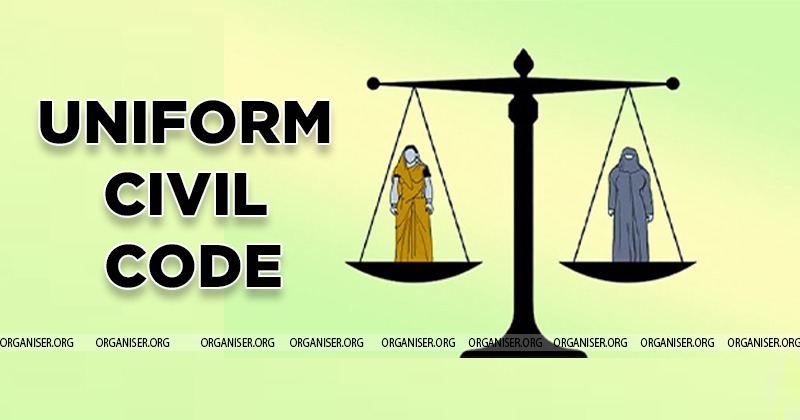
UCC aims to eliminate outdated and regressive practices that are prevalent in some personal laws and make laws the same for all without discrimination on the basis of religion, race, caste, sex or place of birth

WEBDESKWEBDESK
Feb 1, 2024, 06:00 pm IST
inBharat
Follow on Google News
Facebook
Twitter
WhatsAppTelegramEmail

Uniform Civil Code (UCC) has reignited the political debate following Prime Minister Narendra Modi’s remarks at a rally in Madhya Pradesh. PM Modi said on June 27 that India cannot run on two laws and that UCC is part of the Constitution.

The idea of a UCC is to bring out a sense of equal treatment. The Law Commission of India has also invited people to share ideas from June 14 to July 14, 2023.

What is the Uniform Civil Code?

Enshrined under Article 44, Part IV, of the Constitution, the UCC is a ‘Directive Principle of State Policy.’ Article 44 states, “Uniform civil code for the citizens.—The State shall endeavour to secure for the citizens a uniform civil code throughout the territory of India.”

UCC aims to provide a common legal framework for all citizens, irrespective of their religious beliefs, in view of equal treatment regardless of their religious, ethnic, or caste backgrounds. UCC aims to eliminate outdated and regressive practices that are prevalent in some personal laws and make laws the same for all without any tribal, caste, gender, or community difference.

Most contemporary countries have such laws in existence; UCC is followed in many countries, such as Pakistan, Bangladesh, Malaysia, Turkey, Indonesia, Sudan, Egypt, America, Ireland, etc. All these countries have uniform laws for all religions, and there are no separate laws for any particular religion or community.

UCC is an indication that the country has moved away from caste and religious politics. It would eliminate the practices that are against the human rights and values enshrined in the Constitution of India, such as triple talaq, polygamy, child marriage, etc.

UCC aims to provide a single set of legal rules governing personal matters like marriage, divorce, inheritance, and adoption for all citizens of India, irrespective of their religion.

Since India is a developing and progressive country, it is a bit disappointing to hear that we are not paying attention to achieving the core purpose of equality and secularism that we committed to providing to our citizens in 1947.

India can be a Vishwa Guru only if the same laws relating to marriage, family, land, inheritance, etc. apply to all citizens, irrespective of caste, creed or religion. The age-old religious customs and personal laws of our country are usually gender-based.

Benefits of UCC

  • UCC would eliminate discrimination on religious grounds, ensuring that every religion is treated equally.
  •  It would grant all women equal rights and help stop religious atrocities against them.
  • UCC will ensure that the Indian Constitution’s fundamental rights are upheld consistently, regardless of religion.

Here are three prominent cases in which religious personal laws governing individual religions or religions themselves didn’t guaranteed equality:

Shah Bano Case (1985)

Citation: [1985 (1) SCALE 767; 1985 (3) SCR 844; 1985 (2) SCC 556; AIR 1985 SC 945]

A 73-year-old woman by the name of Shah Bano was divorced by her husband, using the now outlawed ‘triple talaq’ or Talaq-e-Biddat, where she was not granted proper maintenance under the same. As a result, she filed a case based on Section 125 of the All India Criminal Code, which pertains to the ‘Maintenance of wives, children, and parents’. Based on the judgment resulting from this case, a union civil code was recommended, and after the verdict, there were agitations and protests. As a result, Parliament passed the Muslim Women’s (Right to Protection on Divorce) Act (MWA) in 1986, making Section 125 of the Criminal Procedural Code inapplicable to Muslim women.

It is to be noted that, in 1985, the Supreme Court ruled in favour of Shah Bano under the “maintenance of wives, children and parents” provision (Section 125) of the All India Criminal Code, which applied to all citizens irrespective of religion. It further recommended that a uniform civil code be set up.

Daniel Latifi Case (2001)

Citation: Writ Petition (Civil) 868  of  1986

The Muslim Woman’s Act (MVA) was challenged on the grounds that it violated Articles 14 and 15 and Article 21 of the Indian Constitution. While declaring the aforementioned law Constitutional, the Apex Court provided provisions that it would complement Section 125 of the Indian Criminal Code. This would ensure that the amount received by a wife during her Iddat period was sufficient to sustain her during that time and to provide for her future.

John Vallamattom Case (2003)

Citation: Writ Petition (Civil) 242 of 1997

A Keralite Priest, John Vallamottom had challenged the Constitutional validity of Section 118 of the Indian Succession Act, which applies to all non-Hindus in the Union of India. He challenged that Section 118 of the ISA, Act was discriminatory in nature against Christians as this particular section put unreasonable restrictions on the amount of donations and charitable that can be done by Christians, with their own free will. The bench struck down the relevant Section 118 as unconstitutional.

If the Uniform Civil Code were to be implemented, any discrimination or inequality faced by members of different religions would be rectified by their personal laws, and the status of all the aforementioned religions would be equalized before the law and the eyes of the law. It promotes real secularism by ensuring that every citizen of the nation is treated equally and regarded as such in the eyes of the law, as it does not restrict anyone’s right to practice any religion of their choice freely.
Topics: Law Commission of IndiaMadhya PradeshPrime Minister Narendra ModiUniform Civil CodePM ModiUCC
Share16
Tweet
SendShareSend
✮ Subscribe Organiser YouTube Channel. ✮
✮ Join Organiser's WhatsApp channel for Nationalist views beyond the news. ✮
Previous News

Tamil Nadu CM MK Stalin refuses to implement CAA; AIADMK reverses its stand, airs similar views for minority votes

Next News

Interim Budget 2024: What are the future indicators from Nirmala Sitharaman’s budget?

Related News

Twenty-Five Years of Seva: The Untold Story of Prime Minister Narendra Modi organised by UP Government in Lucknow

Namo Seva: Ankahi Kahaniyan — Celebrating 25 years of Prime Minister Narendra Modi’s public service

Madhya Pradesh Chief Minister Dr Mohan Yadav and Home Minister Amit Shah

Madhya Pradesh: Home Minister Amit Shah vows drug-free state by 2029: Hails new criminal laws as justice-oriented

Captain Smit Machchhar and Israel Prime Minister Benjamin Netanyahu

Flydubai Terror Attack: PM Netanyahu speaks to Captain Smit; Invites PM Modi & Indian pilot for Israel Independence Day

President Droupadi Murmu has given assent to the Gujarat UCC Bill, 2026, paving the way for its implementation in the state

Gujarat UCC Bill 2026 gets President Droupadi Murmu’s assent, legislation comes into effect across the state

Russian President Vladimir Putin and PM Modi(File Photo)

“PM Modi has very good ideas to end Russia-Ukraine conflict”; President Putin thanks PM Modi for peace efforts

Flydubai Attack: “Hanuman Chalisa gave me strength”, Smit Machchhar tells PM Modi as Indian pilot’s bravery saved lives

Load More

Latest News

Assam Police STF busts Pakistan spy network in Guwahati ; Bihar Man arrested

Assam Police STF busts Pakistan spy network in Guwahati, arrests Bihar man Abhishek Kumar

Victorious candidates of ABVP

Gauhati University Students’ Polls:  ABVP registered victory in 6 seats

Violent Students Protest in France

France Students Protest Turns Violent: Teachers attacked & buildings vandalised; Far-left support fuels political fury

Twenty-Five Years of Seva: The Untold Story of Prime Minister Narendra Modi organised by UP Government in Lucknow

Namo Seva: Ankahi Kahaniyan — Celebrating 25 years of Prime Minister Narendra Modi’s public service

Tamil Nadu: Navy sailor arrested in Coimbatore for allegedly leaking sensitive defence information to Pakistan

Representative Image

The Indian Express Exposed: How misleading narratives, selective facts & omitting Islamist offenders distort the truth?

Central Coalfields Transforming Itself for a New India

From 50 MT to 87.5 MT: How central coalfields rebuilt itself for a new India!

Prime Minister Narendra Modi - Russian President Vladimir Putin

Thirukkural to the World: PM Modi and Cultural Diplomacy

SSC CGL 2026 Tier 1 vs Tier 2: Know the difference in exam pattern, subjects and selection process!

Sambhal’s Mahishmati River revived after 30 years as natural water flow returns to 18-km stretch

Sambhal’s lost river returns: Mahishmati revived after decades as water flows through its restored riverbed

Load More
  • Privacy
  • Terms
  • Cookie Policy
  • Refund and Cancellation
  • Delivery and Shipping

© Bharat Prakashan (Delhi) Limited.
Tech-enabled by Ananthapuri Technologies

  • Home
  • Search Organiser
  • Bharat
    • Assam
    • Bihar
    • Chhattisgarh
    • Jharkhand
    • Maharashtra
    • View All States
  • World
    • Asia
    • Africa
    • North America
    • South America
    • Europe
    • Australia
  • Editorial
  • Operation Sindoor
  • Opinion
  • Analysis
  • Defence
  • Culture
  • Sports
  • Business
  • RSS @ 100
  • Entertainment
  • More ..
    • Sci & Tech
    • Vocal4Local
    • Special Report
    • Education
    • Employment
    • Books
    • Interviews
    • Travel
    • Health
    • Politics
    • Law
    • Economy
    • Obituary
  • Subscribe Magazine
  • Read Ecopy
  • Advertise
  • Circulation
  • Careers
  • About Us
  • Contact Us
  • Policies & Terms
    • Privacy Policy
    • Cookie Policy
    • Refund and Cancellation
    • Terms of Use

© Bharat Prakashan (Delhi) Limited.
Tech-enabled by Ananthapuri Technologies