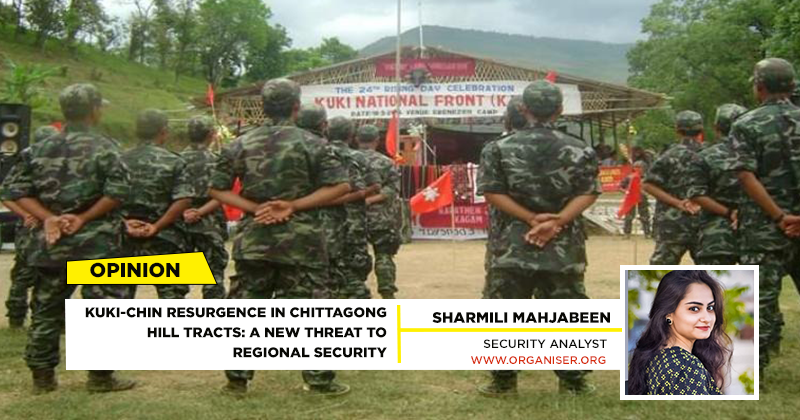
Kuki-Chin Resurgence in Chittagong Hill Tracts: A new threat to regional security
June 7, 2026
  • Read Ecopy
  • Circulation
  • Advertise
  • Careers
  • About Us
  • Contact Us
Android AppiPhone AppArattai
Organiser
  • ‌
  • Bharat
    • Assam
    • Bihar
    • Chhattisgarh
    • Jharkhand
    • Maharashtra
    • View All States
  • World
    • Asia
    • Europe
    • North America
    • South America
    • Africa
    • Australia
  • Editorial
  • International
  • Opinion
  • RSS @ 100
  • More
    • Op Sindoor
    • Analysis
    • Sports
    • Defence
    • Politics
    • Business
    • Economy
    • Culture
    • Special Report
    • Sci & Tech
    • Entertainment
    • G20
    • Azadi Ka Amrit Mahotsav
    • Vocal4Local
    • Web Stories
    • Education
    • Employment
    • Books
    • Interviews
    • Travel
    • Law
    • Health
    • Obituary
  • Subscribe
    • Subscribe Print Edition
    • Subscribe Ecopy
    • Read Ecopy
  • ‌
  • Bharat
    • Assam
    • Bihar
    • Chhattisgarh
    • Jharkhand
    • Maharashtra
    • View All States
  • World
    • Asia
    • Europe
    • North America
    • South America
    • Africa
    • Australia
  • Editorial
  • International
  • Opinion
  • RSS @ 100
  • More
    • Op Sindoor
    • Analysis
    • Sports
    • Defence
    • Politics
    • Business
    • Economy
    • Culture
    • Special Report
    • Sci & Tech
    • Entertainment
    • G20
    • Azadi Ka Amrit Mahotsav
    • Vocal4Local
    • Web Stories
    • Education
    • Employment
    • Books
    • Interviews
    • Travel
    • Law
    • Health
    • Obituary
  • Subscribe
    • Subscribe Print Edition
    • Subscribe Ecopy
    • Read Ecopy
Organiser
  • Home
  • Bharat
  • World
  • Operation Sindoor
  • Editorial
  • Analysis
  • Opinion
  • Culture
  • Defence
  • International Edition
  • RSS @ 100
  • Magazine
  • Read Ecopy
Home Bharat

Kuki-Chin Resurgence in Chittagong Hill Tracts: A new threat to regional security

The Chittagong Hill Tracts have become one of the main routes of dangerous drug smuggling, including Marijuana, Yaba tablets, and ice from India and Myanmar into Bangladesh resulting to insurgency in the country

Sharmili MahjabeenSharmili Mahjabeen
Jun 16, 2023, 07:00 pm IST
in Bharat, Opinion, Mizoram
Follow on Google News
FacebookTwitterWhatsAppTelegramEmail

Two Bangladesh Army soldiers were killed and two officers injured in an attack in Bandarban district on May 16. The Kuki-Chin National Army ambushed the team during a raid, using improvised explosive devices and gunfire. The incident occurred during a conflict between Manipur’s majority Meitei community and the tribal Kuki ethnic community. After this incident, a member of the KNA and a journalist were arrested, alleged to maintain a connection with the KNA.

This ethnic separatist group is carrying out political and military activities to form an autonomous State in the Chittagong Hill Tracts (CHT) covering most of the Bandarban and Rangamati districts. The Kuki-Chin National Front (KNF) is their political front, with an armed wing called the Kuki-Chin Army (KNA). Initially started as a voluntary development organisation, it became separatist in 2017.

They have announced an autonomous’ Kuki-Chin State’ which encompasses Rangamati’s Baghaichhari, Barkal, Juraichhari, Bilaichhari, Roangchhari and Chimbuk Hills on the outskirts of Bandarban along with Ruma, Thanchi, Lama and Alikadam. They published a map and a flag of their proposed state and prepared for fighting.

The CHT, a remote area comprising the three districts- Rangamati, Khagrachari and Bandarban- is a safe haven for various separatist and armed organisations. Kuki-Chin is accused of training an Islamic militant group named Jama’atul Ansar Fil Hindal Sharqiya in the hilly areas of Bandarban. They used to raise a part of their expense from here to run armed organisations. In October, the RAB arrested seven alleged members of the group and three members of KNA during an operation in the remote areas bordering Bandarban and Rangamati. At least 38 people, who went into hiding from different parts of the country, have been trained with militant skills at several training camps of a separatist group in the Hill Tracts, said the RAB.

The presence of such an armed group in remote areas along the border has posed a threat to internal and regional security. The organisation is located in a complex and strategically important area, where the border of Bangladesh, Myanmar and Mizoram is. Mizoram shares 318 kilometres of border with Bangladesh. There are also several separatist groups in the remote areas of Mizoram. The KNF has linked and received training from armed groups in neighbouring countries.

Initially, a group received guerilla, infantry and commando training from Manipur, Karen and Kachin. The trained members then started training the rest of the members. According to local media, at least 3 to 4 thousand trained KNA members are staying in and outside of the country. A group named almost the same as the KNF, the KNF and Kuki were formed in the Mizoram State in the 1990s to carve out a Kuki homeland or Kuki State.

The KNF, locally known as the ‘Bawm Party’, comprises six small ethnic community members, Bawm, Pangkhua, Lusai, Khumi, Mro and Khiang, belonging to the Kuki-Chin group. The Kuki-Chin is a geographic cluster of several ethnic communities of the Tibeto-Burman language group, the majority population of the Chin State of Myanmar and Mizoram of India. They also live in the hilly areas of India’s Assam, Manipur and Nagaland States, along with the Chittagong Hill Tracts of Bangladesh. Due to ethnic homogeneity, it’s easy for the KNF to get support by influencing people across the border. Indian media reported that more than 500 members of the Kuki-Chin tribe crossed the border and took shelter in Mizoram since the army started an operation in the Hill Tracts on November 11. Meanwhile, ZO Reunification Organisation (ZORO), an umbrella body that works for the reunification of Chin, Kuki and Mizo tribes of India, Myanmar and Bangladesh, who share the same ancestry and culture with the Mizos of Mizoram, made a statement that a joint operation by the RAB and the Arakan Army has forced the Kuki-Chin people to `leave’ the country.

Amid the Manipur violence, the possibility of getting support has risen. The Kukis are one of the main counterparts in conflict with most Meiteis of Manipur. Meanwhile, the Mizoram Chief Minister has also stated in favour of cookies, which the Meitei of Manipur has strongly condemned. On the contrary, the attitude of the locals towards a small number of Rohingya refugees living in India is completely different from the attitude towards the refugees of this Chinese State in Mizoram. In February this year, a resolution was passed in the Mizoram Assembly, which said these asylum seekers are Mizos’ blood-related. Hence it is the responsibility of the Mizoram State to provide them with food, shelter etc. At the same time, the Mizoram Government has requested Delhi not to stop the BSF at the border. In an interview with the BBC, Justifying the support for the Kukis entered from Bangladesh, Mizoram Chief Minister Joramthanga said, “We have blood relations with them; you have to understand that.”

On the other hand, several rebel groups, including the Arakan Army, Chin Defense Force and Chin National Army in the Chin State of Myanmar, are a serious concern. Conflicts between these groups and with the government are almost regular in the State. The alarming matter is that the link and cooperation of the Kuki-Chin army with these groups will deteriorate the regional instability.

Also, several separatist organisations have been active in Chittagong Hill Tracts since the independence. As a result of conflicts and rivalries, people infiltrate with fear in the hills. Along with regular killings, abductions and extortions, these groups have created a reign of arms and drug smuggling over the hills. As a result, the Chittagong Hill Tracts have become one of the main routes of dangerous drug smuggling, including Marijuana, Yaba tablets, and ice from India and Myanmar into Bangladesh. There is a possibility of spreading Islamic terrorism within the country. The link between an Islamic militant group and KNF has already been stated.

As a result, the insurgency of such armed groups inside the country will threaten the internal security of the country. Moreover, if such militant activities develop in this vulnerable and volatile trilateral border, it will disrupt regional security, peace and stability. Therefore, to prevent such regional armed violence, neighbouring countries have to play an active role and intensify the activities of the domestic law enforcement forces and intelligence surveillance.


Topics: Mizoram Chief Minister JoramthangaKuki-Chin ResurgenceKuki-ChinChittagong Hill TractsCHTSecurity ThreatMizoramBangladesh
Share20TweetSendShareSend
✮ Subscribe Organiser YouTube Channel. ✮
✮ Join Organiser's WhatsApp channel for Nationalist views beyond the news. ✮
Previous News

UP prisons to be known as “Reform Homes” says Uttar Pradesh CM Yogi Adityanath

Next News

India-U.S. relationship more critical for space exploration: Former NASA official Mike Gold

Related News

MEA spokesperson Randhir Jaiswal highlights India's resolve to deport illegal Bangladeshi migrants via bilateral mechanisms

India reiterates strong resolve to deport illegal Bangladeshis; Flags delay of bilateral procedures from Dhaka

Bangladesh’s reported JF-17 push has triggered fresh scrutiny after India’s Ops Sindoor exposed the vulnerabilities of Pakistani-Chinese defence systems and precision strike capabilities

Shadows of Operation Sindoor: Questions loom over Bangladesh’s JF-17 ambitions amid Sino-Pakistani tech vulnerabilities

Land transfer to BSF in West Bengal: Securing the porous border

People leaving Bangladesh in 1971 unable to bear the atrocities of Pakistan

May 25 marks Pakistan atrocities during Operation Searchlight: How Bengali Hindus were brutally massacred

Taslima Nasreen denounces attacks on non-Hindus in Bangladesh

In Bangladesh, ‘Blasphemy’ becomes weapon to perpetrate violence against minorities: Taslima Writes to PM Tarique

West Bengal’s political shift could redraw India’s eastern strategic map, accelerating the Act East Policy from Kolkata to the Indo-Pacific corridor

How West Bengal is set to become the strategic anchor of India’s Act East Policy and Indo-Pacific Vision

Load More

Latest News

(Left) Victorious Indian Men-s hockey team who who won Gold in U-18 Asia Cup (Right) U-18 Women's hockey team who won bronze medal in the Asia Cup

U18 Asia Cup 2026: Indian Men’s hockey wins gold, women secure bronze medal; PM Modi & Amit Shah hail the teams

India’s semiconductor roadmap shifts from import dependence to silicon sovereignty, aiming for a self-reliant ecosystem by Viksit Bharat 2047

From Import Dependence to Silicon Sovereignty: India’s bold semiconductor roadmap for Viksit Bharat 2047

Keralam Chief Minister V.D. Satheeshan

Jamaat-e-Islami Hind Team Meets CM Satheeshan, Senior Ministers, fuel debate over influence in UDF government

Singapore acts against China-linked posts targeting Indian community, cites threat to social harmony

Singapore Invokes OCHA: Facebook, YouTube and X ordered to block anti-Indian content originating from China

Editors of the HAF Wikipedia page run propaganda and disinformation campaign against the organisation, India and Hindu cultural ethos

Wikipedia fuels propaganda against Hindu American Foundation: How anonymous writers demonise Hindu rights group?

Israel to Install Statue of Chhatrapati Shivaji Maharaj; Israel’s Consul General in Mumbai, Yaniv Revach, met Maharashtra Chief Minister Devendra Fadnavis and sough his support in this regard

Chhatrapati Shivaji Maharaj’s legacy to reach Israel; Statue to be installed as symbol of India-Israel friendship

IIGH Public Policy Seminar: Women’s dignity, safety & equal opportunity discussed

Representative Image

Decoding Hezbollah: How the terror group built a massive arsenal against Israel

Representative Image

Plastic, Traffic and Landslides: How rising tourist footfall is posing threat to the mountainous region

The Green Realignment: Why the US-India trade pact is a battle for climate and supply chain security

Load More
  • Privacy
  • Terms
  • Cookie Policy
  • Refund and Cancellation
  • Delivery and Shipping

© Bharat Prakashan (Delhi) Limited.
Tech-enabled by Ananthapuri Technologies

  • Home
  • Search Organiser
  • Bharat
    • Assam
    • Bihar
    • Chhattisgarh
    • Jharkhand
    • Maharashtra
    • View All States
  • World
    • Asia
    • Africa
    • North America
    • South America
    • Europe
    • Australia
  • Editorial
  • Operation Sindoor
  • Opinion
  • Analysis
  • Defence
  • Culture
  • Sports
  • Business
  • RSS @ 100
  • Entertainment
  • More ..
    • Sci & Tech
    • Vocal4Local
    • Special Report
    • Education
    • Employment
    • Books
    • Interviews
    • Travel
    • Health
    • Politics
    • Law
    • Economy
    • Obituary
  • Subscribe Magazine
  • Read Ecopy
  • Advertise
  • Circulation
  • Careers
  • About Us
  • Contact Us
  • Policies & Terms
    • Privacy Policy
    • Cookie Policy
    • Refund and Cancellation
    • Terms of Use

© Bharat Prakashan (Delhi) Limited.
Tech-enabled by Ananthapuri Technologies