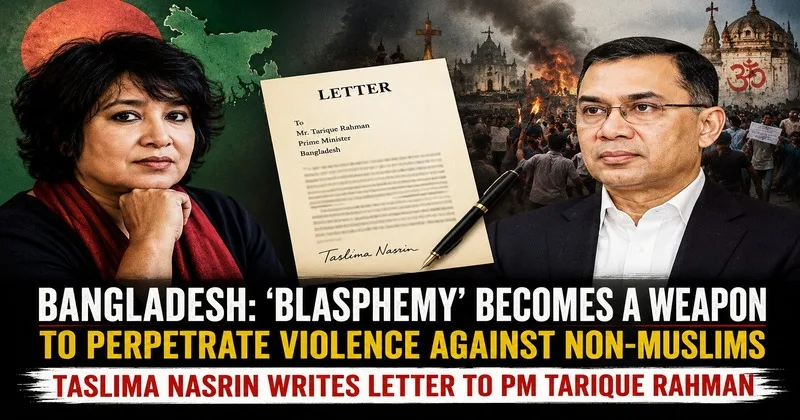
DHAKA: The escalating attacks against the Hindu community and other religious minorities in Bangladesh have once again plunged the entire South Asian region into deep concern. The situation has become so grave that the exiled Bangladeshi writer and human rights activist, Taslima Nasrin, has openly held the government accountable.
In a letter addressed to Prime Minister Tariq Rahman, she alleged that accusations of “blasphemy” are being systematically weaponized within the country to target Hindus and that radical forces aspire to gradually transform Bangladesh into a “Hindu-free nation.”
In her letter, Taslima Nasrin noted that attacks against Hindus have persisted unabated, even following the formation of the new government. She highlighted that false rumors are being circulated to facilitate the illegal seizure of Hindu-owned land; temples are being vandalized and minorities are being terrorized by mobs, thereby forcing them into displacement and exile.
https://twitter.com/taslimanasreen/status/2057846161189564583?s=20
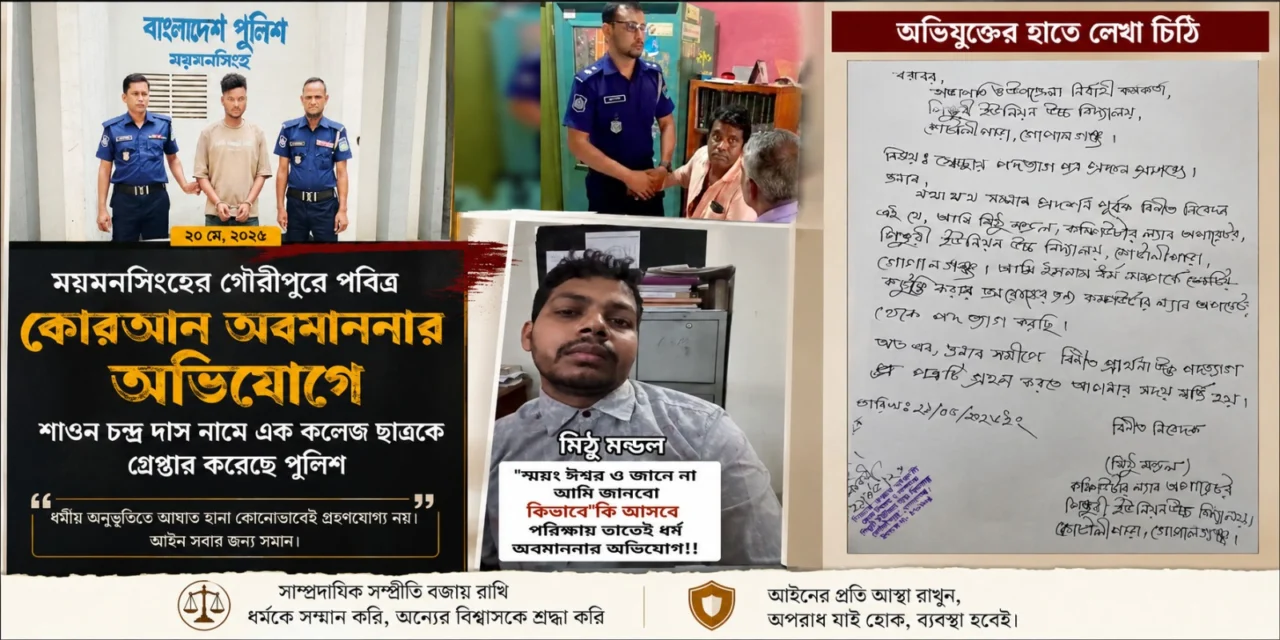
Citing several recent incidents, she pointed out that radical organizations launched violent campaigns against Gouranga Sarkar (a teacher in Satkhira), Mithu Mandal (from Gopalganj) and Shaon Chandra Das (a student at Gouripur College) by leveling accusations of “insulting Islam” against them. Shockingly, instead of taking action against the attackers, the police arrested the Hindu victims themselves and sent them to jail.
Taslima raised a pertinent question- “What will become of their future once these individuals are released from prison? They will have lost their jobs, society will have ostracized them and they will face the constant threat of violence against their lives. Will they, too, ultimately be forced to flee the country?”
Taslima Nasrin Issues a Warning to the Government
In her letter, Taslima Nasrin unequivocally stated that if the government fails to take firm action in a timely manner, radical forces will only grow stronger. She asserted that, in present-day Bangladesh, freedom of expression is rapidly vanishing. He wrote, “Allegations of blasphemy have now become a means to stifle dissent, persecute minorities, and instill social terror. If the state fails to take action against those who seek to turn Bangladesh into a Hindu-free nation, this silence will only embolden the radicals further.”
Minority Organisations Express Grave Concern
On the other hand, Rana Dasgupta, General Secretary of the Bangladesh Hindu Buddhist Christian Unity Council, states that violence against minorities in the country is no longer merely a matter of “sporadic incidents”; it has evolved into a dangerous socio-political trend.
He remarked, “The same pattern unfolds every time. First, rumors are circulated on social media alleging that a Hindu youth has insulted Islam. Subsequently, radical organizations mobilize mobs to attack homes and temples; yet, ultimately, it is the victim who ends up being arrested. This has instilled a deep sense of fear among minority communities.”
According to Rana Dasgupta, thousands of Hindu families have faced violence, intimidation, and social ostracism over the past year and a half to two years. He alleged that in numerous instances, local administrative authorities fail to intervene in a timely manner, a failure that serves to further embolden the radicals.
An Attempt to Intimidate Hindus into Fleeing
Sultana Kamal, a senior human rights activist associated with the organization ‘Ain o Salish Kendra,’ stated that allegations of “blasphemy” in Bangladesh are now being weaponized as a social tool. She observed, “It has become alarmingly easy to incite mobs by inflaming religious sentiments. The most distressing aspect is that, in the aftermath of these incidents, the victimized families rarely receive justice. Many families, out of sheer fear, do not even dare to file a formal complaint.”
Sultana Kamal warned that unless the government takes stringent measures, Bangladesh’s secular identity will face a grave crisis.
NGO Activists Describe a Terrifying Climate
The ‘Human Rights Culture Foundation’, an organization dedicated to advocating for minority rights- echoes this sentiment, noting that the past two years have witnessed a sharp escalation in incidents of violence directed against minority communities. He stated, “We are continuously receiving complaints involving incidents such as attacks on the homes of Hindu families, arson in shops, vandalism of temples and the intimidation of women. In many instances, the victimized families have been forced to abandon their villages.” Most concerning is the fact that, through the dissemination of rumors via social media, mobs are incited to violence within a mere few hours.
He added, “Unless the government takes exemplary action against hate-mongers and those inciting mob violence, this cycle will not cease.”
An Attack on Both Democracy and Human Rights
Kajal Debnath, a minority rights activist in Bangladesh and a Presidium member of the Bangladesh Hindu Buddhist Christian Unity Council, stated that the country’s Hindu community currently feels insecure. He remarked, “This is not merely an issue concerning Hindus; it is a matter involving Bangladesh’s democracy, human rights and constitutional values. If a citizen is targeted solely on the basis of their religion while the State remains silent, it serves as a warning bell for the entire democratic framework.”
Kajal Debnath alleged that numerous radical organizations are openly propagating communal hatred, yet no effective action is being taken against them.
Persistent Attacks on Temples and Festivals
According to human rights groups, temples and places of worship were targeted during several Hindu religious events, including Durga Puja. In numerous locations, idols were vandalized and Hindu-owned shops were set ablaze.
Basudev Dhar, a leader of the Bangladesh Puja Udjapan Parishad, stated that the Hindu community now lives in fear regarding even its religious observances. “Before every festival, there is a lingering dread that someone might incite an attack by spreading rumors. This situation is a disgrace to any democratic and civilized society.”
Today, the Hindu community in Bangladesh is grappling not only with violence but also with a crisis of fear, insecurity and an uncertain future. Human rights organizations and minority leaders warn that unless the government takes decisive action soon, the country’s pluralistic identity and social equilibrium could suffer irreparable damage.