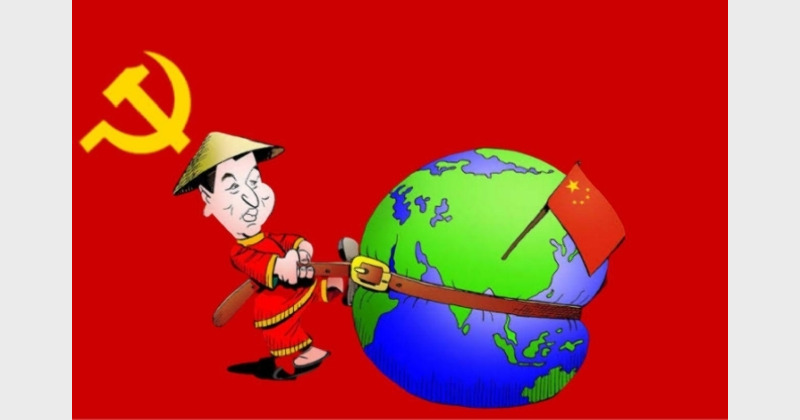
This article is the first piece in a three-article series that will talk about China’s malevolent expansionary plans under the garb of its much touted and advertised Belt and Road Initiative (BRI). The project is being used by China to entrap the participating countries into a debt-trap. This article, the first, talks about China’s debt-trap diplomacy in Africa, followed by the second article that’ll talk about Asia. The third article, last in this series, will summarize China’s BRI and its hidden geo-strategic implications.
The word “China”, as the website dictionary.com says, means “a translucent ceramic material..”. In reality though, there is hardly anything ‘translucent’ about China. From its domestic politics to international diplomacy, China thrives on its opaqueness.
The land of dragons resembles, in reality, a coconut wherein the outer brown shell and the inner white marrow are in complete contrast. China’s much hyped and advertised ‘One Belt One Road (OBOR)’ initiative is exactly like this coconut.
On the outset, China wants the world to see OBOR as an economic, trade-related, diplomatic and humanitarian infrastructural initiative that will benefit the participating countries. However in reality, the project is dragon’s gimmick to dupe other countries into falling in a debt trap.
This makes OBOR similar to the 1989 Tiananmen Square massacre in one important respect : crushing competition or dissent (whether domestic or international) to march towards a Sino-centric world with the Communist Party of China reigning supreme.
The project started when, as an article in The Diplomat mentions “over a course of two speeches in the final months of 2013, Chinese President Xi Jinping announced each leg of what would then go one to become China’s “One Belt, One Road” (OBOR) initiative.
In September 2013, during a visit to Kazakhstan, Xi unveiled what went on to become the centerpiece of China’s foreign and economic policy. Xi introduced the Silk Road Economic Belt (SREB), which, along with the 21st Century Maritime Silk Road (MSR) announced a month later in Indonesia, came to be collectively known as OBOR. By 2017, OBOR had been fully rebranded as the Belt and Road Initiative (BRI).”
The OBOR is touted as the mechanism through which various European, African and Asian countries will receive infrastructural facilities such as railway lines, seaports, roads etc. in their countries. However, in reality, erecting those “infrastructural facilities” have come at a great cost to several participating countries : their sovereignty.
China financed these projects by lending trillions of dollars, through its ‘Export Import Bank of China’ to various countries. This ‘benevolence’ soon turned into a ‘debt-trap’ when the countries were unable to repay the huge amount of loans, causing the Chinese government to own a stake in the infrastructure so erected in these countries. “Mission accomplished” for the dragon?
The threat of losing sovereignty to China is most grave in Africa and Asia. The former necessitates special mention because of its abundant natural resources (ranging from diamond to gold), weak infrastructure and constituent weak nation-states – a perfect recipe for China’s invasive manoeuvres.
Today, China is Africa’s biggest lender and trading partner, far outstripping the US in its trade with the continent. China today has a $200 billion trade relationship with Africa.
As an article in the magazine mentions “According to McKinsey, over 10,000 Chinese-owned firms are currently operating throughout the African continent, and the value of Chinese business there since 2005 amounts to more than $2 trillion. Africa has also eclipsed Asia as the largest market for China’s overseas construction contracts.
The most recent example is that of the Kenyan seaport of Mombasa, a critical asset located at a critical juncture on the East Africa. Kenya risks losing Mombasa port to the Chinese if it defaults on its payment of Kenya Shilling 71.4 billion ($705 million) in the current fiscal period to the China EXIM Bank.
(Gateway House report) The report mentions that under OBOR, the Standard Gauge Railway between Mombasa and inland Nairobi has been developed and has put Kenya into a debt trap due to high interest rates and other costs (The China EXIM Bank granted the $3.2 billion loan for building the railway line at an interest rate of 5.6%, to be repaid in 15 years with a grace period of five years.
This is much higher than the Libor rate of 2%. The Chinese, while negotiating for the railway line development, had insisted for Mombasa being part of that line, wanting “the Kenya Ports Authority to be the guarantor if the Kenya Railways Corporation (KRC) defaulted in its obligations The 472-km Mombasa-Nairobi SGR cost the Kenyan government $3.6 billion.”
The Kenyan government is finding it extremely tough to repay the huge amount of loan it has received, bringing the Mombasa port closer to being taken over by China. This would make China control the sea traffic of East Asia to whose east lies the critical Indian Ocean.
China is already trying to place a ‘string of pearls’ (as the strategy is called) around India in order to choke its access to the Indian Ocean. This is akin to what happened in the Sri Lankan port of Hambantota, wherein the port’s majority stake has passed on to China upon Sri Lanka’s failure to repay the loan using which the port had been developed.
Multiple other African nations such as Nigeria, Madagascar etc. have fallen into this Chinese debt trap in the name of OBOR and other infrastructure projects.
Thus, in the guise of One Belt One Road initiative (later Belt and Road Initiative), China is hiding its real geostrategic, geographic, territorial and political ambitions. Its utter disregard for the rules led international order stems from its age-old belief wherein China is at the epicentre of multiple concentric circles that together resemble a Sino-centric hierarchical world order.
This hierarchical system is applied to its domestic politics too, wherein the centre position is occupied by the ruling Communist Party of China. This philosophy steers the party led government to crush dissenting voices and democracy in its country.
The same philosophy, that led to the Tiananmen Square massacre in 1989 wherein protesting students/people were killed by the People’s Liberation Army for campaigning for pro-democracy reforms, is behind China’s increasingly aggressive behaviour on the diplomatic front.
Thus, in its complete writing off of respecting the other nations’ sovereignty, China has used OBOR to further its global footprints by making other nations debt-trapped.