1857 war of Independence: How Matths and Mandir played important role during resistance
September 14, 2026
  • Read Ecopy
  • Circulation
  • Advertise
  • Careers
  • About Us
  • Contact Us
Android AppiPhone AppArattai
Organiser
  • ‌
  • Bharat
    • Assam
    • Bihar
    • Chhattisgarh
    • Jharkhand
    • Maharashtra
    • View All States
  • World
    • Asia
    • Europe
    • North America
    • South America
    • Africa
    • Australia
  • Editorial
  • International
  • Opinion
  • RSS @ 100
  • More
    • World Hindu Congress 2026
    • Op Sindoor
    • Analysis
    • Sports
    • Defence
    • Politics
    • Business
    • Economy
    • Culture
    • Special Report
    • Sci & Tech
    • Entertainment
    • G20
    • Azadi Ka Amrit Mahotsav
    • Vocal4Local
    • Web Stories
    • Education
    • Employment
    • Books
    • Interviews
    • Travel
    • Law
    • Health
    • Obituary
  • Subscribe
    • Subscribe Print Edition
    • Subscribe Ecopy
    • Read Ecopy
  • ‌
  • Bharat
    • Assam
    • Bihar
    • Chhattisgarh
    • Jharkhand
    • Maharashtra
    • View All States
  • World
    • Asia
    • Europe
    • North America
    • South America
    • Africa
    • Australia
  • Editorial
  • International
  • Opinion
  • RSS @ 100
  • More
    • World Hindu Congress 2026
    • Op Sindoor
    • Analysis
    • Sports
    • Defence
    • Politics
    • Business
    • Economy
    • Culture
    • Special Report
    • Sci & Tech
    • Entertainment
    • G20
    • Azadi Ka Amrit Mahotsav
    • Vocal4Local
    • Web Stories
    • Education
    • Employment
    • Books
    • Interviews
    • Travel
    • Law
    • Health
    • Obituary
  • Subscribe
    • Subscribe Print Edition
    • Subscribe Ecopy
    • Read Ecopy
Organiser
  • Home
  • Bharat
  • World
  • Operation Sindoor
  • Editorial
  • Analysis
  • Opinion
  • Culture
  • Defence
  • International Edition
  • RSS @ 100
  • Magazine
  • Read Ecopy
Home Bharat

1857 war of Independence: How Matths and Mandir played important role during resistance

Was the introduction of cartridges the cause of the 1857 War of Independence? The writer examines the role of Maths and Mandirs which played a significant role in spreading the concept of Swaraj as a means of resisting colonial rule in this period

Dr Ankita KumarDr Ankita Kumar
May 10, 2023, 10:30 am IST
inBharat, Opinion
Follow on Google News
Facebook
Twitter
WhatsAppTelegramEmail

The 1857 War of Independence had a very massive impact across Bharat. This effort to overthrow the colonial power involved people from all walks of life. According to a group of historians, the introduction of cartridges was the cause of the 1857 the war of Independence. However, the social narratives surrounding this period in Indian history paint a different picture when examined more deeply. It is like only scratching the surface of the iceberg to point to cartridges as the primary reason for 1857.

According to the underlying factors, Matths and the Mandirs played a significant role in spreading the concept of Swaraj as a means of resisting colonial rule. The fact that this the war of Independence was meticulously planned shows how much ordinary people had contributed to their hopes for its success. The initial date which was decided was May 31 1857. Parag Tope, in his book Operation Red Lotus indicates the use of Lotus and Chapattis to spread the secret message of the 1857 the war of Independence. It was believed that passing this secret message to far and wide places was important.

This method was employed so that the village headman could keep one roti for himself, add more rotis and pass them to the other people in the village. The acceptance of this roti meant the support of those people in this the war of Independence also that that village would prepare food for the armies when they traversed through their village. The red lotus flower’s stalk represented a platoon, and the petals of the lotus flower represented soldiers preparing to participate. Every soldier was required to remove a petal. The number of petals still on the stalk indicates the percentage of soldiers not participating in a platoon. Thus, the purpose of these previously unidentified symbols during the war was a comprehensive communication system that included recruitment and logistics.

Vinayak Damodar Savarkar, in his book, The Indian War of Independence 1857, underlines the importance of Fakirs, sanyasis, and various nomadic groups for the passing on this secret message. As these groups used to travel from door to door of people to seek alms, the British were never suspicious of them. R.C. Majumdar writes that the atmosphere for the the war of Independence was brewing. On May 10, 1857, the first spark of 1857 was ignited at Meerut. In his book, “A History of great the war of Independence”, John William mentions an ascetic. However, he uses the word fakir, who played a main role in organising all the soldiers who served the British army to unite and resist colonial rule. If oral traditions are to be believed, then the ascetic was Swami Dayanand Saraswati. The mentions of this sanyasi also find a place in the Meerut gazetteer. The British were suspicious of him because of his growing popularity. So, they issued an order which stated that the sanyasi should leave Meerut immediately.

The soldier suggested him a safe place to reside, which is the Manohar Nath Mandir which was close to the army cantonment. The British cantonment was divided into black and white regiments. The Indian soldiers lived in the black regiment. The Indian soldiers visited Manohar Nath Mandir regularly for evening aarti and kirtan, and the sanyasi made the most of this opportunity. The sanyasis aroused the soldier’s national sentiments to resist the British’s discriminatory laws and fight for swaraj.

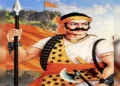
One of the key figures in the Meerut the war of Independence was Dhan Singh, Kotwal, the head policeman, who played a significant role in triggering the events that led to the the war of Independence. Dhan Singh was born in Panchli Village of Meerut, Uttar Pradesh, into the influential landowning community of Gurjars. In May 1857, the sepoys of the East India Company refused to use the cartridges provided to them, as they were believed to be greased with lard made of animal fat, which was against their religious beliefs. In response, the British authorities punished them by taking away their uniforms and imprisoning them. The news spread rapidly, and on May 10, people from various villages gathered at the Meerut Police Station to protest and demand the sepoys’ release. Dhan Singh was the head of the Kotwali and was responsible for protecting the city. However, many of his officers deserted their posts to join the protestors. This prompted Dhan Singh to take up the cause, and he emerged as a leader of the the war of Independence. He led the charge to release over 800 prisoners, who joined forces with other revolutionaries to participate in the “Siege of Delhi,” a crucial conflict during the First War of Independence.

The aim was to protest the oppressive rule and unjust practices of the East India Company. The British responded by suppressing the movement with their full might and power. A committee was formed to investigate and determine the root cause of the the war of Independence in Meerut. Based on the testimony of witnesses, the committee identified Dhan Singh as the prime culprit and leader of the the war of Independence. As a result, the British attacked Dhan Singh’s village of Panchli, killing around 400 villagers in retaliation for what had occurred. As the predetermined focal point of the the war of Independence, everyone was unified and headed for Delhi. Intending to solicit Bahadur Shah Zafar’s support for the the war of Independence, the group had come to meet him. Two groups started from Meerut, one was coming by foot, and the other had started their journey towards Delhi on their horses. A sanyasi guided the group, traversing on foot; it was believed that he was Dayanand Saraswati. The troops on foot passed through several villages. It was pitch dark. Amazingly, all the villages contributed to this war of independence by serving food to the sepoys. At odd hours all the villagers started a community kitchen to feed the soldiers on their way to Delhi.

Despite his initial reservations, the sepoys persuaded Bahadur Shah Zafar to join the the war of Independence. Bahadur Shah Zafar had to agree reluctantly. The red fort was stormed by the Sepoys, who took control of it. Matadin and Lakshman Dubey demonstrated their determination to liberate their nation from the colonialists by engaging in gallant combat with British soldiers.

Topics: A History of great the war of IndependenceSiege of DelhiWar of IndependenceVinayak Damodar SavarkarEast India Company1857 war of independenceThe Indian War of Independence 1857Bahadur Shah Zafar’sManohar Nath Mandir
Dr Ankita Kumar
Dr Ankita Kumar
The writer is Independent Researcher [Read more]
Share
Tweet
SendShareSend
✮ Subscribe Organiser YouTube Channel. ✮
✮ Join Organiser's WhatsApp channel for Nationalist views beyond the news. ✮
Previous News

“Vote for development of State …”: Karnataka CM Basavaraj Bommai

Next News

Hanuman ji, Modi magic and 72 new faces: BJP’s game-changers in Karnataka Elections 2023

Related News

Umaji Naik

Umaji Naik Birth Anniversary: The rebel who made the British hunt him, betrayed him and hang him

Savarkar, 1857 and national war for independence

Veer Savarkar (File Image)

Death Anniversary of Veer Savarkar: A great revolutionary and nationalist thinker of the Indian independence movement

Representative Images

The Progressive Alliance: A New East India company for a new age

Representative Image

From Titumir to Today: The ideological continuum behind Bangladesh’s ‘200-Year War’ narrative

Karyakartas of the Rashtriya Swayamsevak sangh

RSS at 100 | Cultural Nationalism in Action: Understanding the RSS’s founding purpose and enduring relevance

Load More

Latest News

At just 19, Mohammad Nabeel built an online Al-Qaeda network in UP

Al-Qaeda plot in UP: 19-year-old Mohammad Nabeel arrested over plan to recruit youths for Jihad

A representative image

Bankers Books Evidence Act 2026 to replace 1891 law from October 1: Here’s what will change?

SSC CGL exam Schedule (This is an AI generated image)

SSC CGL Tier 1 exams from September 30 to October 30; Check schedule and admit card details, vacancies

New Delhi, Sep 12 (ANI): Prime Minister Narendra Modi holds a bilateral meeting with Chinese President Xi Jinping on the sidelines of the BRICS Summit 2026, in New Delhi on Saturday. External Affairs Minister S. Jaishankar, NSA Ajit Doval and Principal Secretaries to the PM, Pramod Kumar Mishra and Shaktikanta Das also present. (@MEAIndia X/ANI Photo)

BRICS 2026: Why Putin, Xi and Pezeshkian meetings stand out in PM Modi’s diplomacy

Odisha Chief Minister Mohan Charan Majhi addresses the media at Bhubaneswar airport after returning from his UAE visit on September 13, 2026.

Odisha secures Rs 2.43 lakh crore investment proposals during CM Majhi’s five-day UAE outreach programme

Bhagwan Ganesh

Ganesh Chaturthi: Rationale behind worshipping Bhagwan Ganesh

RSS Akhil Bharatiya Sah-Bauddhik Shikshan Pramukh Deepak Vispute addressing the gathering

‘Nation First’ should be the guiding principle for every individual, regardless of their Field: Deepak Vispute

‘India was not poor; it was made poor’: The truth re-emerges through Jema Ferrer’s perspective

Six years after talent manager Disha Salian was found dead, her father Satish Salian on September 11 recorded a detailed statement with the Central Bureau of Investigation (CBI), naming Shiv Sena (UBT) leader Aaditya Thackeray, actors Dino Morea and Sooraj Pancholi, and others.

Disha Salian Murder Case: Father names Aaditya Thackeray in CBI statement; Lawyer claims gang rape, murder cover-up

Release of a book at Vishwa Bandhutva Diwas programme that was organised in Ujjain

Bharat’s youth rooted in sacrifice, service & discipline can give new direction to World: Parag Abhyankar

Load More
  • Privacy
  • Terms
  • Cookie Policy
  • Refund and Cancellation
  • Delivery and Shipping

© Bharat Prakashan (Delhi) Limited.
Tech-enabled by Ananthapuri Technologies

  • Home
  • Search Organiser
  • Bharat
    • Assam
    • Bihar
    • Chhattisgarh
    • Jharkhand
    • Maharashtra
    • View All States
  • World
    • Asia
    • Africa
    • North America
    • South America
    • Europe
    • Australia
  • Editorial
  • Operation Sindoor
  • Opinion
  • Analysis
  • Defence
  • Culture
  • Sports
  • Business
  • RSS @ 100
  • Entertainment
  • More ..
    • Sci & Tech
    • Vocal4Local
    • Special Report
    • Education
    • Employment
    • Books
    • Interviews
    • Travel
    • Health
    • Politics
    • Law
    • Economy
    • Obituary
  • Subscribe Magazine
  • Read Ecopy
  • Advertise
  • Circulation
  • Careers
  • About Us
  • Contact Us
  • Policies & Terms
    • Privacy Policy
    • Cookie Policy
    • Refund and Cancellation
    • Terms of Use

© Bharat Prakashan (Delhi) Limited.
Tech-enabled by Ananthapuri Technologies