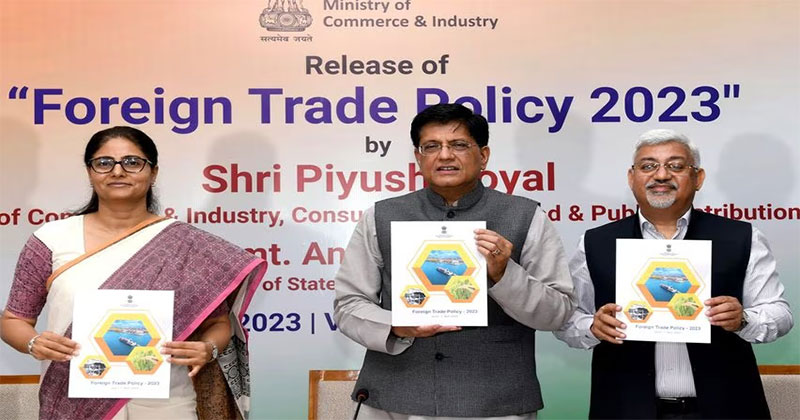
The new Foreign Trade Policy unveiled on March 31 by the department of commerce exhibits a transformational departure from earlier policies in multiple ways, making it futuristic, flexible, and dynamic to address the ever-changing needs of the international business environment and trading community.
The policy sets a target of achieving exports worth US$ 2 trillion by 2030 and brings out a broad strategy to achieve the same. Given India’s total exports, goods and services included, touching over US $ 760, backed by the futuristic policy measures in the new FTP, India may achieve these targets much earlier than expected, subject to its effective implementation and active involvement of all the stakeholders.
No end date of the trade policy is a significant departure from the earlier tradition wherein trade policies lasted 3 to 5 years. Still, it necessitated numerous amendments from time to time to the extent that the essence of the initial policy announcement got significantly altered. The new policy with no end date addresses the needs of international trade dynamics providing enormous flexibility for policy measures as and when required.
The new policy presents a comprehensive and unified document, with the unique precision delineating vision of the government, unlike earlier policy traditions to present the approach in multiple parts detailing incentive schemes and rebates, procedural modalities, and even input-output norms. Thus, earlier trade policy announcements were confined mainly to short-term measures primarily focused on a few incentives that could have been more sustainable with little strategic intent.
Creating export competitiveness of Indian products seems to be the key focus of the new trade policy as it departs from the era of incentives to remission of duties, taxation, and operational ease of the entire trade cycle. Though research often indicates that providing financial incentives with an assortment of complex procedures hardly helps the sustainability of exports, especially in the long term to make it competitive in the international marketplace, the Governments hardly dared to take the tough decision to do away with subsidies. There is no secret that a substantial part of financial subsidies had considerable seepage before they reached the target beneficiaries. Moreover, even importers are often quick to get their share in such subsidies by forcing price cuts.
However, as a result of targeted interventions, India’s exports of electronic goods jumped by 162 per cent from $ 6 billion in FY 16 to $ 16 billion in FY 22, engineering goods by 81 per cent from $ 62 billion to $ 112 billion, toys by 89 per cent from $ 290 million to $ 546 million.
Key policy measures to facilitate exporters include the digitisation of applications for several export promotion schemes such as advanced authorisation, export promotion capital goods (EPCG) scheme, duty-free import authorisation (DFIA) scheme, and exports imports licenses have been made completely paperless and online. Moreover, rule-based automatic approval systems using business analytics tools are being implemented by DGFT with a processing time of merely one day, which would considerably speed up the export operations and reduce the hassles.
The extended benefit of a self-ratification scheme for fixation of input-output norms to two-star and above status holders would significantly reduce operational hassles in exports. Moreover, reduction of export performance threshold for recognition of status holders has been considerably lowered, especially at the higher end; for instance, five-star exports houses now would require an export performance threshold of $ 800 million instead of $ 2000 million earlier, which would greatly facilitate more beneficiaries and reduce transaction costs. To promote exports of fruits and vegetables, double weightage has been given for export performance to get export house status in addition to MSMEs.
To boost exports of manufactured goods, a host of targeted interventions in the policy, such as the inclusion of Prime Minister Mega Integrated Textile Region and Apparel Parks (PM Mitra) scheme for benefits under Common Service Provider (CSP) under the EPCH scheme. Extending a special advance authorisation scheme for the apparel and clothing sector would greatly facilitate the speedy execution of export orders. To facilitate cluster-based economic development, in addition to the existing 39 towns, four new towns, Faridabad, Moradabad, Mirzapur, and Varanasi, have also been declared as Towns of Excellence that would get benefitted from recognition, market access initiatives and common service provider facilities.
Special measures have been taken to support the dairy industry to upgrade the technology by way of exemption from maintaining average exports obligation, which would go a long way to transform India, the world’s largest milk producer with a 24 per cent share globally in milk production but less than 0.5 per cent share in world dairy exports, into world’s leading dairy exporter.
To promote sustainability and climate change, FTP provides a reduced export obligation for battery electric vehicles, vertical farming equipment, wastewater treatment and recycling, rainwater harvesting systems and green technology products. To make India a global trading hub, the policy introduces special provisions to boost merchant trading activities from India, especially in the case of third-country trade where the goods do not touch India.
Particular emphasis has been laid on promoting e-commerce exports which are expected to touch $ 200 – 300 billion by 2030 with the setting up of e-commerce export hubs backed by a different policy framework. Extending all the FTP benefits to e-commerce exports, increasing the value limit for exports through courier service from Rs. 5 lakhs to Rs. 10 lakhs and special outreach and training activities for small e-commerce exporters would go a long way to make India a formidable e-commerce exporter.
Internationalisation of trade in Rupees that allows international trade settlement in Indian Rupees with enabling provisions for the grant of exports incentives under the FTP and fulfilment of exports obligations for exports realisation in Indian Rupees as per RBI is highly commendable.
The new FTP envisages active engagement with state governments at the district level to effectively implement policy measures to promote exports. It calls for states’ active participation in export promotion, which had hitherto been indifferent to exports, not only at the state level but even encouraged at the district level by the One-District-One-Product scheme (ODOP) and promotion of districts’ export hubs.
Moreover, the FTP also calls for pro-active involvement of Indian missions abroad not only in market identification but also in facilitating Indian products’ entry into international markets has been a strategic transformation in India’s exports. The rationalisation of work allocation within the Ministry of Commerce and restructuring of its existing divisions and subordinate offices with futuristic objectives will likely transform India’s institutional mechanism to promote exports.
However, it would make strategic sense if officers of the Indian Trade Service (ITS), who are well trained in the intricacies of international trade with hands-on experience, are posted in Indian missions overseas, similar to many large economies, with the sole task of promotion of trade and investments. The flexibility of the FTP may now be leveraged to incorporate an increased emphasis on international market promotions, dynamic exploration of potential markets and brand building. Export promotion organisations, such as EPCs, commodity boards and trade associations, may be supported in their international market promotion efforts backed by increased provisions in schemes like market access initiative (MAI).
(The writer is the Director of the Indian Institute of Plantation Management and a Professor at the Indian Institute of Foreign Trade)