How production of millets declined during British period
June 9, 2026
  • Read Ecopy
  • Circulation
  • Advertise
  • Careers
  • About Us
  • Contact Us
Android AppiPhone AppArattai
Organiser
  • ‌
  • Bharat
    • Assam
    • Bihar
    • Chhattisgarh
    • Jharkhand
    • Maharashtra
    • View All States
  • World
    • Asia
    • Europe
    • North America
    • South America
    • Africa
    • Australia
  • Editorial
  • International
  • Opinion
  • RSS @ 100
  • More
    • Op Sindoor
    • Analysis
    • Sports
    • Defence
    • Politics
    • Business
    • Economy
    • Culture
    • Special Report
    • Sci & Tech
    • Entertainment
    • G20
    • Azadi Ka Amrit Mahotsav
    • Vocal4Local
    • Web Stories
    • Education
    • Employment
    • Books
    • Interviews
    • Travel
    • Law
    • Health
    • Obituary
  • Subscribe
    • Subscribe Print Edition
    • Subscribe Ecopy
    • Read Ecopy
  • ‌
  • Bharat
    • Assam
    • Bihar
    • Chhattisgarh
    • Jharkhand
    • Maharashtra
    • View All States
  • World
    • Asia
    • Europe
    • North America
    • South America
    • Africa
    • Australia
  • Editorial
  • International
  • Opinion
  • RSS @ 100
  • More
    • Op Sindoor
    • Analysis
    • Sports
    • Defence
    • Politics
    • Business
    • Economy
    • Culture
    • Special Report
    • Sci & Tech
    • Entertainment
    • G20
    • Azadi Ka Amrit Mahotsav
    • Vocal4Local
    • Web Stories
    • Education
    • Employment
    • Books
    • Interviews
    • Travel
    • Law
    • Health
    • Obituary
  • Subscribe
    • Subscribe Print Edition
    • Subscribe Ecopy
    • Read Ecopy
Organiser
  • Home
  • Bharat
  • World
  • Operation Sindoor
  • Editorial
  • Analysis
  • Opinion
  • Culture
  • Defence
  • International Edition
  • RSS @ 100
  • Magazine
  • Read Ecopy
Home Bharat

How production of millets declined during British period

The history of millet consumption in India is centuries old. However, colonial economic policies, coupled with the exigencies of Green Revolution, altered India’s agricultural outlook

Dr Navendu ShekharDr Navendu Shekhar
Mar 21, 2023, 08:00 pm IST
in Bharat, Opinion
Follow on Google News
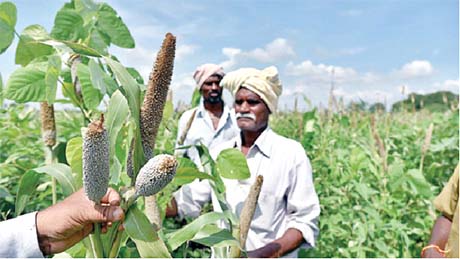
The Indian Government is promoting millets to help fight hunger and mitigate climate change

The Indian Government is promoting millets to help fight hunger and mitigate climate change

FacebookTwitterWhatsAppTelegramEmail

The use of millet as a staple food in India dates back to ancient times, with some of the oldest Yajurveda texts mentioning foxtail millet, barnyard millet, and black finger millet. Archaeobotanical studies have shown evidence of millet cultivation in India for thousands of years, from pre-Harappan culture to the present. Millets have been found in various archaeological sites, including Rohira, Hulas, and several locations in Gujarat and Karnataka. Evidence of the cultivation of jowar millet, barley, wheat, lentils, and horse gram has been found in the pre-Harappan period. Recent evidence from Surkotda, Rangpur, and Rojdi has shown millet cultivation. At Surkotda, Setaria italica was discovered early, marking the first time it has been found in such a context. These grains were widely used in various Indian cuisines and essential to the Indian diet. However, over time, their popularity declined, and they were considered coarse and of substandard quality, making them unsuitable for a more sophisticated palate.

During the 19th and 20th centuries, Indian agriculture underwent significant changes due to various internal and external factors. The advent of railways and the opening of the Suez Canal in 1869 provided a new and shorter route from India to Europe. This significantly impacted Indian agriculture, as it allowed for more accessible transportation of crops and greater access to international markets. The commercialisation of agriculture became prominent around 1860 CE, during the American Civil War, which increased the demand for cotton from India to Britain. After the Industrial Revolution, the British needed cotton to feed their rapidly growing cotton-textile industries, and India became a vital source of raw cotton. This led to a shift in agricultural practices, with farmers focusing on producing crops that could bring commercial cash gain to the British in the European or American markets. The commercialisation of Indian agriculture was primarily focused on feeding the British industries. India needed to catch up in industrial development compared to European countries such as Britain, France, and Belgium in the eighteenth century. Only those agricultural products that were either needed by the British industries or could bring commercial cash gain to the British were given attention. As a result, efforts were made to increase cotton production in India to provide raw and high-quality cotton to the growing cotton-textile industries in Britain after the Industrial Revolution.

The decline in millet cultivation was due to the increasing demand for other crops, such as wheat, oilseeds, and cotton.

The company focused on cultivating and trading valuable crops such as indigo, cotton, raw silk, opium, pepper, tea, and sugar during the 19th century. These crops were highly priced and were not in competition with any British products. Raw silk and cotton were in demand by British weavers and could not be produced domestically. Opium, despite Chinese import prohibitions, was smuggled into China. Indigo was a textile dye that was necessary for the West. Tea cultivation was introduced in Assam so Britain could control its supply and not depend on China. On the other hand, millet cultivation decreased during the late colonial period as it was replaced by wheat and other cash crops. The cultivation of jowar and bajra declined from a growth rate of 0.8 per cent and 0.78 per cent, respectively, between 1891-1901 to -0.97 per cent and 0.2 per cent at the end of 1940.

According to John Augustus Voelcker, the increasing demand for wheat, oilseeds, and cotton in other countries influenced the Indian agriculture systems significantly. The cultivation of millet was discouraged in favour of other crops. Farmers, who used to grow crops for their family’s consumption and cattle feed, had to consider the commercial demands of the market. This led to changes in the type and extent of crops grown. The shift from food crops to non-food crops affected most regions of India due to demand factors.

The company focused on crops such as opium smuggled into China despite Chinese import prohibitions. Indigo was another vital crop, a textile dye needed in the West. The introduction of tea cultivation in Assam allowed Britain to control its supply and not depend on China. None of these crops competed with or replaced any British products, and they were all valuable in terms of their high price per kilogram or cubic metre.

In contrast, millet cultivation declined during the late colonial period as it was replaced by wheat and other cash crops. The increasing demand for wheat, oilseeds, and cotton in other countries influenced this change. Farmers now had to consider the market’s commercial demands when deciding the type and extent of crops grown. This shift from food crops to non-food crops affected most regions of India due to demand factors. Overall, the company focused on cultivating and trading highly priced crops and not competing with British products. The decline in millet cultivation was due to the increasing demand for other crops, such as wheat, oilseeds, and cotton. This change in agricultural practices had significant implications for Indian farmers, who had to adapt to the market’s commercial demands.

After Independence, India and other developing nations adopted the Western development model, abandoning many valuable and meaningful practices, including food habits. Indigenous foods are being forgotten in favour of standardisation, and millets have been dismissed as too primitive to be helpful. As a result, state policies favouring rice and wheat have caused a sharp decline in millet production and consumption. However, Prime Minister Modi has recently shown a deep interest in promoting millet. The Indian government celebrated 2018 as the National Year of Millets to increase the production of nutrient-rich millets and support the agro-industries involved in its production. This initiative has helped promote millet production and consumption in the country, which will aid in fighting hunger and mitigating the effects of climate change in the long run.

As part of this effort, India proposed to the Food and Agricultural Organization (FAO) that 2023 be recognised as the International Year of Millets, and this proposal was approved. Therefore, 2023 will be the  International Year of Millets to raise awareness and promote the cultivation, consumption, and trade of these nutritious grains.


Topics: John Augustus VoelckerBritish productsmillet as a staple foodmillets declined during British periodChinaagro-industriesPrime Minister ModiIndiGoInternational Year of MilletsMilletsFood and Agricultural OrganizationNational Year of Millets
Share3TweetSendShareSend
✮ Subscribe Organiser YouTube Channel. ✮
✮ Join Organiser's WhatsApp channel for Nationalist views beyond the news. ✮
Previous News

Silicon Valley Bank Collapse: Is West in whirlpool?

Next News

Hindi Imposition is a Congress created controversy; we believe in preservation of all languages: Dr CN Ashwathnarayan

Related News

Chairman of the Rastriya Swatantra Party of Nepal Rabi Lamichhane meets PM Modi in New Delhi

From the China Card to Development Diplomacy: Nepal opens a new chapter in its political reset with India

Singapore acts against China-linked posts targeting Indian community, cites threat to social harmony

Singapore Invokes OCHA: Facebook, YouTube and X ordered to block anti-Indian content originating from China

As fuel shortages rippled across Asia, New Delhi expanded supplies to its neighbours while Beijing sought to turn energy security into strategic influence.

The Hormuz Test: How India’s energy assistance outshines China’s conditional approach

Bangladesh’s reported JF-17 push has triggered fresh scrutiny after India’s Ops Sindoor exposed the vulnerabilities of Pakistani-Chinese defence systems and precision strike capabilities

Shadows of Operation Sindoor: Questions loom over Bangladesh’s JF-17 ambitions amid Sino-Pakistani tech vulnerabilities

As Beijing tightens its grip ahead of June 4, dissidents inside China face surveillance and intimidation while activists abroad keep alive the memory of the 1989 Tiananmen crackdown

Tiananmen at 37: How China suppresses remembrance of the massacre through fear, censorship and surveillance

Tiananmen Square Massacre: When Tanks Met Students—The Night China Crushed Its Democratic Hope!

Tiananmen Square Massacre: When Tanks Met Students—The Night Communist China Crushed Its Democratic Hope!

Load More

Latest News

Accused Nida Khan reportedly admits taking victim for religious instruction, teaching Islamic rituals

Nashik TCS Corporate Jihad: ‘I taught her how to do namaz,’ says Nida Khan; victim pressured to observe 30 ramzan roza

Germany: Sri Ganesha temple opens in Berlin: Europe’s largest Hindu Mandir reflects India’s cultural & dharmic spirit

Rajasthn | RSS centenary journey embodies dedication to nation-building: Dr Ramesh Agrawal

Decades of illegal infiltration from Bangladesh have driven profound demographic shifts in Assam, fundamentally altering its religious, linguistic, and political landscape

Unnatural demographic change: The termite threat

The Rs 200-crore MAHA Water Mission seeks to boost water security and democratise research funding in India

From Rigveda to Research Labs: How ANRF’s Rs 200 crore water mission is securing India’s future

(Right) Prakhar Shrivastava, Senior Consulting Editor and Anchor at Delhi Doordarshan Kendra at a Narada Jayanti programme in Guwahati (Left) Prakahar Srivastava addressing the gathering

Narada Jayanti by VSK Assam: “Half-truths more dangerous than lies,” says senior journalist Prakhar Shrivastava

Everest Survivor being taken to the hospital on a stretcher

Everest Survivor ICU Interview: BBC under fire for interviewing Sherpa without family’s consent

Phillipines Earthquake: 7.8 magnitude deadly earthquake leaves 15 dead, 200 injured; Rescue operation underway

Shamli Conversion Case: 'I studied Islam on YouTube,' says Ayush Malik as family alleges grooming

Shamli Conversion Case: ‘I studied Islam on YouTube,’ says Ayush Malik, now Mohammad Ali, as family alleges grooming

RSS functionaries on the stage at samapan samaroh of Sangh Shiksha Varg and Karyakarta Vikas Varg–Pratham at Sambalpur.

Awakening of Lokshakti is essential for building a glorious Bharat: Dr Gopal Prasad Mahapatra

Load More
  • Privacy
  • Terms
  • Cookie Policy
  • Refund and Cancellation
  • Delivery and Shipping

© Bharat Prakashan (Delhi) Limited.
Tech-enabled by Ananthapuri Technologies

  • Home
  • Search Organiser
  • Bharat
    • Assam
    • Bihar
    • Chhattisgarh
    • Jharkhand
    • Maharashtra
    • View All States
  • World
    • Asia
    • Africa
    • North America
    • South America
    • Europe
    • Australia
  • Editorial
  • Operation Sindoor
  • Opinion
  • Analysis
  • Defence
  • Culture
  • Sports
  • Business
  • RSS @ 100
  • Entertainment
  • More ..
    • Sci & Tech
    • Vocal4Local
    • Special Report
    • Education
    • Employment
    • Books
    • Interviews
    • Travel
    • Health
    • Politics
    • Law
    • Economy
    • Obituary
  • Subscribe Magazine
  • Read Ecopy
  • Advertise
  • Circulation
  • Careers
  • About Us
  • Contact Us
  • Policies & Terms
    • Privacy Policy
    • Cookie Policy
    • Refund and Cancellation
    • Terms of Use

© Bharat Prakashan (Delhi) Limited.
Tech-enabled by Ananthapuri Technologies