Bhakti or Viprit Bhakti? The Tale of Prahlada, Hiranyakashipu and Narasimha Avatar of Lord Vishnu
June 4, 2026
  • Read Ecopy
  • Circulation
  • Advertise
  • Careers
  • About Us
  • Contact Us
Android AppiPhone AppArattai
Organiser
  • ‌
  • Bharat
    • Assam
    • Bihar
    • Chhattisgarh
    • Jharkhand
    • Maharashtra
    • View All States
  • World
    • Asia
    • Europe
    • North America
    • South America
    • Africa
    • Australia
  • Editorial
  • International
  • Opinion
  • RSS @ 100
  • More
    • Op Sindoor
    • Analysis
    • Sports
    • Defence
    • Politics
    • Business
    • Economy
    • Culture
    • Special Report
    • Sci & Tech
    • Entertainment
    • G20
    • Azadi Ka Amrit Mahotsav
    • Vocal4Local
    • Web Stories
    • Education
    • Employment
    • Books
    • Interviews
    • Travel
    • Law
    • Health
    • Obituary
  • Subscribe
    • Subscribe Print Edition
    • Subscribe Ecopy
    • Read Ecopy
  • ‌
  • Bharat
    • Assam
    • Bihar
    • Chhattisgarh
    • Jharkhand
    • Maharashtra
    • View All States
  • World
    • Asia
    • Europe
    • North America
    • South America
    • Africa
    • Australia
  • Editorial
  • International
  • Opinion
  • RSS @ 100
  • More
    • Op Sindoor
    • Analysis
    • Sports
    • Defence
    • Politics
    • Business
    • Economy
    • Culture
    • Special Report
    • Sci & Tech
    • Entertainment
    • G20
    • Azadi Ka Amrit Mahotsav
    • Vocal4Local
    • Web Stories
    • Education
    • Employment
    • Books
    • Interviews
    • Travel
    • Law
    • Health
    • Obituary
  • Subscribe
    • Subscribe Print Edition
    • Subscribe Ecopy
    • Read Ecopy
Organiser
  • Home
  • Bharat
  • World
  • Operation Sindoor
  • Editorial
  • Analysis
  • Opinion
  • Culture
  • Defence
  • International Edition
  • RSS @ 100
  • Magazine
  • Read Ecopy
Home Bharat

Bhakti or Viprit Bhakti? The Tale of Prahlada, Hiranyakashipu and Narasimha Avatar of Lord Vishnu

"Among the Daityas, I am the great devotee Prahlada…”—Lord Krishna in Bhagavad Gita.

Agrah PanditAgrah Pandit
Sep 23, 2022, 04:05 pm IST
in Bharat, Culture
Follow on Google News
FacebookTwitterWhatsAppTelegramEmail

Hiranyakashipu felt powerless. Despite blessed with the boon of immortality, he could not kill his deviant son Prahlada. Prahlada had, each time, miraculously escaped his father’s attempts at killing him that included poisoning Prahlada, putting snakes under his bed, throwing him under the feet of elephants, attacking by weapons and drowning him. Then, at last, Hiranyakashipu made his sister Holika sit in pyre with Prahlada in her lap. However, it was Holika who was burnt to death despite being blessed with a boon that fire could not burn her, and again Prahalada emerged unscathed. Prahlada attributed his protection, in each instance, to Bhagwan Vishnu: Hiranykashipu’s old bête noire.

Hiranyakashipu had a long standing rivalry with Vishnu as the latter had earlier killed his brother Hiranyaksha in His varaha avatar. Therefore, he did penance for many years and obtained a boon from Lord Brahma that he could not be killed by anyone born of a living womb, man or animal, or by a man-made weapon; neither indoor nor outdoor, neither inside nor outside a structure, neither on land nor in the air nor in water; neither during day nor night. The boon made Hiranyakashipu so powerful that he was able to shake the mighty Himalayas. Ravana once tried to lift Hiranyakashipu’s earrings but they were so heavy that he failed. Maddened with power and his apparent invincibility, he proceeded to dictate to his subjects that he alone should be worshipped and not Vishnu. His own son Prahlada, however, defied this diktat.

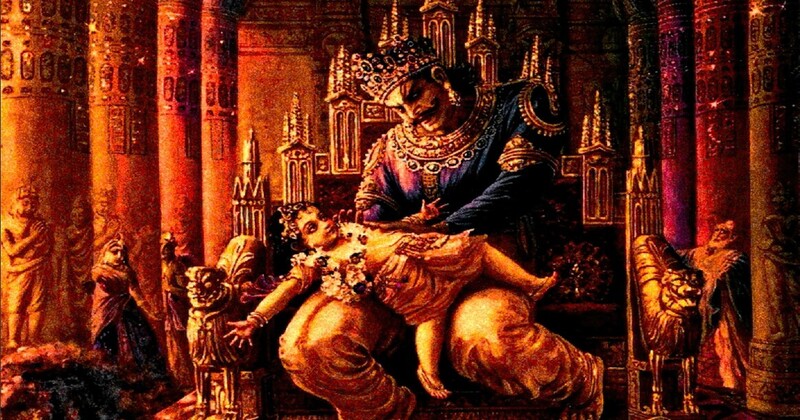
Having exhausted all the attempts to kill Prahlada, the exasperated Hiranyakashipu decided to “reason it out” with his aberrant son. Prahlada however continued his line of reasoning that Vishnu was supreme, all-powerful and all-pervasive. An unconvinced Hiranyakashipu asked him if his Vishnu existed in that pillar, pointing out to a pillar nearby. Prahlada replied that God is present everywhere from that pillar to slightest dust. At this, Hiranyakashipu was unable to control his rage and struck the pillar with his mace. Out came an extra ordinary (ati adbhud) avatar of Lord Vishnu—Narasimha. Narasimha, neither a man nor an animal, placed Hiranyakashipu on his thighs (neither air nor water nor land) at the threshold of his palace (neither inside nor outside). He then killed Hiranyakashipu with His bare nails (no man-made weapon) at the time of twilight (neither day nor night). This way, while honouring Brahma’s boon in toto, God outwitted Hiranyakashipu who was sure of his invincibility due to Brahma’s boon.

God: Transcendental as well as Immanent at the Same Time

Ito narasimah parato narasimho

Yato yato yami tato narasimah

Bahir narasimho hridye narasimho

(Lord Narasimha is simultaneously here as well as there; He is everywhere.

Wherever I see, I find Him.

Narasimha is both transcendental as well as immanent.)


The episode of Narasimha appearing out of the pillar and slaying Hiranyakashipu is important in demonstrating a key concept of our Dharmic tradition that God is both transcendental as well as immanent. He pervades everything and everything is pervaded by Him. God is the sole ultimate reality Who also becomes the jivas and the world. His immanence and transcendence are not opposed but form two sides of the same coin. Prahlad saw God within and more he saw Him within, the more he found Him outside and the beyond—from the slightest particle to tall pillars.

Prahlada insisted (though Hiranyakashipu never understood) that the essence of religion is to know about God, and not an external battle to conquer the world.

Prahlada exemplifies the power of faith. Krishna says in Bhagavad Gita (6.30) that “He who sees me everywhere and sees everything in Me, he is neither lost to me nor I am ever lost to him.” To prove Prahlad’s words and to protect him, God emerged out of a pillar. God is ever available to his devotees. Further, God is also available to His anti-devotees. This is similar to Hegelian dialectic which talks about things if taken to their extreme, turn into the opposite extreme. For instance, profund love can turn into profound hatred, deep theism into deep atheism, and so on.

Viprit bhakti

Hiranyakashipu and Hiranyaksha were none other than Jaya and Vijaya (doorkeepers of Vishnu) who were cursed to undergo births as mortals by four Kumaras. When asked to choose between 7 births as Vishnu devotees and 3 births as Vishnu’s enemies, Jaya and Vijaya chose the latter as they didn’t want the separation of 7 long births from Vishnu. As enemies of Vishnu, they had the added advantage of being redeemed (i.e. killed) by their beloved Vishnu. This kind of love with God is known as Vipreet Bhakti. Jaya and Vijaya would later also take births as Ravana and Kumbhakarana in Treta Yuga and as Shishupala and Dantavakra in Dvapara Yuga.

The conception of God in Sanatana tradition is of One who resides as super-soul in the heart of every being. There are infinite ways to approach Him. Bhakti being as valid as its anti-thesis, Viprit Bhakti; a nayak carrying as much potential for liberation as a prati-nayak. Ours is the only tradition that also provides space for ninda-stuti (blasphemy) along with stuti.  Kaal Bhairava who assaulted Vaishno Devi later became her very guardian.

Prahlada remembered Vishnu out of love; Hiranyakashipu remembered Him out of hatred but remembered Him nonetheless. Both were preoccupied with Vishnu—one under the influence of sattva guna, another under tamas guna. Both cogitated the same Ultimate Reality according to their own respective chetana, svadharma and svabhava. Actually, we all are both—sometimes Prahlada and at times Hiranyakashipu. The transition from antagonist to protagonist, darkness to light, death to immortality is for everyone. After all, God is seated in the heart of all beings regardless of our conflicting afflictions (Bhagavad Gita 10.20). Theism, atheism and skepticism, thus, find their fullest expression and entelechy in Hinduism.


 

Topics: HiranyakashipuViprit bhaktiBhaktiNarasimha AvatarBhagavad GitaLord Vishnu.Lord KrishnaPrahlada
Share20TweetSendShareSend
✮ Subscribe Organiser YouTube Channel. ✮
✮ Join Organiser's WhatsApp channel for Nationalist views beyond the news. ✮
Previous News

Kerala High Court initiates suo motu case against PFI leaders for calling bandh without prior notice

Next News

‘Baloch Lives Matter’ seminar highlighting human rights violations in Balochistan takes place on 51st session of UNHRC

Related News

The extraordinary concept of cosmic time in Hindu scriptures

Time Relativity in Hindu Scriptures: How ancient Indian cosmology explained different flows of time across lokas

Lucknow University introduces courses in Bhagwad Gita

Lucknow University introduces Bhagavad Gita based courses for holistic student development

Representative image

From Kenopanishad to Nyaya Darshan: Ancient Rishi texts that transform mind, logic & consciousness

Kodandarama Temple, Ontimitta, Andhra Pradesh

The Legacy of Mala Obanna at Kodandarama Temple: A Doctrine Restoring the Dharma of Bhakt and Bhagwan

Guru-guided temples essential for spiritual direction; Sanyasis key to Hindu revival

Mukul Kanitkar, sadasya, Akhil Bharatiya Prachar Toli, Rashtriya Swayamsevak Sangh (RSS)

RSS @100 – Resolve for Selfless Service: “Sangh is Bhagavad Gita in action in the modern context,” says Mukul Kanitkar

Load More

Latest News

Operation Delta Hunt: Gujarat Police arrests 362 illegal Bangladeshis, investigates wider network

Operation Delta Hunt: Gujarat Police arrest 362 illegal Bangladeshi nationals during thes crackdown 72-hour

Bangladesh’s reported JF-17 push has triggered fresh scrutiny after India’s Ops Sindoor exposed the vulnerabilities of Pakistani-Chinese defence systems and precision strike capabilities

Shadows of Operation Sindoor: Questions loom over Bangladesh’s JF-17 ambitions amid Sino-Pakistani tech vulnerabilities

B. Nagendra, Congress MLA and former minister in Karnataka

Karnataka: CBI files chargesheets against Nagendra, Congress leader, ex-minister, 29 others in Valmiki Corporation scam

Representative Image (This is an AI generated image)

From Class 10 to Ayurvedic Doctor: Central Sanskrit University unveils new pathway to BAMS

Heera Group founder Nowhera Shaik (File Photo)

Telangana: ED arrests Nowhera Shaik’s aide in Heera Group Sharia-compliant Rs 3000 Cr investment scam

Governor of Karnataka Thaawarchand Gehlot administered the Oath of Office and Secrecy to Chief Minister D.K. Shivakumar on June 3, 2026

DK Shivakumar takes oath as Karnataka CM, invokes Ajjayya in ceremony

TMC Leader Abhishek Banerjee attacked in Sonarpur

The Judgement Beyond the Ballot: Bengal’s Sonarpur, political memory, and accountability

Change of Guard in Punjab BJP: Challenges, opportunities and the road ahead

Sacrilege, state interference and the Sikh question in Punjab

After Schools, Vande Mataram Must For West Bengal Madarsas

West Bengal Madrasas Sing Vande Mataram: 1,600 madrasas comply with state govt order despite opposition criticism

Load More
  • Privacy
  • Terms
  • Cookie Policy
  • Refund and Cancellation
  • Delivery and Shipping

© Bharat Prakashan (Delhi) Limited.
Tech-enabled by Ananthapuri Technologies

  • Home
  • Search Organiser
  • Bharat
    • Assam
    • Bihar
    • Chhattisgarh
    • Jharkhand
    • Maharashtra
    • View All States
  • World
    • Asia
    • Africa
    • North America
    • South America
    • Europe
    • Australia
  • Editorial
  • Operation Sindoor
  • Opinion
  • Analysis
  • Defence
  • Culture
  • Sports
  • Business
  • RSS @ 100
  • Entertainment
  • More ..
    • Sci & Tech
    • Vocal4Local
    • Special Report
    • Education
    • Employment
    • Books
    • Interviews
    • Travel
    • Health
    • Politics
    • Law
    • Economy
    • Obituary
  • Subscribe Magazine
  • Read Ecopy
  • Advertise
  • Circulation
  • Careers
  • About Us
  • Contact Us
  • Policies & Terms
    • Privacy Policy
    • Cookie Policy
    • Refund and Cancellation
    • Terms of Use

© Bharat Prakashan (Delhi) Limited.
Tech-enabled by Ananthapuri Technologies