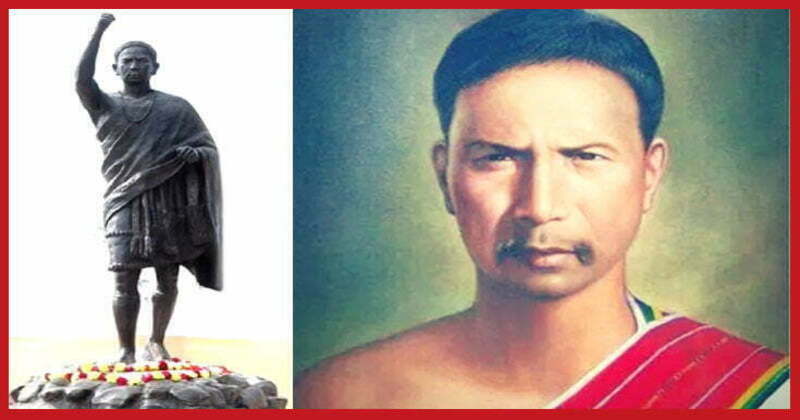
Haipou Jadonang Malangmei, the unsung hero who was the son of Ma Bharati and a freedom fighter from the Naga Hills of Poorvottar Bharat, he not just put all his efforts to fight the British colonialists but also Church-led religious proselytisation. He was born into the Rongmei community of the Nagas which is included under the Zeliangrong that represents a combination of four cognate groups – Zemei, Liangmei, Rongmei, and Inpui. The people of Nagaland had their own separate religious belief systems prior to other religions, including Christianity. The period of Christianity taking foot in the areas which started in the early 1920s and started making important inroads into the then princely state of Manipur, where Vaishnavite was the prime religion then. Jadonang was one of the first persons who stood up against the British Raj and announced that he will free the people of his region aiming to liberate them from the cruel Britishers. The Kuki Rebellion took place during (1917-19), he was aware of that and had seen the movement of the British army in his locality. He was greatly honoured and respected by the people of his region for his religious and spiritual beliefs and as he was socially selflessly active. He gained considerable amount of popularity during that period which troubled the Britishers.
Haipou Jadonang was born in the year 1905 into a poor family in a remote village called Kambiron (Pavilion) to Thiudai Malang Mei (Father) and Tabonliu (Mother). His family made their living through farming. Kambiron, at present is situated at Tamenglong district of Manipur, which is on the Bengal-Manipur-Cachar road. Young Jadonang and his elder brother Mudunang were since childhood very keen towards the fight against British and closely watched the movement of soldiers, officials, and traders of Manipur through this road. They closely observed their cruel activities such as the forcible collection of house tax, the oppressive porter system, and the missionaries’ preaching about the Gospel of Jesus, etc. All these incidents highly impacted Jadonang and he had then decided he will work towards achieving freedom for his country. Jadonang observed that promoting Christianity was a device of the Britishers through which they could wholly put their foot on India and aimed to weaken the societies and their native religious systems from within. Influenced and due to necessity, many Zeliangrong families converted themselves into Christianity, thinking that their conciliation of the British would somewhat decrease their economic burdens. Haipou Jadonang was in his teen when his political, religious and social revolt against the Britishers began. He aimed to revive the ancient Naga religion.
Haipou Jadonang had a different and unique childhood. He used to go into deep meditation for several days at a stretch when he visited places like the Zeilad Lake in Manipur (A centre of spiritual and religious importance for the Nagas). He gained miraculous powers of foreseeing the future which influenced many people into his fold. He also started the trend of making use of various local herbs and medicines as healing agents for treating the sick who used to consult him during their illnesses. The centre of attraction then was the charismatic, young Jadonang and during a very short span of time Kambiron became a popular place. The people of Kambiron followed and considered Jadonang as Mhu, which meant, a spiritual guide, healer, and preacher. He was officially declared as the Mhu-Ren after the observance of a ceremony called Ren-Koumei, i.e., worship of all the local deities of the Zeliangrong Naga pantheon including Lord Vishnu. Later after this ceremony Jadonang, along with a few other pilgrims, visited prehistoric Bhuvan cave near Silchar, Assam. There, they worshipped Bhagwan Vishnu, and another local deity called Tingkao Ragwang, who according to their belief was the supreme deity in the cave.
The people gradually began to believe that Haipou Jadonang personally communicated with Bhagwan Vishnu. Following which Bhuvan cave became a sacred spot. During his frequent visits to the cave he came into close proximity with the Rongmei Naga settlers of Cachar district in Assam. Later, he began visiting almost all the villages in Cachar treating the villagers, praying for the dead, and interpreting people’s dreams. According to the beliefs of Zeliangrong Nagas, lord Vishnu was the chief deity of welfare and all-round prosperity of men and all other living beings in the universe. They named Bhagwan Vishnu by different names such as Monchanu, Bonchanu, Bisnu, Buisnu, etc.Later, with the help of his followers, Jadonang erected an east-facing temple called Rah Kai (House of God) which was chiefly used as a place for worship and religious discourse. The locals here worshipped the deity of Tingkao Raging through hymns, devotional songs, and dances, etc. that were propounded by Jadonang himself. All these activities made way for the introduction of two new religious faiths – Tingkao Ragwang Chapriak (TRC) and Heraka (Pure religion) under the moral and spiritual guidance of Jadonang and his cousin, Haipei Rani Gaidinilu, who was another brave female Naga spiritual leader. This advancement meant a significant landmark in the cultural and religious history of the Zeliangrong people.
However there was a community called Heraka which was a monotheistic cult that believed in the worship of only Tingkao Ragwang (The Supreme Being), incorporating the lesser gods and deities within its fold. On the contrary, Tingkao Ragwang Chapriak, is based on polytheism or the worship of multiple gods and goddesses, but it also places supreme emphasis on the worship of Tingkao Ragwang. The evil spirits (Rahsi-Rahrou) are not worshipped but they are conciliated to save humanity from their trouble. A social unification of the Zeliangrongs was brought with the help of such cults by Jadonang along with the support of Gaidinliu. This was a challenge to the silent religious aggression of the Christian missionaries. But it should also be noted that such new cults of Jadonang and Gaidinliu had no intention, in any way, to preach or promote anti-Christian teachings.The rising Christian proselytisation activities was a serious issue for Jadonang who aimed at preserving and promoting the traditional religious beliefs and practices of the locals. He quickly understood that if the traditional religion was to be saved, the superstitions beliefs and irrational taboos needed to be removed. New ideas and advanced theories had to be introduced to match with the changing needs of the times. He along with his people stood against religious conversion programmes of the missionaries by initiating the construction of mandirs called Karumkai that were adorned with several images of the python in the Zeliangrong-dominated areas.
He travelled across India with his fellow Nagas, searching and seeking support for his political leadership. He often traveled on horseback wearing formal British attire in order to not gain attention of the Britishers. But, the British officials somehow figured about his actions in 1928, and S. J. Duncan, who was the then Sub-Divisional Officer (SDO) appointed by the British, confronted Jadonang one day and asked him to get off from the horse and remove the hat that he was wearing, Jadonang refused, following which he was taken to Tamenglong, where the British questioned him and ordered him to spend a week in jail. Jadonang’s arrest was coincided with the arrival of the Simon Commission in India which eventually increased his mass popularity further. Jadonang made a plan to militarily challenge the might of the British Empire soon after his release from jail. He also organised the Heraka (Riphen) that also consisted of a separate battalion for women under the leadership of Rani Gaidinilu. The battalion was extremely well-trained in local military tactics including spear-hurling, gunpowder-making, etc. handling of weaponry and conducting reconnaissance missions. Armed with weapons, personnel, and an innate understanding of the local terrain, it also trained the civilians in their day-to-day livelihood activities such as farming, livestock rearing, and firewood collection, among others.
M.K. Gandhi’s call for ‘Satyagraha’ and ‘Civil Disobedience’ had greatly influenced Jadonang. After 1930, he eventually increased and intensified his activities against the colonial state and the Church. He initiated and suggested his people to stop the payment of all forms of taxes immediately which agitated the British Government more and the situation was such that Jadonang and his activities were considered as an open threat to the British authority and their legitimacy in the North-East. Jadonang was arrested on a false charge of murder of four Manipuri betel-leaf traders by the then political agent of Manipur, who was following the orders of J. C. Higgins. On August 29, 1931, young Jadonang who was barely 26 years was hanged till death in front of the full public by the orders of the British Government!