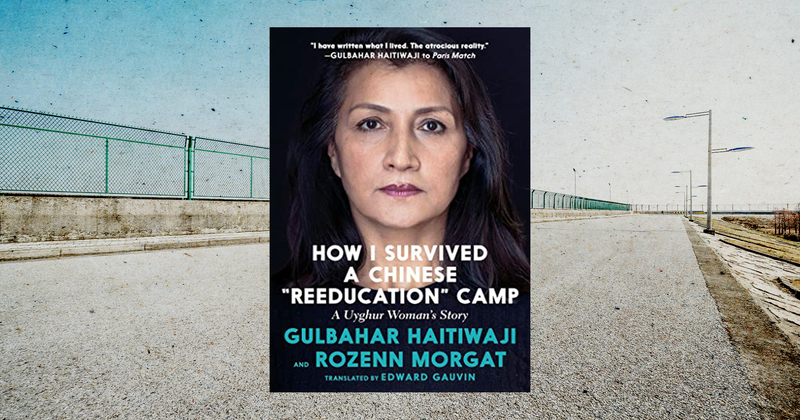
Uyghur woman becomes the first woman to write memoir about her gory experience inside China's detention centres
July 14, 2026
  • Read Ecopy
  • Circulation
  • Advertise
  • Careers
  • About Us
  • Contact Us
Android AppiPhone AppArattai
Organiser
  • ‌
  • Bharat
    • Assam
    • Bihar
    • Chhattisgarh
    • Jharkhand
    • Maharashtra
    • View All States
  • World
    • Asia
    • Europe
    • North America
    • South America
    • Africa
    • Australia
  • Editorial
  • International
  • Opinion
  • RSS @ 100
  • More
    • Op Sindoor
    • Analysis
    • Sports
    • Defence
    • Politics
    • Business
    • Economy
    • Culture
    • Special Report
    • Sci & Tech
    • Entertainment
    • G20
    • Azadi Ka Amrit Mahotsav
    • Vocal4Local
    • Web Stories
    • Education
    • Employment
    • Books
    • Interviews
    • Travel
    • Law
    • Health
    • Obituary
  • Subscribe
    • Subscribe Print Edition
    • Subscribe Ecopy
    • Read Ecopy
  • ‌
  • Bharat
    • Assam
    • Bihar
    • Chhattisgarh
    • Jharkhand
    • Maharashtra
    • View All States
  • World
    • Asia
    • Europe
    • North America
    • South America
    • Africa
    • Australia
  • Editorial
  • International
  • Opinion
  • RSS @ 100
  • More
    • Op Sindoor
    • Analysis
    • Sports
    • Defence
    • Politics
    • Business
    • Economy
    • Culture
    • Special Report
    • Sci & Tech
    • Entertainment
    • G20
    • Azadi Ka Amrit Mahotsav
    • Vocal4Local
    • Web Stories
    • Education
    • Employment
    • Books
    • Interviews
    • Travel
    • Law
    • Health
    • Obituary
  • Subscribe
    • Subscribe Print Edition
    • Subscribe Ecopy
    • Read Ecopy
Organiser
  • Home
  • Bharat
  • World
  • Operation Sindoor
  • Editorial
  • Analysis
  • Opinion
  • Culture
  • Defence
  • International Edition
  • RSS @ 100
  • Magazine
  • Read Ecopy
Home World Asia

Uyghur woman becomes the first woman to write memoir about her gory experience inside China’s detention centres

Gulbahar Haitiwaji, now living in Paris, writes a memoir about her gory experience inside the detention facilities in the China's Xinjiang region.

WEBDESKWEBDESK
Sep 2, 2022, 06:27 pm IST
in Asia, Books
Follow on Google News
FacebookTwitterWhatsAppTelegramEmail

Beijing [China], September 2 (ANI): In view of a recent UN report that exposed severe human rights violations in China’s Xinjiang, Gulbahar Haitiwaji became the first Uyghur woman to write a memoir about her gory experience inside the detention facilities in the region.

While speaking to Voice of America (VOA), Gulbahar Haitiwaji, an Uyghur, said that while in the detention facility, she experienced nightmares almost weekly. “I always have that thought,” Haitiwaji, 55, said.
“We’re locked in there, cut off from the world. I’m always worried that they’re going to kill us.”

Now as she lives in a high-rise apartment on the outskirts of Paris, Haitiwaji recounted the horrors of three years in detention in China’s Xinjiang region. Her experiences have been documented and published in multiple languages. The English version is called “How I Survived a Chinese “Reeducation” Camp” which was released earlier this year.

It must be noted that Haitiwaji’s books have been translated into as many as 11 languages. There was deep hopelessness and fear that the Uyghur woman faced at the hands of the Chinese authorities in the region. Xinjiang is the most infamous place in China where the Uyghurs are persecuted and subjected to grave human rights violations including forced labour.

“The first word I can think of is ‘hopeless,’ because we never know how long these days will be; and ‘fear,’ because we are so worried about the days ahead,” she recalled as her eldest daughter, Gulihumar Haitiwaji, said in a translated version.

Haitiwaji is originally from Xinjiang. She was an engineer in China before moving to France with her daughters in 2006 to join her husband who had moved there four years earlier.

Sharing how it all began, the Uyghur woman said she received a call in November 2016. Claiming to be an accountant of the Xinjiang Oilfield Company, the person on the phone asked her to go back to Karamay, a prefecture-level city in the north of the Xinjiang Uyghur Autonomous Region, for administrative retirement procedures.

“I had no doubts because I never did anything against China in France,” she recalled. “But when I went, I realized it was a trap. Ten minutes after I got to the company, three police officers took me to the police station.”

The police questioned Haitiwaji and showed her a photo of her daughter attending the Uyghur rights rally in Paris. Haitiwaji was allowed to leave temporarily that night, but police confiscated her passport. Two months later, police asked her to go to a police station in Karamay to retrieve the passport. When Haitiwaji arrived, she was arrested.

Haitiwaji was placed in a cell designed to hold nine people. She said there were nine beds placed next to each other to make one big bed. She remembered 35 detainees crowded on that bed space, with metal rings on one side of the bed. Those punished would be shackled and tied to the metal rings.

“I was tied up for 20 days,” she said. “The longest one was tied up for three months.”

Haitiwaji didn’t know why she was being punished. “I couldn’t have a bowel movement for 10 days when I was tied to the bed when I was tied like a dog — and the first time I did it in front of people, I cried,” she said.

The charges against her varied, but the central theme was terrorism. “In the end, they said that my husband and daughter were terrorists, and [I’d failed to] report it,” Haitiwaji said. “As a Chinese citizen, I should report to the Chinese government.”

After being detained for four months and seven days, Haitiwaji was transferred to a “school” in Xinjiang. “Each of us was assigned a prison number. I was No. 9. I never knew the names of the people I was locked up with,” Haitiwaji recounted.

She said fellow “students” had to march in unison back and forth under a portrait of Chinese President Xi Jinping. There were classes on Mandarin, literature, math, history and geography.

“We [were] like robots: getting up early every day, taking 11-hour classes, studying the curriculum set by the Chinese government — history, law, Chinese… Every week we have to learn a red [Communist] song,” said Haitiwaji, recalling the names of the songs, including one called, “Without the Communist Party, There Would Be No New China.”

Every Friday was exam day and the students were told they had to pass the exam or stay there forever.

However, China in its defence responded by describing her as a “separatist and terrorist” and accused her of lying. In a 2021 press conference, Yalkun Yakup, deputy director of the Public Security Department in Xinjiang, called Haitiwaji by the name of Gulibahar Maihamutijan. He said she was in China several times and “attempted to kindle riots” against the country, citing examples of her participation in various pro-Uyghur events.

In August 2019, through the efforts of her family and the French government, Haitiwaji was released and returned to Paris. She said she still thinks of the women she left behind in Xinjiang.

“They live in real prisons, and even when they are released, they are in open-air prisons because they have never had freedom of speech, criticism, or thought and expression,” Haitiwaji said.

On the title page of her memoir, it says “to all those who didn’t make it out.”

Meanwhile, a report published by the Office of the UN High Commissioner for Human Rights (OHCHR) on Wednesday stated that China has committed “serious human rights violations” against the Uyghur and “other predominantly Muslim communities” in Xinjiang Uyghur Autonomous Region (XUAR).

The long-awaited report by OHCHR comes in the wake of the visit by UN High Commissioner of Human Rights, Michelle Bachelet in May, who said that “allegations of patterns of torture, or ill-treatment, including forced medical treatment and adverse conditions of detention, are credible, as are allegations of individual incidents of sexual and gender-based violence.” (ANI)


Topics: xinjiang detention centreChinaXinjiangUyghur MuslimsprcGulbahar Haitiwaji
Share33TweetSendShareSend
✮ Subscribe Organiser YouTube Channel. ✮
✮ Join Organiser's WhatsApp channel for Nationalist views beyond the news. ✮
Previous News

World’s leading Solar tracker Arctech Opening of First Solar Tracker Factory in India

Next News

How India’s new naval ensign shed its colonial past

Related News

Great Nicobar is emerging as a strategic gateway that strengthens India's maritime reach while increasing pressure on China's Malacca Dilemma

Great Nicobar Project to boost India’s Indo-Pacific leverage, deepen China’s Malacca Dilemma: Report

As India expands its global partnerships, China grapples with growing political, military and economic challenges

Coup Fears in China? Why President Xi staying home while PM Modi expands India’s global diplomatic footprint?

Different shades of diplomacy and foreign policy

CCP tightens grip on China's state-controlled Catholic church

Bible and Xi: China’s new mandate makes president’s speeches mandatory study in Catholic Churches

World Population Day: India’s demographic dividend drives growth, while Europe, China & US battle ageing crises

Union Minister Shobha Karandlaje

Karnataka: Shobha Karandlaje urges Amit Shah to halt PRC of Congress govt; Cites illegal Bangladeshi immigration

Load More

Latest News

J&K unit of BJP has filed the defamation case against the CM Omar Abdullah

J&K: BJP serves Rs 100-crore defamation notice to CM Omar for making allegations of bribery to NC legislators

(Left) CDS Gen N S Raja Subramani (Right) Union Defence Minister Rajnath Singh

Bharat’s bold leap towards Integrated Theatre Commands: CDS Gen Subramani pushes historic military reform

A delegation of Hindu Aikyavedi met Chief Minister VD Satheeshan

Keralam: Hindu Aikyavedi delegation meets CM, submits resolutions adopted at Hindu leadership conclave

IED blast targets Assam Rifles Convoy in Nagaland; One martyred

IED attack on Assam Rifles convoy in Nagaland; One soldier martyred, four injured; CM Rio terms it cowardly act

Representative Image

PoJK protests hit White House as Kashmiri diaspora shouts anti-Pakistan slogans; Muzaffarabad rises against abuse

Home Minister Amit Shah laying foundation stone for 125-foot Dr Syama Prasad Mookerjee statue in Kolkata

Dr Syama Prasad Mookerjee: Not just a statue but the foundation of Sonar Bangla

Indian mathematician T A Sarasvati Amma

The Woman Who Rewrote Mathematical History: The extraordinary journey of T A Sarasvati Amma

The people in Pakistan-occupied Jammu Kashmir (PoJK) are rising against Pakistan's brutality

POJK Unrest: Azad or gulam

Prime Minister Narendra Modi (Left) and Indonesian President Prabowo Subianto (Right)

PM Modi’s Indonesia Visit: Threads from the past, transformation for future

PoJK: Uprising against continued colonisation

Load More
  • Privacy
  • Terms
  • Cookie Policy
  • Refund and Cancellation
  • Delivery and Shipping

© Bharat Prakashan (Delhi) Limited.
Tech-enabled by Ananthapuri Technologies

  • Home
  • Search Organiser
  • Bharat
    • Assam
    • Bihar
    • Chhattisgarh
    • Jharkhand
    • Maharashtra
    • View All States
  • World
    • Asia
    • Africa
    • North America
    • South America
    • Europe
    • Australia
  • Editorial
  • Operation Sindoor
  • Opinion
  • Analysis
  • Defence
  • Culture
  • Sports
  • Business
  • RSS @ 100
  • Entertainment
  • More ..
    • Sci & Tech
    • Vocal4Local
    • Special Report
    • Education
    • Employment
    • Books
    • Interviews
    • Travel
    • Health
    • Politics
    • Law
    • Economy
    • Obituary
  • Subscribe Magazine
  • Read Ecopy
  • Advertise
  • Circulation
  • Careers
  • About Us
  • Contact Us
  • Policies & Terms
    • Privacy Policy
    • Cookie Policy
    • Refund and Cancellation
    • Terms of Use

© Bharat Prakashan (Delhi) Limited.
Tech-enabled by Ananthapuri Technologies