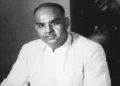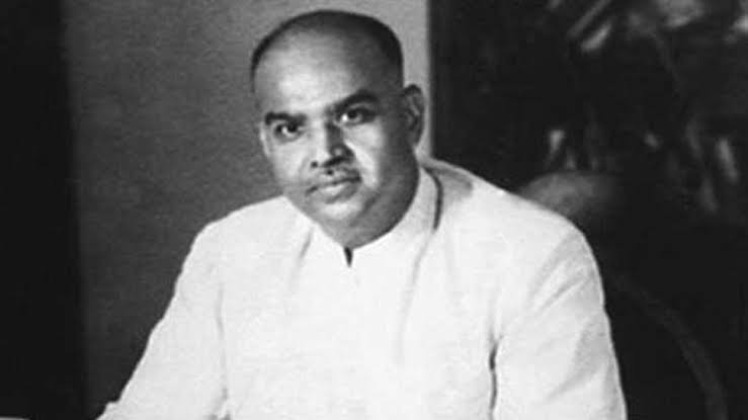
Dr Syama Prasad Mookerjee was born in Calcutta on July 6, 1901. His father was Sir Ashutosh Mookerjee and was a well-known educationist. His mother’s name was Jogamaya Debi. Uma Prasad Mukhopadhyay was his younger brother. Mookerjee did his matriculation in 1917 and received his B.A. In 1921. Then he did an M.A. in Bengali and passed it with first division. After acquiring the law degree in 1923, he went abroad and returned home as a barrister from England in 1926. After his father’s death in 1924, he registered for advocacy in the Calcutta high court.
Following his father, he too had achieved remarkable successes in the field of education at a young age. At the young age of 33, he became the vice-chancellor of Calcutta University. He was the youngest vice-chancellor to be appointed to the post. Dr Mookerjee continued in this post till 1938.
In 1937, he invited Guru Rabindranath Tagore to speak in Bengali at the convocation of Calcutta University. It was the first time in the history of any university in Bharat that someone has delivered a convocation speech in a Bharatiya language.
As An Educationist
Dr Mookerjee was Vice-Chancellor, University of Calcutta, for two successive terms-1934-38. He was President of Postgraduate Councils in Arts and Science for successive years, Dean of the Faculty of Arts, Member and then Chairman, Inter-University Board. During the four years of his service as the Vice-Chancellor, Syama Prasad did not spare time, energy, health, convenience or anything worth having in life; where they stood in the way of the performance of what he considered his duty and this he did against the advice of his doctors. He initiated certain new departments and courses and developed and improved existing ones. His contributions as Vice-Chancellor may be summed up as hereunder:
(I) Without any encouragement from the Government of the day he put into effect a scheme for agricultural education and introduced the diploma course in Agriculture. He was deeply interested in women’s education and implemented noteworthy scheme with the endowment of late Viharilal Mitra.
(II)the organization of the Teacher’s Training Department and the introduction of short term training courses including a vacation course to provide trained teachers for our schools; the establishment of Chinese and Tibetan studies; the foundation of the Asutosh Museum of Indian Art and Fine Arts Gallery; the work of archaeological excavations undertaken by the University; the establishment of the Appointment and Information Board: the construction of the new Central Library Hall with research and reading room facilities on modern lines. Introduction of Hindi in the B.A course and of Honors courses in Bengali, Hindi and Urdu as second languages — these were some of his achievements.
(III)At his instance, a Bengali Paribhasa of scientific terms was prepared and published and a special scheme for training students for public services examination was put through.
(IV)A special series of Bengali publications in different branches of knowledge was undertaken. The series was intended for the benefit of students and general readers. Bengali spellings were standardized on his initiative.
(V)The college code was formulated for the first time during his Vice-Chancellorship and the new Matriculation Regulations were framed and the age restriction of students was abolished.
(VI)The systems of compartmental examinations and concessions to failed students for appearing at examinations without getting themselves admitted into colleges, were introduced during the tenure of his office.
(VII)The question of giving military training to students engaged his serious attention and in spite of discouraging factors, he succeeded in initiating military training course in our scheme of studies. This was no mean achievement in the days when he was Vice-Chancellor.
(VIII)The welfare of the younger generation and of the country at large was the ideal he set before himself and with single-minded devotion he laboured hard to attain it. To this end he took step to improve and expand the Student’s Welfare Department for the promotion of the physical health of our pupils and abolished hostels reserved for students coming from the so called backward class providing accommodation for them in the general hostels and messes attached to colleges. Primarily intended to create the spirit of brotherhood among them. Syama Prasad saw the special reduced seat-rents were charged from them.
(IX)It was during his Vice-Chancellorship that the University Foundation Day (i.e. January 24) was celebrated every year. Students of different colleges attended the ceremony with banners and badges and teachers of colleges and schools also attended it. This was an attempt at bringing teachers and students into closer personal relationship.
(X)During his time, a scheme was initiated in the Applied Chemistry department for imparting training in largescale production of certain industrial goods.
(XI)Invited Rabindranath Tagore to give Convocation Address in Bengali in 1937, for the first time.
Excerpts from his convocation addresses:
Speech delivered at Patna University Convocation on 27th November 1937: In India also, for century, education imparted through the medium of a foreign language has unduly dominated its academic life and it has now produced a class of men who are unconsciously so denationalised that any far reaching proposal for the recognition of the Indian languages as the vehicle of teaching and examination up to the highest University stage is either ridiculed as impossible or branded as reactionary.
But I plead earnestly for the acceptance of this fundamental principle not on account of any blind adherence to things that I claim as my own but out of a firm conviction that the fullest development of the mind of a learner is possible only by this natural approach and also that by this process alone can there be a great revival of the glory and richness of the Indian languages.
Speech delivered at Agra University Convocation on 23rd November 1940: Political and social justice requires, not the disintegration of a country and destruction or humiliation of a class which shows initiative, intelligence and drive, but equality of opportunity for all, genuine freedom for self-fulfilment, in which all men irrespective of caste or creed may share.
Speech delivered at Benaras Hindu University Convocation on 1st December 1940: A nation that fails to take pride in its past achievements or to take inspiration therefrom, can never build up the present or plan for the future. A weak nation can never attain greatness.
(Dr.Syama Prasad Mookerjee Quoted from Talreja, K. M. (2000). Holy Vedas and Holy Bible: A comparative study. New Delhi: Rashtriya Chetana Sangathan) Generally speaking, an Indian university must regard itself as one of the living organs of national reconstruction. It must discover the best means of blending together both the spiritual and the material aspects of life. It must equip its alumni irrespective of caste, creed or sex, with individual fitness, not for its own sake, not for merely adorning varied occupations and professions, but in order to teach them how to merge their individuality in the common cause of advancing the progress and prosperity of their motherland and upholding the highest traditions of human civilisation.
Speech delivered at Nagpur University Convocation on 5th December 1936: I would also ask you to fulfil in an abundant measure your obligation for the revival of the glory of Hindu culture and civilisation, not from a narrow or bigoted point of view but for strengthening the very root of nationalism in this country. In this great land of ours where twenty-eight crores of Hindus live, the word Hindu sometimes stinks in the nostrils of many a son of India.