While underlining India’s position that dialogue is the only solution to the Ukraine conflict, PM Narendra Modi, on 02 May 22, sought to soothe frayed nerves in Europe. After the 6th India-Germany inter-governmental consultations that he chaired with Chancellor Olaf Scholz, PM Modi said that nobody was going to win the Ukraine war, and all would suffer losses.
Some experts predicted that Russia, with cruise missiles, EW, PGMs, hypersonics and stealth fighters would start with a Gulf War-style’ Desert Storm’ overwhelming air campaign to destroy the Ukrainian air force on the ground and hit air defence and command centres before committing its ground forces.
Instead, Russian generals neglected logistics and attempted to initially perform 2003 Iraqi Freedom-style’ Thunder Runs’ to seize major objectives without first achieving air superiority. This was a very costly mistake.
Russian Air Force
The reluctance of Russia to use air force after a few days is perplexing as the establishment of air superiority, or at least a favourable air situation is required for successful ground operations. Russia could have conducted speedy ground operations by using more air force.
The air force was not used so as to avoid collateral damage to civilian areas due to Russian overconfidence, caution to preserve the air force for later use against NATO and the effective Ukrainian air defence.
Russian and Ukrainian air missions and sortie generation are not known. Possibly both sides are not willing to take risks with their aircraft or pilots.
Air Force Comparison
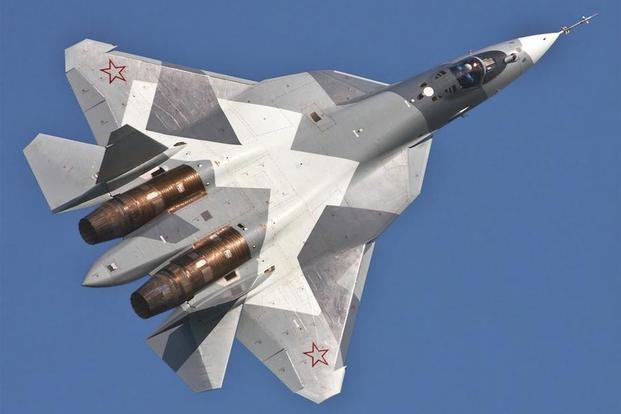
Despite its massive superiority in combat aircraft (300+ combat aircraft vs Ukraine’s less than 100), Russia’s air force has been conspicuously absent in the air. Only now, larger strike packages of Su-30 and Su-34s are being assembled. This is a far cry from the US/Western airpower doctrine, which stresses large packages of the strike, and escorts to overwhelm the enemy on Day 1 of the air campaign.
Before the crisis, the Ukrainian AF had observed training in dispersed operations from road bases. This, and the difficulty of shutting down airbases completely, has assisted the Ukr AF to remain operational against a much larger Russian Air Force.
Nine weeks into the Russia-Ukraine war, the mismatch between the air forces of the two sides is becoming more evident. Ukrainian fighters are facing issues such as fewer and older planes, more vulnerable bases, and pilot shortages. Ukraine’s fighter pilots are exposed to greater risk due to older missiles that require constant guidance.
The Ukrainian Air force is confining itself into air defence mode and sneak raids by its aircraft and drones.
As the offensive progresses into the ninth week, there are signs of greater use of Unmanned Aerial Vehicles (UAVs) and drones by Russia.
Airborne, Heliborne Operations and Special Forces
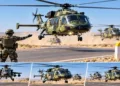
There was a Russian daring helicopter-borne assault on Gostomel Airport outside Kyiv, the home of Antonov Aircraft and the giant An 225 transporter. The capture of the Gostomel airfield in the early stages would have helped to support the airborne forces in Kyiv and create an air bridge to sustain follow-on operations by the ground forces.
In this operation, 6-7 helicopters were shot down in an opposed landing, along with two of the latest Ka-52 attack helicopters. The special forces involved in this aerial bridgehead were then repulsed, causing 18- Il-76s with the main force to abort their flight and turn back to base. Despite this setback, the Russians attempted another air assault. This time, it reportedly lost two Il-76s in the process–one shot down by a Ukrainian Su-27 fighter. Both these aircraft were full of paratroopers. Almost 300 elite troops may have died in these Operations–a high price that illustrates the danger of operating military transport air crafts in contested airspace.
Conducting heliborne operations without air supremacy was a risky operation and not successful. The drop zones were located at a large distance from the ground forces, and they could not link up.
Employment of Drones
Poor intelligence and military casualties were the reasons for Russia’s slow progress. Among the many potential explanations, one is that the Russian army lacked Intelligence, Surveillance & Reconnaissance (ISR) assets such as light drones, or the assets that couldn’t keep up with the tanks due to Ukraine’s anti-drone tactics, air defences and electronic warfare networks. The lack of drones has highlighted a key vulnerability in Russia’s military operation. According to the images available in Open-Source Intelligence, Russian ISR drones tracked Ukraine’s BM-21 to their concealed hide and destroyed the BM-21 battery.
The Ukrainian military was using counter-UAV systems during the heavy fighting around Mariupol. Ukrainian military used its Turkish-made TB2 combat drones to strike Russian convoys in the initial stages, but now their use by Ukraine has gone down due to attrition and limited numbers.
Long-Range Missiles vs Airpower
Russia has used long-range fires of its Kalibr (Caliber) cruise missiles, Iskander ballistic missiles and MBRLs (Multiple Barrel Rocket Launchers) such as Soviet Grad (Hail), Smerch (Tornado) and Uragan (Hurricane) multiple rocket launchers throughout the campaign.
This has partly compensated for its little use of air force and reinforced the usefulness of missiles and rockets in future wars vis-à-vis air force, which is costly, and aircraft losses are bad news and economic loss.
Russia has used its Kinzhal hypersonic missiles in Ukraine for the first time. This points to the limited availability of precision munitions and their selective usage on High-Value Targets by Russia.
On the Ukrainian side, the failure to counter Russian long-range missiles reflects the need for not only a robust missile shield for a defender but also a capable of ballistic surveillance missile acquisition systems.
Conduct of Air Defence
Russia has targeted Ukrainian ground-based static air defence systems with ballistic and cruise missiles, anti-radiation missiles and using unguided weapons. However, Ukraine’s mobile-based air defence systems still seem to be active. This is an advantage with mobile air defence systems as it is difficult to locate and destroy them. A timely tactical intelligence and the use of more precision ammunition by Russia would have achieved better results when targeting Ukrainian mobile air defence systems.
A disadvantage of a mobile system is that it may not be fully integrated into the overall air defence architecture. Air defence assets such as Man-portable air-defence systems -Stingers and lately the sophisticated New Generation Light Anti-tank Weapon and Javelin systems supplied by the US and the West are being operated by Ukrainian troops, including militia. In the absence of a credible integrated Identification Friend or Foe, Ukrainian pilots too would be susceptible to them.
Battlefield Transparency
The availability of Smartphones has given every patriotic citizen the capability to act as an important surveillance element in captured areas, as is being done by Ukrainians. In modern warfare, there are no surprise and deception except for timings and intentions, as the battlefield is under watch with advanced ISR systems. Therefore, ground forces need to reorient and train themselves to fight on a transparent battlefield.
Lessons For India
It is obvious that Russia overestimated its military capability and underestimated that of Ukraine. Russia’s military hierarchy has failed to give honest and objective advice to President Putin.
The time has come for Indian military leaders to provide the country’s political leadership with a clear-eyed appraisal of India’s military preparedness.
The Indian Air Force will also have to revise its tactics in the era of shoulder-fired Anti-aircraft and anti-tank missiles and stand-off weapons.
The Indian Army relies on Russian tanks, artillery, rockets, and ammunition with the Russian Su-30 MKI forming the backbone of the Indian Air Force. The Ukraine war really shows that the era of low-tech war as waged in World War II is over as it only led to a long war of attrition with no clear cut winners.
Investing in a dedicated Suppression/Destruction of Enemy Air Defence Organisation with dedicated platforms for dynamic targeting and IFF, be it air force, smart ammunition, soft kill technology, damage assessment means, or low-cost assets such as drones is a must.
An important lesson is the successful use of technology in employing drones, loitering ammunition, man-portable stinger missiles, and more. We need to invest more in high technology.
The handheld portable air defence systems and handheld anti-tank weapon systems deployed in large numbers have proved to be very effective and have been able to deter superior air force and powerful armoured columns. A Ukrainian commented, “If Russians have more tanks, we have more anti-tank weapons.”
Poor leadership and quality of soldiers have been the bane of the Russian military in Ukraine. Despite the best technology available, its largely conscripted soldiers lack the discipline, motivation, and quality training to perform in battle. Ukraine has made better use of a similar system with higher motivation and better training.
Future wars will also be fought with indigenous weapons and equipment. We have to, therefore, make ourselves self-reliant. Atmanirbharta in defence requirements is the need of the hour.
The biggest takeaway for us is that when the chips are down, you have to be prepared to fight your battles alone. The US may be a strategic ally and Russia a trusted partner, but no one will fight our battles with China if we are pushed to it.
In view of aggressive China, India needs space and time to focus its resources and consolidate its military modernisation.
All this leads to a need for us to develop capabilities across the full spectrum of conflict and focus on multi-domain operations. Similarly, our doctrines, equipment, training and tactics will have to be flexible and able to adapt rapidly to these new challenges.