
Electric vehicles: Present day problems, solutions and issues ahead
August 25, 2026
  • Read Ecopy
  • Circulation
  • Advertise
  • Careers
  • About Us
  • Contact Us
Android AppiPhone AppArattai
Organiser
  • ‌
  • Bharat
    • Assam
    • Bihar
    • Chhattisgarh
    • Jharkhand
    • Maharashtra
    • View All States
  • World
    • Asia
    • Europe
    • North America
    • South America
    • Africa
    • Australia
  • Editorial
  • International
  • Opinion
  • RSS @ 100
  • More
    • Op Sindoor
    • Analysis
    • Sports
    • Defence
    • Politics
    • Business
    • Economy
    • Culture
    • Special Report
    • Sci & Tech
    • Entertainment
    • G20
    • Azadi Ka Amrit Mahotsav
    • Vocal4Local
    • Web Stories
    • Education
    • Employment
    • Books
    • Interviews
    • Travel
    • Law
    • Health
    • Obituary
  • Subscribe
    • Subscribe Print Edition
    • Subscribe Ecopy
    • Read Ecopy
  • ‌
  • Bharat
    • Assam
    • Bihar
    • Chhattisgarh
    • Jharkhand
    • Maharashtra
    • View All States
  • World
    • Asia
    • Europe
    • North America
    • South America
    • Africa
    • Australia
  • Editorial
  • International
  • Opinion
  • RSS @ 100
  • More
    • Op Sindoor
    • Analysis
    • Sports
    • Defence
    • Politics
    • Business
    • Economy
    • Culture
    • Special Report
    • Sci & Tech
    • Entertainment
    • G20
    • Azadi Ka Amrit Mahotsav
    • Vocal4Local
    • Web Stories
    • Education
    • Employment
    • Books
    • Interviews
    • Travel
    • Law
    • Health
    • Obituary
  • Subscribe
    • Subscribe Print Edition
    • Subscribe Ecopy
    • Read Ecopy
Organiser
  • Home
  • Bharat
  • World
  • Operation Sindoor
  • Editorial
  • Analysis
  • Opinion
  • Culture
  • Defence
  • International Edition
  • RSS @ 100
  • Magazine
  • Read Ecopy
Home Opinion

Electric vehicles: Present day problems, solutions and issues ahead

NITI Aayog and Rocky Mountain Institute predict that by 2030, 80% of two- and three-wheelers and 50% of the country's four-wheelers will be electric vehicles.

Dr. C. Vasu ReddyDr. C. Vasu Reddy
Apr 28, 2022, 04:51 pm IST
inOpinion
Follow on Google News
Representative Image

Representative Image

Facebook
Twitter
WhatsAppTelegramEmail

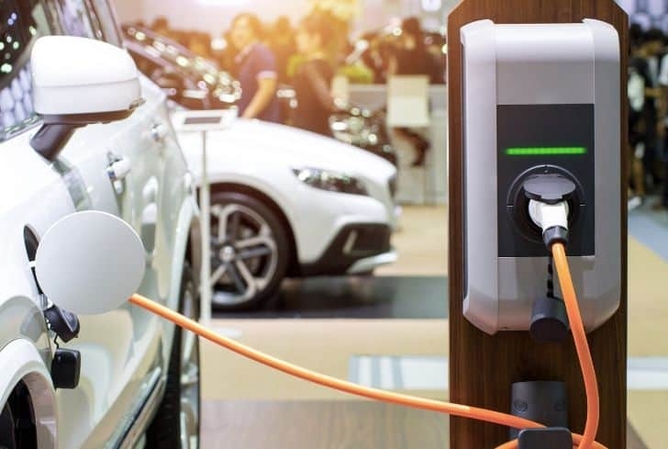
With the increasing demand for crude oil and rising prices, it has become necessary to look for alternate energy sources, and this search led to the development of EVs worldwide. With the established and routine use of electric four-wheelers now, it has extended to the manufacturing of 2 wheelers. The central government, apart from providing subsidies to the EV manufacturers and buyers, thought of the difficulty faced by the users in getting them charged. Apart from the increasing number of charging stations in the coming future, with the increased number of vehicles, it may be difficult in cities to provide a place for charging stations for so many vehicles. In last August 2021, the government gave the option for the manufacturers to manufacture two-wheeler EVs with or without batteries. During this fiscal 2022-23 budget, a new Battery swapping policy has been introduced to reduce the cost of EVs and quick replacement of batteries, thereby promoting their usage. Few states in India are providing subsidies and incentives for battery swapping stations. Various companies which have come forward to establish these stations are Sunmobility, ChargeUp, Lithion power, Reliance-British BP joint venture and Hero MotoCorp with Taiwan’s Gorgo. With NITI Aayog and Rocky Mountain Institute’s prediction that by 2030, 80% of two- and three-wheelers and 50% of the country’s four-wheelers will be electric vehicles. Hence, it becomes necessary to develop safety and protective measures.

Types of batteries

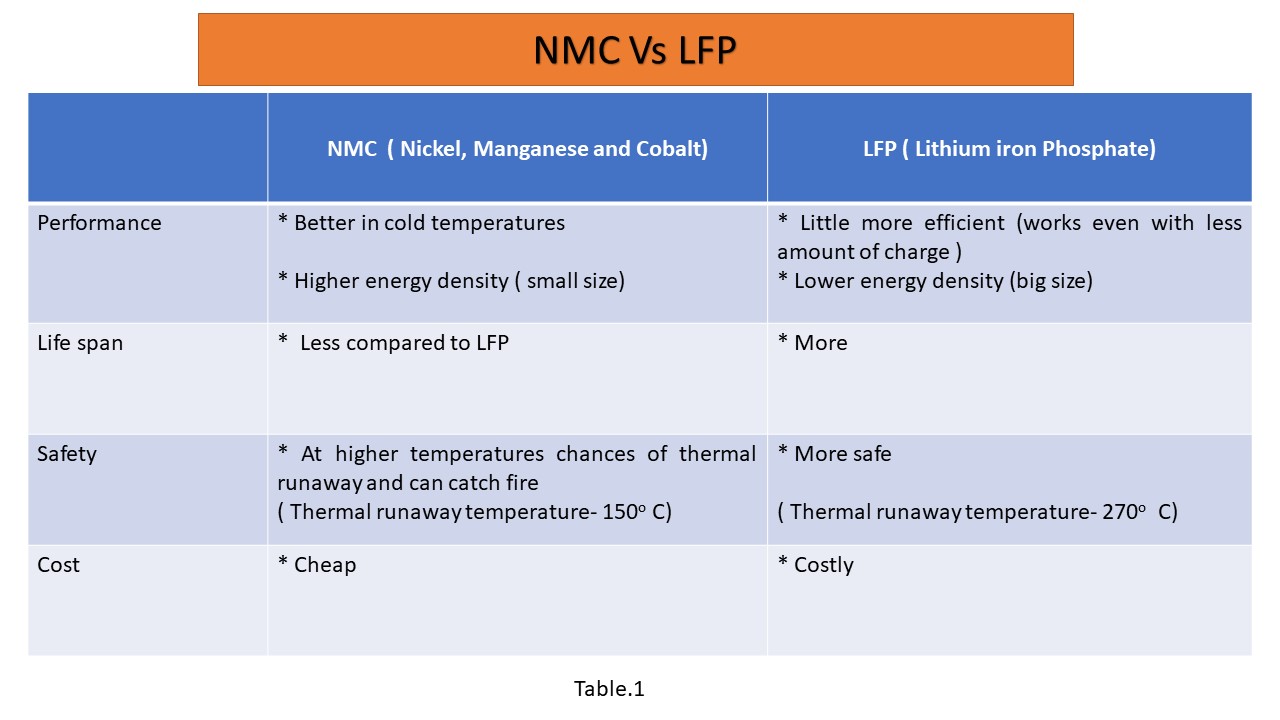
Lithium batteries are used for EVs instead of lead batteries due to its high specific charge density (lasts longer and stores more energy) and huge voltage (3- 3.5 Volts /battery). In Lithium-ion batteries, there are two types–traditional Li-NMC batteries, where the cathode is a mixture of NMC (Nickle, Manganese and cobalt) and LFP (Lithium Iron phosphate), where the cathode is LiFePo4 (Lithium Iron Phosphate). The difference between the two types of lithium batteries is explained below in Table.1.
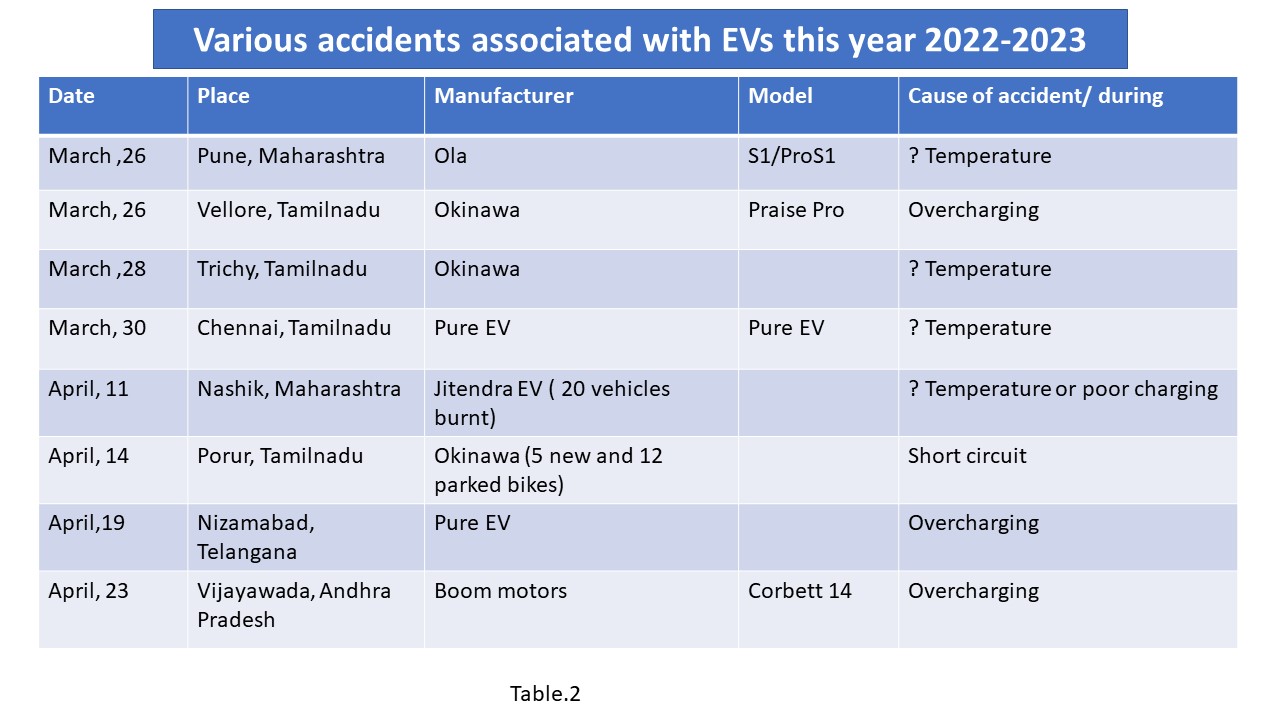
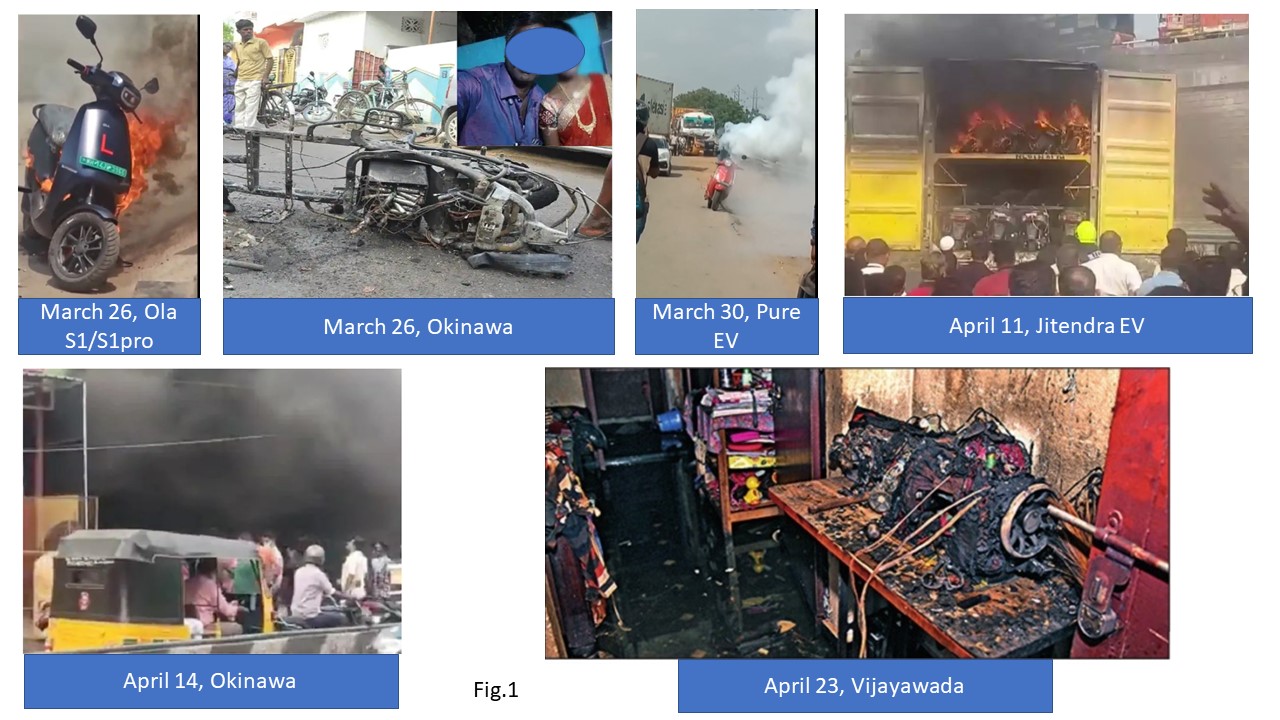
In this annum, nearly ten accidents have occurred (Fig.1 & Table.2). With the government providing subsidies and incentives, many start-up companies have come forward with most of the batteries imported from other nations. The market of EVs has risen threefold, with 1,34,821 units sold in fiscal 2020-21 to nearly 4,29,417 units being sold in the 2021-22 fiscal year. The various reasons proposed for the increased accidents are described below:

1. Poor quality of cell design: Each battery of lithium-ion contains nearly 100-200 cells. If they are not packed properly, the anode, cathode and the separator may come into contact leading to a short circuit.

2. Poor battery design: Here, the insulation may not be proper, and the wires may not be connected properly, leading to a short circuit.

3. Cheap quality BMS (Battery Management system): whenever the battery gets heated up, there should be a system within it to sense and start countermeasures to cool up the system. If an efficient BMS is lacking, it leads to short circuits and fire accidents.

4. Smart management system and thermal management system: In a smart management system, not only the temperature of the battery but the temperature of every cell is kept under surveillance, and any rise in temperatures is countered by a thermal or active cooling system where fans are activated around the battery to cool the system.
Measures to be taken while purchasing and maintenance of the EVs

1. Don’t expose the EVs to extreme hot or cold temperatures

2. Use original and authorised charges

3. Keep batteries away from inflammable elements

4. Store batteries at room temperature only

5. Check whether batteries are getting overheated

6. Don’t charge the battery to 100% or allow to discharge to less than 20%, try to maintain charge between 20-80%

7. While purchasing EVs, purchase battery from authorised dealers only

8. Check whether EVs and battery are certified by ARAI (Automotive Research Association of India)

9. Check whether the battery is of AIS 156 standard

Government actions

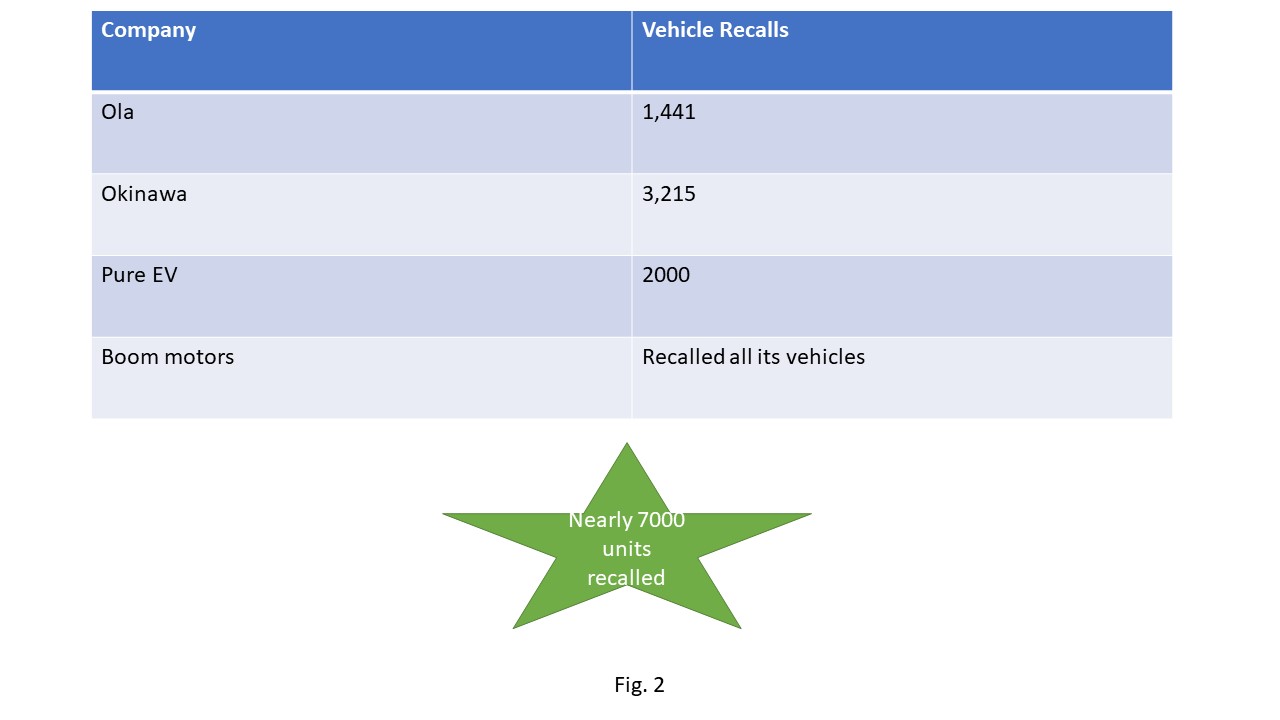
As soon as the accident occurred on March 26, MoRTH has ordered for investigation by the Centre for Fire, Explosive and Environment Safety (CFEES), an agency under DRDO. Also, the government has asked original equipment manufacturers to recall the vehicles and check for any defaults. As a result, around 7000 vehicles have been recalled by various companies (Fig.2). Also, the government is trying to develop new testing norms for batteries, cells and management systems. Alternate energy sources like the green hydrogen batteries are in the investigative phase.
Conclusion

It becomes necessary for every customer to look into the batteries and go for the premium ones which fit into the standards described rather than running for cheaper ones. LFP batteries are to be preferred in place of NMC batteries. Better BMS with superior intelligence which can act at the right time during raised temperatures. By proper checking on software and hardware systems in the batteries and with proper precautions, we need to move further in utilising the EVs.

Topics: IndiaEVSunmobilityChargeUpLithion powerHero MotoCorpTaiwan's GorgoNITI AayogRocky Mountain Institute
Share
Tweet
SendShareSend
✮ Subscribe Organiser YouTube Channel. ✮
✮ Join Organiser's WhatsApp channel for Nationalist views beyond the news. ✮
Previous News

Prime Minister Narendra Modi, Ratan Tata inaugurate 7 state-of-the-art cancer hospitals in Assam

Next News

CISF vehicle attack in J-K: MHA hands over the case to NIA

Related News

Russian President Vladimir Putin and External Affairs Minister Dr. S. Jaishankar

EAM Jaishankar meets Russian President Putin & briefs bilateral developments; Extends PM Modi’s invite to BRICS Summit

Commerce & Industry Minister Piyush Goyal meets business leaders in Japan

Piyush Goyal leads India’s biggest business delegation to Japan; Pitches deeper ties in infra, energy & frontier tech

Israeli Prime Minister Benjamin Netanyahu,Prime Minister Narendra Modi, Turkish President Recep Tayyip Erdogan

Turkey Targets India in Israel Row: Ankara casts New Delhi as part of a wider strategic challenge to its interests

India’s Semiconductor Revolution: Building the ecosystem to lead the global chip race

Governor Nagasaki and his team with UP CM Yogi Adityanath

UP-Japan Partnership: A resolve taken in Yamanashi now takes shape in Uttar Pradesh

MEA Spokesperson Randhir Jaiswal slams Pakistan

MEA calls removal of barricade outside Pakistan High Commission as proportionate action; Hails J&K as integral to India

Load More

Latest News

Russian President Vladimir Putin and External Affairs Minister Dr. S. Jaishankar

EAM Jaishankar meets Russian President Putin & briefs bilateral developments; Extends PM Modi’s invite to BRICS Summit

Tamil Nadu Assembly

Tamil Nadu: TVK govt drops Parandur airport project, announces free bus travel and LPG cylinders

From students voice to political instrument?

PM addressing the Nation on the occasion of 80th Independence Day celebrations at Red Fort, in Delhi on August 15, 2026.

80th Independence Day Address of PM Modi: Walking the difficult path confidently

Representative Image

Beyond ‘Gen Z’: Why Bharat must reclaim its younger generation through ‘Samvad’ and ‘Kutumb Prabodhan’

JeM headquarters rebuilt in Bahawalpur, Pakistan

Pakistan: Destroyed in Operation Sindoor, JeM base rebuilt in 15 months; Exposes Islamabad’s eternal terror nexus

Dimagi Naxals: Decoding the cognitive virus

“A result of a gang war”: Former Envoy to Canada Sanjay Verma on Goldy Brar’s purported claim of hand in Nijjar killing

Tamil Nadu: Tirunelveli POCSO court awards death sentence to church pastor Abraham, for sexually assaulting minor girls

AI Generated Image

West Asia: 20,000+ Pakistanis deported; Gulf countries flag illegal entry, drug trafficking & national security threat

Load More
  • Privacy
  • Terms
  • Cookie Policy
  • Refund and Cancellation
  • Delivery and Shipping

© Bharat Prakashan (Delhi) Limited.
Tech-enabled by Ananthapuri Technologies

  • Home
  • Search Organiser
  • Bharat
    • Assam
    • Bihar
    • Chhattisgarh
    • Jharkhand
    • Maharashtra
    • View All States
  • World
    • Asia
    • Africa
    • North America
    • South America
    • Europe
    • Australia
  • Editorial
  • Operation Sindoor
  • Opinion
  • Analysis
  • Defence
  • Culture
  • Sports
  • Business
  • RSS @ 100
  • Entertainment
  • More ..
    • Sci & Tech
    • Vocal4Local
    • Special Report
    • Education
    • Employment
    • Books
    • Interviews
    • Travel
    • Health
    • Politics
    • Law
    • Economy
    • Obituary
  • Subscribe Magazine
  • Read Ecopy
  • Advertise
  • Circulation
  • Careers
  • About Us
  • Contact Us
  • Policies & Terms
    • Privacy Policy
    • Cookie Policy
    • Refund and Cancellation
    • Terms of Use

© Bharat Prakashan (Delhi) Limited.
Tech-enabled by Ananthapuri Technologies