Amidst controversy over the use of temple gold to deal with the COVID-19 pandemic, there is a solid mounting demand to free the Hindu religious trusts from Government supervision, just like Muslim, Sikh and Christian religious places. The Haryana Government has recently attempted to acquire the Chandi Mata Temple and the Durga Mata Temple at Banbhuri village in Hisar district. In Beri (Jhajjar district), the Government made a similar decision to acquire the temple, which was withdrawn after fiery protests from the local Hindus and the members of Vishva Hindu Parishad (VHP). RSS Sarsanghchalak Dr Mohan Bhagwat too has raised concerns over the sorry state of temples in the country during his annual Vijayadashami address. He said, “The operating rights of temples must be handed over to Hindus and its wealth be utilised for the welfare of the Hindu community only. The temples of South India are fully controlled by the State Governments, while in the rest of the country some are managed by the Government, some others by devotees. The wealth of Hindu temples is used for non-Hindus—who have no faith in Hindu Gods. Even Hindus need it, but it is not used for them.”
To a layman, all places of worship, be it temples, mosque, gurudwara or church under Government-control wouldn’t be a problem, but if you are a firm believer in constitutional values, this fact is very much troubling to you that out of all communities, only Hindus are not allowed to be incharge of their temples. Why can all communities manage their religious affairs but not one community, which is the majority community?
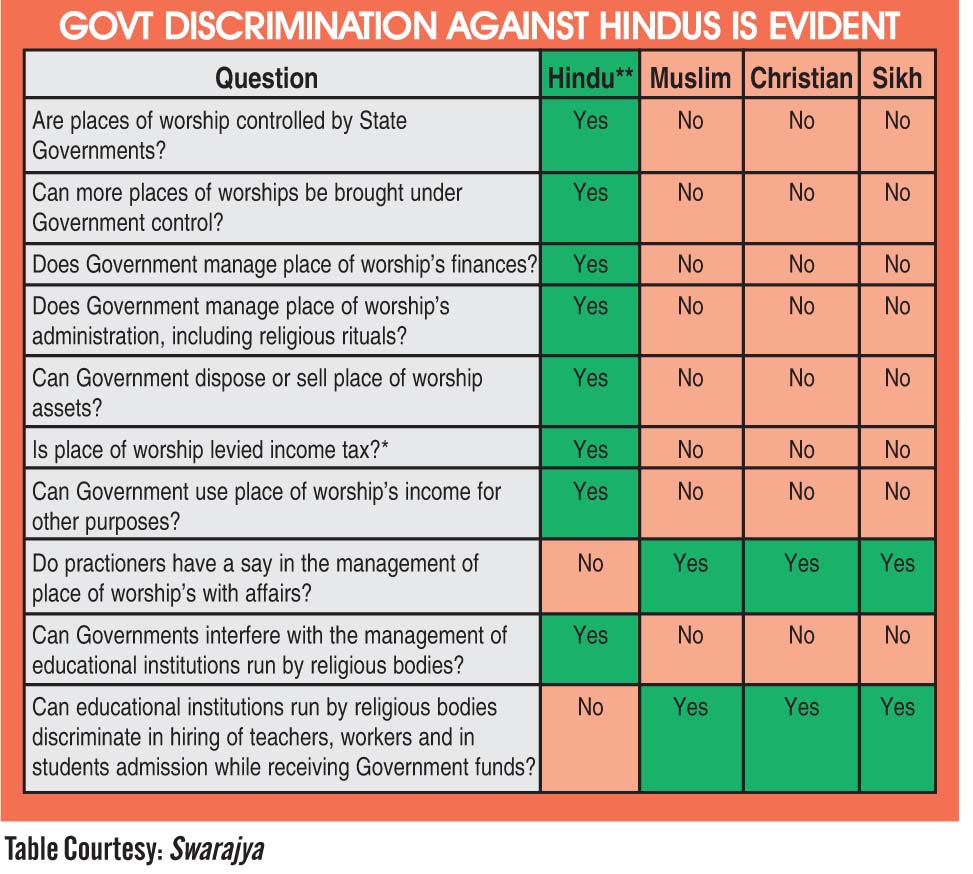
Article 26 of our Constitution provides people of all religions the Fundamental Right to practice their religion the way they want and manage their religious institutions. But Hindu Religious and Charitable Endowment (HRCE) act is draconian in nature. Despite a fundamental right of the believers, various State governments are exercising their financial and management control over a hundred thousand temples through their respective HR & CE Acts. Doesn’t that amount to blatant discrimination against Hindu temples?
The question arises why Hindu temples are under Government-control while places of worship of other Indian communities are free from Government clutches. There’s a long history to this. In old times, Hindu temples in North India were managed by Mahants, while South Indian temples were largely under the patronage of the kings. In 1817, the East India Company took over the temples in accordance with the first Madras regulation. To them, temples meant wealth—-land, gold, diamonds etc. They knew that if they could control temples, it would be easy to rule India. Then in 1840, Christian missionaries raised their voice that it was disgraceful for Christians to manage Pagan temples. So a directive was issued to set the Hindu temples free. But by then, enough of gold and diamond had been looted.

In the early 1920s, Britishers realised that temples were becoming the centres of catalysing the freedom movements, so the Madras Religious and Charitable Endowments Act brought them under Government Control. Since the minority communities strongly protested, their places of worship were released, except the Hindu temples. Hindu Religious Endowments Act, 1926, later modified to The Hindu Religious and Charitable Endowments (HR&CE) Act, 1951, allows the State Governments to take over temples and have complete control over their assets and properties. This act also empowers State Governments to appoint temple boards to look after their finances.
After Independence, the Government of India continued the ‘status quo’ as with most of the other borrowed systems from the British era. In Tamil Nadu, the HR & CE Act was implemented to govern the temples. Tamil Nadu and Karnataka are mainly to be mentioned because these two States have the maximum number of temples in India.

Hindu Religious Institutions and Charitable Endowments Act of 1997 says that all the revenue generated by the temple will go to the Government. And what gets spent for the temple maintenance or development is entirely left to their whims and fancies and it is the prerogative of the Govt to decide how much of this revenue will be returned to the temples for their maintenance.
Gradually, secularism came into play, and the funds donated to temples by devotees were used for all kinds of schemes and projects driven by appeasement politics. Often, only a small percentage of the revenues collected by the State Governments is spent on temple management and the remaining is not adequately utilised. It is amply clear the rules are not the same for all religious institutions. Temples have been singled out for milking out funds. This is not fair at all in a secular nation. It is bizarre that all this applies to Hindu places of worship alone. None of it applies to mosques, churches or gurudwaras, who have their religious boards to manage their places of worship.
State Governments are free to use the money generated by a temple (donations, income from assets etc.) for purposes that have absolutely nothing to do not just with the temple but also with Hindus or Hinduism. How bizarre! And unfair.
This is so unfair and heartbreaking that hard-earned money of devotees taken from temples in the name of development doesn’t even benefit the community from which it is taken. Temples are crumbling, priests are impoverished, and there’s an irreparable loss to heritage from several millennia ago, leaving even the UNESCO officials shocked. There are several serious charges of corruption, mismanagement of temples and defalcation.

Most temples now have no revenue for their upkeep and continue to languish in dilapidated state, causing much pain and anguish to the Hindu community.
The mismanagement of temple funds is so prevalent and rampant that last year, the Government of Tamil Nadu submitted a report to the Madras High Court stating that in 11,999 temples in the State, there is no pooja or ritual taking place as there is lack of funds. In 34,000 temples, there is only one person to manage all the affairs of the space. While thirty seven thousand temples record a revenue less than Rs 10,000 per annum. Currently, 44,000 temples with over half a million acres of land are under the management of the Government of Tamil Nadu. However, the revenue from all this is only Rs 128 crore per annum.
In comparison, the Shiromani Gurdwara Parbandhak Committee has 85 Gurdwaras in their hands, but their budget is over Rs 1,000 crore. For 44,000 temples that belong to a community comprising 87 per cent of the population, a revenue of Rs 128 crore smacks of abysmal mismanagement, says Sadhguru Jaggi Vasudev, an ardent supporter of the “Free Hindu Temples” movement.
Those opposing the movement of ‘free Hindu temples’ argue that if temples are given back to the Hindu community, they may not be managing them in a corruption-free manner. But this claim has no substance. If temples are left to the devotees, they will manage them in a much better, transparent and vibrant way.
The Supreme Court, too in at least three landmark judgments, has asked State Governments to hand over religious institutions to the community. The Supreme Court said that governments can take over temples for administrative purposes only. But the reality is different. Financial control of temples too lies with the respective State Governments.
This is so unfair and heartbreaking that hard-earned money of devotees taken from temples in the name of development doesn’t even benefit the community from which it is taken. Temples are crumbling, priests are impoverished, and there’s an irreparable loss to heritage from several millennia ago, leaving even the UNESCO officials shocked
If India is a “secular” country in a true sense where the State should be officially neutral in religion, then what business does the State apparatus have in trying to control religious affairs? And if a secular State should control religious institutions, then why not churches and mosques too?
The secular fabric of our nation doesn’t allow the State to manage religious institutions still at least 15 State Governments control over 4 lakh out of an estimated 9 lakh temples across the country. However, there is no such control over Muslim and Christian religious bodies. So “The HRCE Act 1951” allows the State Governments to take complete control over temples and their assets.
Targeting only Hindu religious institutions in the name of secularism has given rise to widespread resentment, animosity and anguish among in the majority community. Hindu temples have much more than other places of worship. But that does not mean in the name of secularism their educational, financial and other activities can be controlled by the State.
It’s high time that the Government makes right the historical wrongs.