Vedic literature and Bhagavad Gita: Connecting The World Through The Indian Way
December 7, 2025
  • Read Ecopy
  • Circulation
  • Advertise
  • Careers
  • About Us
  • Contact Us
Android AppiPhone AppArattai
Organiser
  • ‌
  • Bharat
    • Assam
    • Bihar
    • Chhattisgarh
    • Jharkhand
    • Maharashtra
    • View All States
  • World
    • Asia
    • Europe
    • North America
    • South America
    • Africa
    • Australia
  • Editorial
  • International
  • Opinion
  • RSS @ 100
  • More
    • Op Sindoor
    • Analysis
    • Sports
    • Defence
    • Politics
    • Business
    • Economy
    • Culture
    • Special Report
    • Sci & Tech
    • Entertainment
    • G20
    • Azadi Ka Amrit Mahotsav
    • Vocal4Local
    • Web Stories
    • Education
    • Employment
    • Books
    • Interviews
    • Travel
    • Law
    • Health
    • Obituary
  • Subscribe
    • Subscribe Print Edition
    • Subscribe Ecopy
    • Read Ecopy
  • ‌
  • Bharat
    • Assam
    • Bihar
    • Chhattisgarh
    • Jharkhand
    • Maharashtra
    • View All States
  • World
    • Asia
    • Europe
    • North America
    • South America
    • Africa
    • Australia
  • Editorial
  • International
  • Opinion
  • RSS @ 100
  • More
    • Op Sindoor
    • Analysis
    • Sports
    • Defence
    • Politics
    • Business
    • Economy
    • Culture
    • Special Report
    • Sci & Tech
    • Entertainment
    • G20
    • Azadi Ka Amrit Mahotsav
    • Vocal4Local
    • Web Stories
    • Education
    • Employment
    • Books
    • Interviews
    • Travel
    • Law
    • Health
    • Obituary
  • Subscribe
    • Subscribe Print Edition
    • Subscribe Ecopy
    • Read Ecopy
Organiser
  • Home
  • Bharat
  • World
  • Operation Sindoor
  • Editorial
  • Analysis
  • Opinion
  • Culture
  • Defence
  • International Edition
  • RSS @ 100
  • Magazine
  • Read Ecopy
Home Analysis

Vedic literature and Bhagavad Gita: Connecting The World Through The Indian Way

WEBDESKWEBDESK
Aug 23, 2021, 09:38 am IST
in Analysis
Follow on Google News
FacebookTwitterWhatsAppTelegramEmail

                                                                                                                                                                                                   Pankaj Jayaswal


The Vedic literature and Bhagavad Gita assures us on the path of wisdom inculcating human values, growing materially and spiritually in all dimensions of life, nurturing environment. 


We have seen a tremendous change in the life and lifestyle of everyone in the last few decades. The–advancements in technology with automated machines, vehicles, computers and information technology-based equipment and software have given a new dimension to life. It is fascinating to see the changing external world without much physical strenuous work and high speed; everyone is striving for asset creation. However, in the process, we lost something called peace, joy and happiness. Isn’t it? The ultimate purpose of everything we do is to make ourselves happy, joyous and peaceful; the question is, “Are we HAPPY, JOYOUS AND PEACEFUL”? 
Various studies by different research organisations point out that though we are rising exponentially in the external world, the reverse is happening with individual’s peace, happiness index and mental and social health. We should have be happier, contented, full of joy and peaceful seeing the comfort in life with more bank balance and better facilities. However, it is not the reality; what could be the reasons?

The study shows that mental health is a global crisis that is too major in developed nations. The global superpower USA has a poor record on mental health even after providing luxurious life for the majority of its population. European nations and many Asian countries, including India, are suffering from the same. Not only depression and anxiety, but also suicidal tendencies and suicides are on the rise globally. There is nothing wrong in rising financially, creating assets and having high ambitions. However, we have forgotten something important to balance life, which Indian culture had in the past, and many Indians still follow the same. Let us see what was made prosperous socially and economically with great heritage, knowledge, skills, and technology with a joyous and happy life with better environmental practices before the the Mughal invasion era.

We need to move back a few centuries to apprehend this phenomenon. When Britishers and few European nations were travelling around the world for businesses and even grabbed territories for their benefits and power. India was also one of them. They were successful in converting mindsets and thought process. Change in the Education system resulted in a big change in social and economic behaviour and approach towards development. However, the European model of development has major drawbacks and output listed below.

• People started seeing success in the failures of others. Definition of success changed to money power, muscle power. Satisfying ego has become the priority. 

• Wealth creation has become more important than ethics, stability in society and environment.

• Natural resources are taken for granted; misused heavily resulted in depletion and heavy environmental damage.

• Physical, mental and social health has taken a backseat, causing many nuisances in society and the world.

• Greed has taken the front seat forgetting that we owe to society and nature. 

• Unhealthy competition to grab power, money.

• Grabbing territory, destroying heritage with fake narratives, discrimination on caste and colour.

• Too much comfort affected health badly.

• Fighting spirit lost owing to too much comfort zone.

• Research and development used with mal intention to become powerful and to get extraordinary benefits financially.

• Neglecting eternal truth of life.

• Corrupt mindset caused corruption, violence….

If we look back before the Mughal invasion in India, India had a diversified culture, the best education system, and deep knowledge of different techniques and best practices to nurture and balance the environment. 

People used to be happy without any condition, joyous and mostly peaceful. They had no ulterior motive or a wrong intent as the culture taught them to respect “Unity in Diversity”. Worshipping and nurturing every aspect of nature, whether biotic or abiotic, was inherited and prominent. Whether you worship God or are an atheist, you were respected equally. They used to take care of individual health and very advanced in science and technology considering that era. Few to mention medicines, surgery, sculpture, metallic structures, water conservation, building ships, town planning, administration, economics, yoga and meditation techniques, building forts and temples with the highest creativity and skills. 

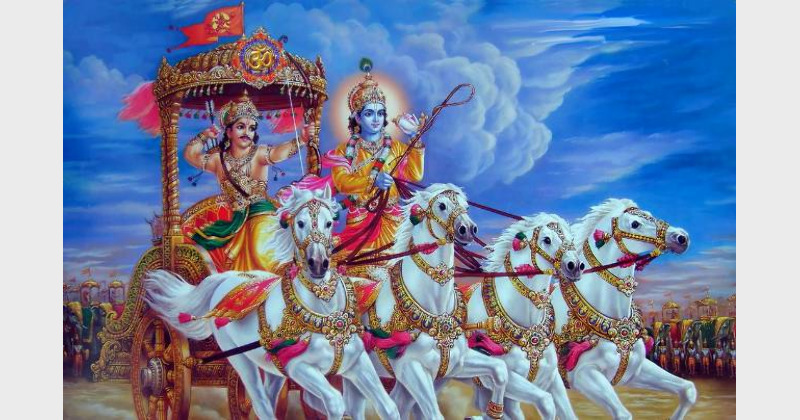
The Vedic literature and Bhagavad Gita assures us on the path of wisdom inculcating human values, growing materially and spiritually in all dimensions of life, nurturing environment. It respects all the religions and sects equally; you will not find a single line against any religion or culture; rather, it believes in connectivity with belongingness to grow mutually. Hence, you will not find a single incidence where India has grabbed territory of other nations or forced people to convert to Sanatan Dharma.

The most difficult part of life is managing the mind, understanding the ego, sharpening the intellect, developing memory and understanding the soul. Gita and Vedas give us deeper understandings of everything with the right solutions, which can be practised daily with ease to remain happy, healthy and move ahead in life to achieve a goal and do something better for society.    
Bhagavad Gita provides a solution for managing complex situations and projects with ease and joyfully. Developing Leadership qualities, discriminating between right or wrong ways of life, Dharma and Adharma, etc., are important aspects of Bhagavad Gita.
The European Union has stated in UN that when the European model has not done any better to them, what is the point in asking other nations to implement it in their country. Let every nation follow its own culture. 

Indians need to realise that our model of development is far better and proven than the European model. India will again prosper if we go back to our roots and follow a development model which builds a nation on equanimity, ethical values, nurturing and balancing the environment and most importantly, that too joyfully, happily and peacefully.

Let us reconnect with our roots and broader our vision.
 

ShareTweetSendShareSend
✮ Subscribe Organiser YouTube Channel. ✮
✮ Join Organiser's WhatsApp channel for Nationalist views beyond the news. ✮
Previous News

Afghan National Abbas Khan, With Fake Aadhaar Card, Arrested in Kerala

Next News

Abdul Salam Impersonated as Vicky and Anil, Married Four Hindu Girls in 15 Yrs

Related News

(L) Panakkad Munavarali Shihab Thangal (R) Fathima Nargese

Kerala: Muslim League leader’s 16 years old daughter Fathima Nargese backs women entry into Mosques, father disputes

Pakistani traders protest mounting losses as prolonged border closures disrupt regional commerce and strain ties with Kabul

Taliban strike back as Pakistan border shutdown with Kabul choke trade routes and trigger protest at home

The doctrine of Geeta diplomacy

The Doctrine of Gita Diplomacy: Culture, strategy and the evolving global connect of India

Defence Minister Rajnath Singh speaks post inaugurating the infrastructure projects of BRO in Leh

Defence Minister Rajnath Singh hails the role of BRO in revolutionising communication & connectivity in border regions

Dismantling the threat of white-collar terrorism

The white terror module and the need for de-radicalisation of campuses

Lok Sabha to hold special discussion on 150 years of Vande Mataram

150 years of Vande Mataram: Winter session of Lok Sabha to hold special discussion on Dec. 8; PM Modi to address

Load More

Comments

The comments posted here/below/in the given space are not on behalf of Organiser. The person posting the comment will be in sole ownership of its responsibility. According to the central government's IT rules, obscene or offensive statement made against a person, religion, community or nation is a punishable offense, and legal action would be taken against people who indulge in such activities.

Latest News

(L) Panakkad Munavarali Shihab Thangal (R) Fathima Nargese

Kerala: Muslim League leader’s 16 years old daughter Fathima Nargese backs women entry into Mosques, father disputes

Pakistani traders protest mounting losses as prolonged border closures disrupt regional commerce and strain ties with Kabul

Taliban strike back as Pakistan border shutdown with Kabul choke trade routes and trigger protest at home

The doctrine of Geeta diplomacy

The Doctrine of Gita Diplomacy: Culture, strategy and the evolving global connect of India

Defence Minister Rajnath Singh speaks post inaugurating the infrastructure projects of BRO in Leh

Defence Minister Rajnath Singh hails the role of BRO in revolutionising communication & connectivity in border regions

Dismantling the threat of white-collar terrorism

The white terror module and the need for de-radicalisation of campuses

Lok Sabha to hold special discussion on 150 years of Vande Mataram

150 years of Vande Mataram: Winter session of Lok Sabha to hold special discussion on Dec. 8; PM Modi to address

India is marching towards Atmanirbharta in defence

Atmanirbharta in Defence: India’s defence manufacturing takes off

Defence Minister Rajnath Singh extends greetings on the occasion of Armed Forces Flag Day

Defence Minister Rajnath Singh extends greetings on Armed Forces Flag Day; Urges people to donate to AFFD Fund

Representative Image

SIR for protecting the health of democracy

Dr. S. Jaishankar,
Minister of External Affairs of India

EAM Jaishankar expresses optimism as India US trade deal moves closer to agreement

Load More
  • Privacy
  • Terms
  • Cookie Policy
  • Refund and Cancellation
  • Delivery and Shipping

© Bharat Prakashan (Delhi) Limited.
Tech-enabled by Ananthapuri Technologies

  • Home
  • Search Organiser
  • Bharat
    • Assam
    • Bihar
    • Chhattisgarh
    • Jharkhand
    • Maharashtra
    • View All States
  • World
    • Asia
    • Africa
    • North America
    • South America
    • Europe
    • Australia
  • Editorial
  • Operation Sindoor
  • Opinion
  • Analysis
  • Defence
  • Culture
  • Sports
  • Business
  • RSS @ 100
  • Entertainment
  • More ..
    • Sci & Tech
    • Vocal4Local
    • Special Report
    • Education
    • Employment
    • Books
    • Interviews
    • Travel
    • Health
    • Politics
    • Law
    • Economy
    • Obituary
  • Subscribe Magazine
  • Read Ecopy
  • Advertise
  • Circulation
  • Careers
  • About Us
  • Contact Us
  • Policies & Terms
    • Privacy Policy
    • Cookie Policy
    • Refund and Cancellation
    • Terms of Use

© Bharat Prakashan (Delhi) Limited.
Tech-enabled by Ananthapuri Technologies