With the covid epidemic ravaging our beloved nation at this point, we are focusing on the problems at hand, but I am tempted to cross the bridge that we are yet to pass, and that is the policy changes we must make to secure the future. The reason why I am doing it today is that we, as a nation are prone to स्मशान वैराग्य “smashan vairgya” and hence are unlikely to revisit the problems we are facing at this point. So, while the trauma is still around, we must identify the problems that we must tackle in the future.
The sudden and massive surge in covid cases has exposed the limitations of our healthcare infrastructure on various fronts but, due to the psychological appeal that oxygen has, our attention is diverted to one of the smaller peaks of the iceberg. The mad rush to provide more beds with oxygen and the tactical challenges linked to it may look to be the central issue to the laymen running around to get hold of a bed or a ventilator, but it is actually a momentary blip that will vanish in a short time.
The real problem and one of the major causes of deaths that we are seeing is not the lack of physical infrastructure but of the management of the disease that depends more on the strength and quality of manpower than the machines.
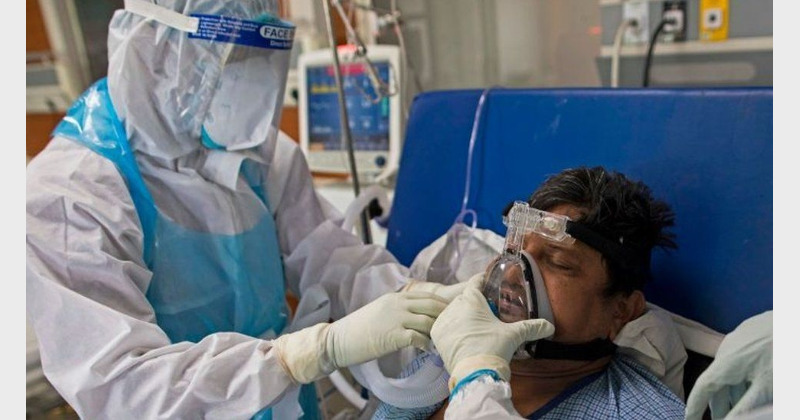
With hype and misinformation causing people to run for a hospital when diagnosed covid-positive, the lack of oxygen/beds is caused by a mass-frenzy that has led to impossible stretching of not just the infrastructure but of the healthcare workers’ ability to perform.
With the corona pathology well-understood now, timing is the real key to corona treatment, so it demands doctors with sound clinical judgement to be available to observe the patient. And it being a pulmonary disease, it also demands careful and constant expert attention and nursing management while the patient is in the hospital. Unfortunately, on both these fronts, we are in real short supply.
Doctors_1 H x
Indians are not dying because they are not getting oxygen or ventilators in time.
Indians are dying because they are not getting good doctors in time.
For some strange but not too inexplicable reasons, India, a nation that has no dearth of human resources is almost at the bottom of the pool in terms of per-capita doctors (even neighbour countries are marginally better than India).
The real lacuna of the existing healthcare system is lack of availability of good doctors in adequate numbers, and that phenomenon, I am sorry to say is self-induced malaise that we have ignore for far too long and are now paying price for.
Why a nation that supplies some of the best doctors to the first world nations like USA and UK lacks its own doctors is not exactly a mystery, but it has never really found attention of the policymakers because it is a systemic cancer that we have nurtured.
If we look at the main and now hopefully erstwhile regulator that controlled the supply of doctors to India, it is the Medical Council of India (MCI) that has such a checkered history that it is not worthy of a mention in any respectable forum.
While pretending to ensure that only the best of the best of the best become doctors, it has done nothing but keeping a stranglehold on the supply side. Such a control on the supply side of doctors has served the cause of the developed world and even the local doctors, but surely not the nation.
For the developed world, it has served as a qualitative sieve. As becoming a doctor so exclusive and meritorious, what we have done is to identify our best talent for the nations like USA and UK to steal. All that they do is to lure our talent with better economic opportunities and our best brains head westwards willingly.
For the Indian doctors, the MCI-created scarcity is a boon as there is lesser competition and more monopoly. The net result is that an Indian doctor has pharma company MRs lining up in his clinic’s waiting room from the first day of his practice, and if he is a go-getter, turning into a businessman from a professional by building a hospital is not really a distant dream.
With the developed world, the pharma companies and even the doctors being happy with the self-induced scarcity, there has rarely been any pressure to increase the supply of doctors on our policymakers. So, we have passed seventy odd years without doing much to change the supply dynamics of doctors.
We did see some momentary considerations through privatization, but that is mainly because the politicians (starting from south and now everywhere) saw the premium on the academic qualification and moved in to make money by setting up medical colleges.
This capitalism driven opening did nothing much to the quality of healthcare available to the man on the street, as the mushrooming of these colleges produced mainly poorly trained doctors who joined government jobs or academics or turned businessmen short-selling healthcare.
As we stand today, we have extremely low supply of doctors and even lower supply of quality doctors as a lot of highly skilled have migrated to first world and a lot of low quality has entered the profession via private (mostly politician-run) colleges to dilute the local pool further.
If we look at the demand side, it is clear that people are desperate to become doctors and are willing to go to any length, including paying crores of rupees or go to most obscure colleges anywhere in the world including China and Russia where there is a massive language barrier.
If we sum the situation of India today, we have a lot of people, we have people who want to become doctors and we need more doctors. So, the solution to this problem is obvious and simple and hence it will be extremely difficult to implement (as most commonsensical ideas are).
We need to produce more doctors. But How?
First and the foremost is the need to revisit the idea of linking number of in-take to the infrastructure available. We must accept that most of these criteria are eyewash and are being managed artificially by private collages. They need to be diluted substantially and each college must be allowed to increase the intake at least three times on urgent bases.
Such a sudden increase will have its problems as it will be a windfall for the crooks but the increase in supply will soon reduce the premium and market will naturally stabilize in a short time.
While the in-take may be increased, we need to tighten the quality side by introduction of a single quality-check exam common for the entire nation for earning the qualification. The greed and corruption may allow any substandard material to enter the system but the sacred job of treating a human body must be awarded only to those who are deserving. So, a stringent qualification-awarding exam is essential to ensure quality.
By fixing the demand and quality, we can quickly change the number of doctors that are “manufactured” each year, but the problem of them migrating to better pastures will remain till we don’t fix the entire system and make it a meritocratic ecosystem.
Such a change in the Indian mindset is a long process that social organizations must take up, but we need policymakers to start the process to change the demand-supply dynamics.
Healthcare is not an isolated sector. It helps create healthy people and hence decides the quality of the nation they will form. It is the corner stone for any society and must be given urgent attention by the policymakers.
Samir Shukla, An Architect and Lawyer is a regular blogger and column writer on national platforms like Times of India and DNA. He has also been a visiting faculty at IIMA and NID. He prefers to write on policy issues linked with national interests.