Those who whine over ‘4G restoration after 500 days’ must know that Srinagar’s Sheetal Nath Mandir opened after 31 years
August 15, 2026
  • Read Ecopy
  • Circulation
  • Advertise
  • Careers
  • About Us
  • Contact Us
Android AppiPhone AppArattai
Organiser
  • ‌
  • Bharat
    • Assam
    • Bihar
    • Chhattisgarh
    • Jharkhand
    • Maharashtra
    • View All States
  • World
    • Asia
    • Europe
    • North America
    • South America
    • Africa
    • Australia
  • Editorial
  • International
  • Opinion
  • RSS @ 100
  • More
    • Op Sindoor
    • Analysis
    • Sports
    • Defence
    • Politics
    • Business
    • Economy
    • Culture
    • Special Report
    • Sci & Tech
    • Entertainment
    • G20
    • Azadi Ka Amrit Mahotsav
    • Vocal4Local
    • Web Stories
    • Education
    • Employment
    • Books
    • Interviews
    • Travel
    • Law
    • Health
    • Obituary
  • Subscribe
    • Subscribe Print Edition
    • Subscribe Ecopy
    • Read Ecopy
  • ‌
  • Bharat
    • Assam
    • Bihar
    • Chhattisgarh
    • Jharkhand
    • Maharashtra
    • View All States
  • World
    • Asia
    • Europe
    • North America
    • South America
    • Africa
    • Australia
  • Editorial
  • International
  • Opinion
  • RSS @ 100
  • More
    • Op Sindoor
    • Analysis
    • Sports
    • Defence
    • Politics
    • Business
    • Economy
    • Culture
    • Special Report
    • Sci & Tech
    • Entertainment
    • G20
    • Azadi Ka Amrit Mahotsav
    • Vocal4Local
    • Web Stories
    • Education
    • Employment
    • Books
    • Interviews
    • Travel
    • Law
    • Health
    • Obituary
  • Subscribe
    • Subscribe Print Edition
    • Subscribe Ecopy
    • Read Ecopy
Organiser
  • Home
  • Bharat
  • World
  • Operation Sindoor
  • Editorial
  • Analysis
  • Opinion
  • Culture
  • Defence
  • International Edition
  • RSS @ 100
  • Magazine
  • Read Ecopy
Home Bharat

Those who whine over ‘4G restoration after 500 days’ must know that Srinagar’s Sheetal Nath Mandir opened after 31 years

WEBDESKWEBDESK
Feb 17, 2021, 10:22 am IST
inBharat
Follow on Google News
Facebook
Twitter
WhatsAppTelegramEmail

The Left-Liberals who crib over the delay in restoration of 4G internet connectivity in Kashmir after a gap of 500 days must remember that several temples that were shut during the years of militancy were yet to be opened for Hindu devotees. A few were opened very recently — after more than three decades. But the ‘outrage gang’ has not cared to spare a thought on hapless Hindu devotees.

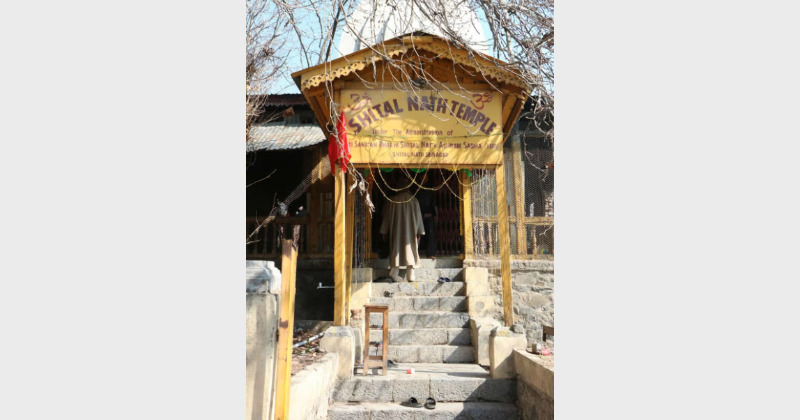
The Sheetal Nath Mandir at Kralakhud in Srinagar was reopened for devotees on February 17 after 31 years. The temple bells rang as Basant Panchmi puja and havan were being performed.

The temple was forcefully closed after Islamic terrorism raised its ugly head in the ’90s when Farooq Abdullah was the Chief Minister of the State, and Mufti Mohammad Syed was Union Home Minister.

Around 30 Kashmiri Hindus attended the prayers and ‘prasad’ was also distributed among the devotees. “We have formally reopened the temple,” said Upendra Handoo, the priest, recalling how the temple was closed in 1990.

Shri Handoo said earlier Basant Panchmi puja in Srinagar used to be performed at the Sheetal Nath Mandir where hundreds of Kashmiri Hindus congregated before militancy began. He said the day is very significant for the Kashmiri Pandits as the community starts the formal education of their new-borns on this day.

“The reopening of the temple is a big confidence-building measure and would send out a message outside the Valley that Kashmir is safe,” Shri Handoo said. He also said the Ashram Sabha members had urged the government to take more steps to ensure return of Hindus to the Valley.

Handoo is also a trustee of Shri Sanathan Dharma Sheetal Nath Ashram Sabha which looks after the maintenance of the temple.

Srinagar Mayor Junaid Mattu also visited the Sheetal Nath Mandir on Tuesday and interacted with the Mandir management officials and devotees.

Meanwhile, the Kashmiri Hindus thanked the Modi Government and said it all happened because of the abrogation of Article 370 and 35A.

In the early 1940’s when VD Savarkar visited Kashmir, he addressed a public meeting and predicted that nefarious designs of the Muslim League. He also said that Jinnah will be disastrous for Kashmir and warned Maharaja Hari Singh of Nehru and Sheikh Abdullah nexus.

He also said that “the demand of Pakistan by Muslim League will take shape in the near future. Britishers are supporting them, and Congress leadership is confused only because we stand for Akhand Bharat. If Pakistan becomes a reality, their first claim will be on Kashmir, and everyone including Maharaja has to be vigilant.”

Share
Tweet
SendShareSend
✮ Subscribe Organiser YouTube Channel. ✮
✮ Join Organiser's WhatsApp channel for Nationalist views beyond the news. ✮
Previous News

Ganga Samagra: An Integrated Approach to Rejuvenate Maa Ganga

Next News

Ram Mandir Nirmaan Katha: Nidhi Samarpan and Asha Kanwar’s last wish

Related News

Decolonisation saw nations across Africa and Southeast Asia reclaim their cultures, languages and identities after independence (This image is generated by AI)

From Colonial Rule to Cultural Revival: How African and Southeast Asian nations shed their colonial legacies

Rashtriya Swayamsevak Sangh (RSS) Sarsanghchalak Dr Mohan Bhagwat went viral by adopting the Gen Z slang phrase "clock it" and making the corresponding hand gesture during a youth conference in Mumbai on August 6

Independence Day 2026: Anarchy vs Freedom – Revisiting Ambedkar on protest in democracy

The Pakistan-Saudi Arabia-Türkiye defence pact faces an early test amid rising regional tensions and security challenges

Pakistan-Saudi Arabia-Turkiye Defence Pact: A shaky beginning and growing questions over its strategic credibility

India’s journey from Swadhinta to Swatantrata begins with decolonising minds and embracing Bharatiya values (This image is generated by AI)

Decolonising the Mind: How citizens can embrace Bharatiya languages, traditions & values to realise absolute freedom

Two Asian Democracies, One Date: Why 15 August Belongs to India and Korea

Two Asian Democracies, One Date: Why 15 August Belongs to India and Korea

St. Joseph's Church, also known as Wangfujing Catholic Church, in Beijing, China.

CCP tracks faith across China’s state system, mapping Christians, Muslims and others to guard party control

Load More

Latest News

Decolonisation saw nations across Africa and Southeast Asia reclaim their cultures, languages and identities after independence (This image is generated by AI)

From Colonial Rule to Cultural Revival: How African and Southeast Asian nations shed their colonial legacies

Rashtriya Swayamsevak Sangh (RSS) Sarsanghchalak Dr Mohan Bhagwat went viral by adopting the Gen Z slang phrase "clock it" and making the corresponding hand gesture during a youth conference in Mumbai on August 6

Independence Day 2026: Anarchy vs Freedom – Revisiting Ambedkar on protest in democracy

The Pakistan-Saudi Arabia-Türkiye defence pact faces an early test amid rising regional tensions and security challenges

Pakistan-Saudi Arabia-Turkiye Defence Pact: A shaky beginning and growing questions over its strategic credibility

India’s journey from Swadhinta to Swatantrata begins with decolonising minds and embracing Bharatiya values (This image is generated by AI)

Decolonising the Mind: How citizens can embrace Bharatiya languages, traditions & values to realise absolute freedom

Two Asian Democracies, One Date: Why 15 August Belongs to India and Korea

Two Asian Democracies, One Date: Why 15 August Belongs to India and Korea

St. Joseph's Church, also known as Wangfujing Catholic Church, in Beijing, China.

CCP tracks faith across China’s state system, mapping Christians, Muslims and others to guard party control

Tamil Nadu: Chidambaram Nataraja Temple continues tradition of hoisting Tricolour atop Rajagopuram on Independence Day

Odisha | Partition Horrors Remembrance Day: Recalling 1947 vital to prevent repetition of history, Says Prafulla Ketkar

Bharat’s decolonization continues, requiring deeper reforms beyond colonial institutions and inherited systems (This image is generated by AI)

Beyond Symbolism: Why Bharat’s decolonisation journey needs deeper institutional, intellectual and cultural reforms

Bharat’s journey from ancient prosperity to colonial exploitation was marked by political upheaval, social disruption and economic decline (This image is generated by AI)

Bharat’s Historical Journey: Ancient prosperity, colonial exploitation and social disruption

Load More
  • Privacy
  • Terms
  • Cookie Policy
  • Refund and Cancellation
  • Delivery and Shipping

© Bharat Prakashan (Delhi) Limited.
Tech-enabled by Ananthapuri Technologies

  • Home
  • Search Organiser
  • Bharat
    • Assam
    • Bihar
    • Chhattisgarh
    • Jharkhand
    • Maharashtra
    • View All States
  • World
    • Asia
    • Africa
    • North America
    • South America
    • Europe
    • Australia
  • Editorial
  • Operation Sindoor
  • Opinion
  • Analysis
  • Defence
  • Culture
  • Sports
  • Business
  • RSS @ 100
  • Entertainment
  • More ..
    • Sci & Tech
    • Vocal4Local
    • Special Report
    • Education
    • Employment
    • Books
    • Interviews
    • Travel
    • Health
    • Politics
    • Law
    • Economy
    • Obituary
  • Subscribe Magazine
  • Read Ecopy
  • Advertise
  • Circulation
  • Careers
  • About Us
  • Contact Us
  • Policies & Terms
    • Privacy Policy
    • Cookie Policy
    • Refund and Cancellation
    • Terms of Use

© Bharat Prakashan (Delhi) Limited.
Tech-enabled by Ananthapuri Technologies