What happened to George Floyd in Minneapolis on the fateful evening of May 25, 2020, can be called a blatant act of racism of both kinds – individual as well as institutional. Anger then turned into violence as the radical leftist Antifa and other vested interest groups soon appropriated what started as a just and peaceful movement. In the time of such dissonance, a call to Dharma is the most logical step
Britain Minneapolis Police Death Protests
In Basant of 1994, I had to face the biggest dilemma of my adult life to date. I was accepted in more than one graduate program of foreign universities across two continents, and I had to make a choice. I sought counsel from some of my closest gurus and acharyas in JNU’s linguistics department. To make things easier for me, they were all unanimous in their recommendation. Following their advice, I ended up in a large swath of cornfield — a sleepy campus town of Champaign-Urbana, Illinois — that August. One of the primary reasons for them recommending an American university over others was racism. In their judgment, and they were all ‘foreign returned’ high-profile professors in their own right, the US ranked much lower on the racism spectrum.
Almost a quarter-century later, and after a full two-term presidency of a bi-racial black president, the US is still grappling with the question of race, racial prejudice, and individual as well as institutional discrimination of blacks and other minorities. There are individual, psychological, and cultural reasons for racism. Society, media, judiciary, the education system — they all play a pivotal role in shaping racism. Just as in Hinduphobia, it is entirely possible that much of the racism manifests itself at the subconscious level and most people are not aware of it unless it is pointed out as such.
Historically, most blacks were sold in open markets to their owners and brought to America as slaves. During slavery, most southern states of the US had Black Codes to regulate slaves. After slavery was legally abolished, not much changed for the ’emancipated’ slaves; Neither could they return to their ancestral homeland from where they were uprooted without consent, nor did their owners get out of their hair. In the absence of institutional slavery, however, people found other measures to perpetuate their racism just as some European colonisers found a way in the institution of Girmitiya (indentured) labour of its subjects. In the US, Jim Crow laws were one such measure. There were separate drinking fountains for blacks and whites. Blacks could not eat in public and could not go on the streets after dark. Blacks had separate schools as well.
Rampant discrimination even after the abolition of slavery sent blacks flocking to cities in big numbers looking for greener pasture. Farming during the 1920s was increasingly getting mechanised. Those blacks who found employment as sharecroppers for subsistence wages and did household chores for their masters were suddenly rendered jobless. City life was miserable for most of these migrants, yet they urged those who were left behind to migrate to cities of the North – “Your neck has been in the yoke. Will you continue to keep it there because some “white folks nigger” wants you to?” (Terry Jones, 1974)
The root of racism in the US lies in the basic institutions – in workplaces, banking, housing, education, judiciary, etc. Often, individual and institutional racism seem one and the same. However, it is crucial to recognise the differences. Racism is neither isolated nor self-sustaining. A racist individual depends on the institutional framework for his/her racist behaviour, and institutions need willing individuals to perpetuate discrimination.
Dharma sees conflicts and dissonance as ‘burdening of the earth’. Such conflicts, according to Dharma, are a product of one’s relationship with one’s self as well as other elements of the cosmos. Hence a solution to such conflicts must also arise from that relationship
Stokley Carmichael and Charles V Hamilton, in their book Black Power (1967) talk about two kinds of racism – overt and covert. For them, the acts of individual racism committed by individual whites against individual blacks are overt racism. The overt racism mostly involves acts by individuals that cause “death, injury, or the violent destruction of property.” They are also more visible through media reporting, etc. The covert racism, on the other hand, is less identifiable but no less harmful and destructive. This kind of racism — the institutional racism — authors observe, “originates in the operation of established and respected forces in the society, and receives far less public condemnation than the first type.”
Institutional racism establishes and sanctions unequal treatment for a given race or people. To understand institutional racism and how it permeates American society, it is essential to understand that, to a certain extent, every major institution in the US functions based on some amount of racial discrimination.
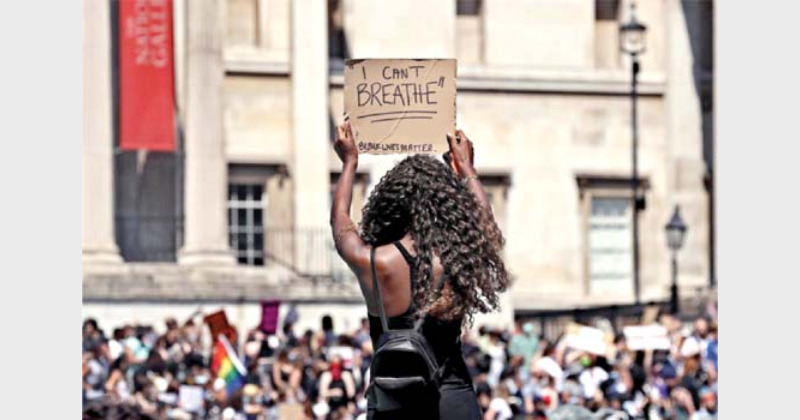
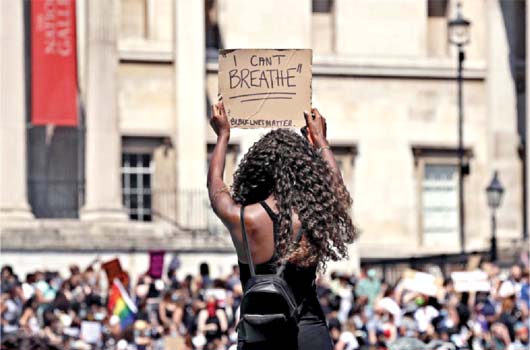
What happened to George Floyd in Minneapolis on the fateful evening of May 25, 2020, can be called a blatant act of racism of both kinds – individual as well as institutional. The 46-year-old Texan had moved to Minneapolis, Minnesota, for employment and to start a new life after a run-in with the law that saw him incarcerated for five years. One of the store clerks of the Cup Food store in Minneapolis had called the cops on suspicion of Floyd passing a counterfeit $20 bill. Floyd died after Derek Chauvin, a white officer of the Minneapolis Police Department, pressed his knee to Floyd’s neck for close to nine minutes. All this while, Floyd was handcuffed and face down in the street. In the last three minutes of this ordeal, Floyd’s body remained motionless and lifeless. A few bystanders filmed this episode on their smartphones. Some of them tried to intervene, as well. But three other Minneapolis Police Department comrades – a Somali, a Hmong, and a Latin American – watched from the sidelines as Floyd begged for mercy saying “I can’t breathe.”
The incident sent a shockwave across America and the world. The angered protestors filled the streets and alleyways of their towns and cities, and “I can’t breathe” became the catch slogan of the protests across the globe. “We are deeply saddened and outraged by what happened to George Floyd in front of our store,” Cup Foods owner Mahmoud Abumayyaleh wrote on his Facebook wall. “The tragic cold-blooded murder of Mr George Floyd is one of the countless examples in which African-Americans have been treated as less than human,” said Vishal Agarwal, a Minneapolis resident whose family has been involved in post-riot cleanup and fundraising.
Anger then turned into violence as the radical leftist Antifa and other vested interest groups soon appropriated what started as a just and peaceful movement. Most of these radicals are affluent, educated, ‘progressives’. Among those arrested by the police for the ensuing violence were two lawyers who allegedly threw Molotov cocktails, also known as petrol bombs, into a police car. Colinford Mattis is a New York University and Princeton University graduate while Urooj Rahman is a Fordham University graduate. “The far Left’s strategy to turn this into a class war deploying violent means has hurt the movement,” opined Ram Prasad, a Chicago-area based behavioural science specialist. “There is a lot of dissonance people are having to deal with. They find cops at fault, but they also find fault with violence and destruction,” said Prasad.
In the time of such dissonance, a call to Dharma is the most logical step. Dharma, a central tenet of the Hindu faith, is the universal Truth that connects individuals to the rest of the world in a quantum way. The Mahabharata defines Dharma as something that sustains and upholds the people as well as the universe we live in. Dharma is a means of securing the good of all living beings. This goodness comes from love and compassion. The ethical ordering of Dharma is geared towards maintaining natural harmony. One man’s conduct towards another is contingent on retaining this harmony with the universal law of man’s being.
Dharma sees conflicts and dissonance as ‘burdening of the earth’. Such conflicts, according to Dharma, are a product of one’s relationship with one’s self as well as other elements of the cosmos. Hence a solution to such conflicts must also arise from that relationship. The ultimate Dharma, however, lies in us as individuals transcending ourselves. This transcendence can only be achieved through numerous acts of our daily living, including acts of kindness and compassion towards each other’s sufferings and navigating complicated relationships in this quantum universe.
Dharma also recognises that each individual has different physical, mental, and spiritual capabilities as well as varying levels of development. Dharma calls upon individuals to follow the righteous path and do the righteous deeds based on her/his abilities for the overall wellbeing of our society. We all need to embrace Dharma to root out inequality, injustice, disharmony, and discrimination from our community.
Inaction is not an option.
(The writer is a JNU and the University of Illinois Urbana-Champaign alumnus and writes frequently on the topics of Indic Knowledge Tradition, language, culture, and current affairs)