Varada Sambhus
The contemporary political theory has very well established that the democracy does not lie only in the formal structures and institutions of the governance, but the role of the civil society and the semi and informal sites of deliberation are equally important. The citizenry action, engagement and mutual cooperation has become important especially in the present-day context of the Corona pandemic. It is starkly realized that the state machinery is insufficient to deal with the emergency in most of the countries including the ‘developed world’.
On this backdrop, the message of all-inclusivity, Seva, congeniality and collective action by Dr Mohan Bhagwat, the Chief of Rashtriya Swayamsevak Sangh (RSS) holds a substantive value. The RSS, which has given the country two Prime Ministers, number of Chief Ministers, and is the largest cadre-based voluntary organization in the world has remained surrounded by controversies. The dispassionate academic analysis of the organization and its work has remained the rarity in the midst of polar onions held by the supporters and the opponents. The current global humanitarian crisis necessities to take a look at how the largest voluntary organization responded to the situation and what are the principles of its response.
Non-discrimination and Congeniality
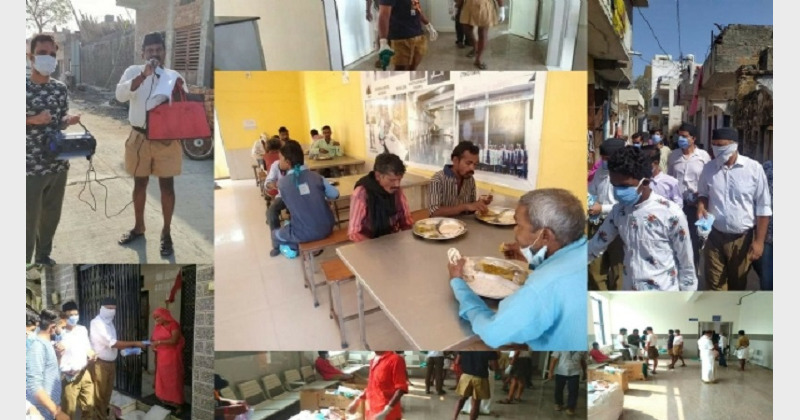
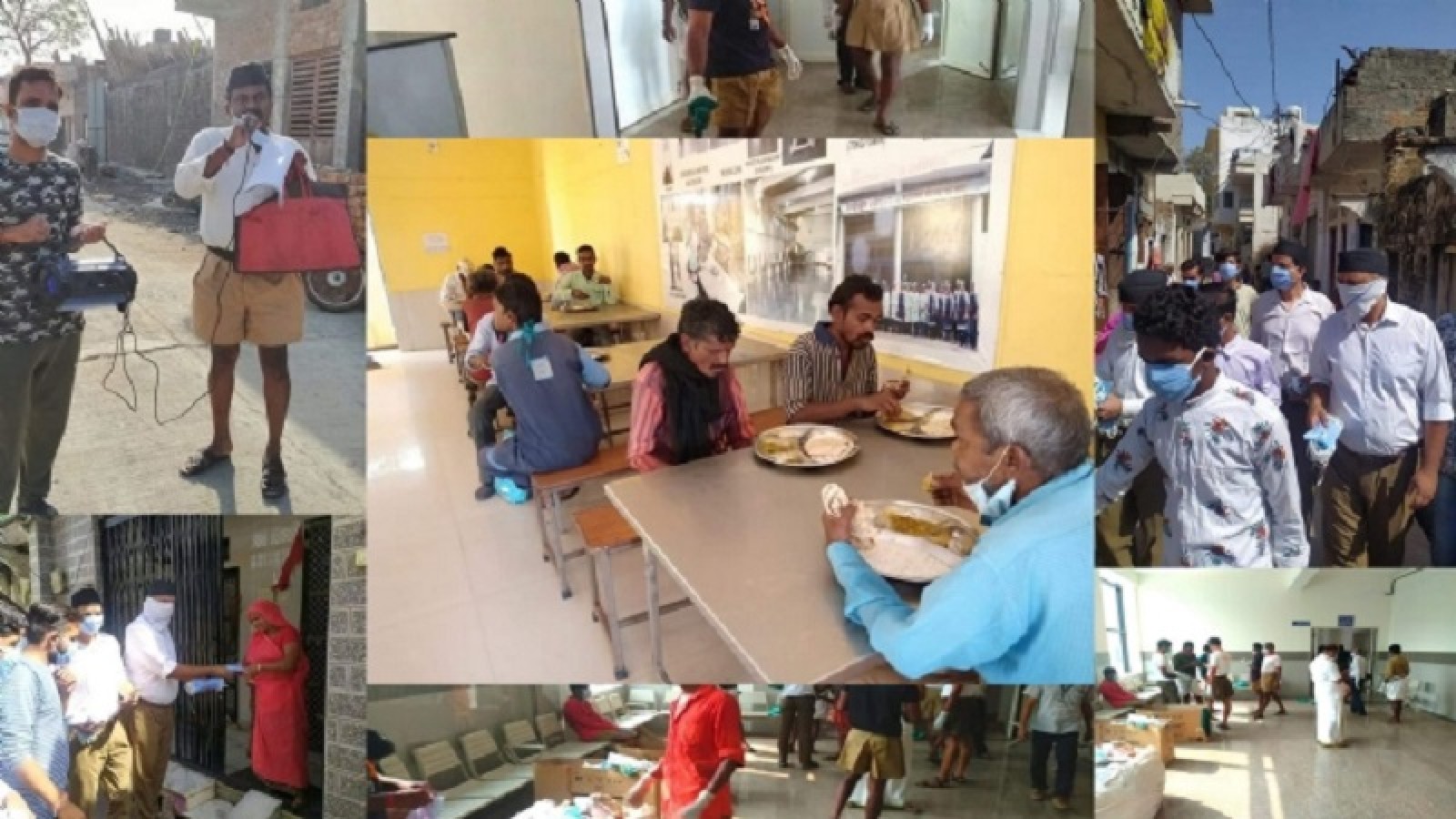
The recent address delivered by Dr Bhagwat provides an opportunity to take a fresh look at the RSS. The address highlighted the sewakarya (service work) done by the RSS (see the table below) and the message to the swayamsevaks. Dr. Bhagwat started with the principle “Ekant mein aatmasadhana aur locant mein paropkar” and reminded that though the shakhas and the regular programs are not being conducted, the focus during the pandemic is on sewa. He added that the motivation for sewa is not self-interest or publicity but rather the sense of belongingness and congeniality. He appealed to the swayamsevaks to engage in persistent, selfless sewa and awareness campaign with love and affinity. Referring to the Tablighi Jammat issue he said that because of the actions of few irresponsible people the entire community shall be not be stigmatized. He urged that anyone who calls for help, shall be given help, and take along everyone who wants to join hands. Any kind of otherization, of the state as well as the people, is harmful in general and in the present situation of crisis in particular. He said that all 130 crore Indians are our won and should be looked after with the sense of oneness.
Places served | 45,481 |
Dedicated Volunteers | 2,57,690 |
Ration kit donated to Families | 29,60,985 |
Meal packets distribution | 192,59,179 |
Migrant workers helped in different ways | 3,51,054 |
Blood Donation | 11,740 |
COVID-19 Pandemic – Sewa work by Rashtriya Swayamsevak Sangh Swayamsevaks till 17th April, 2020
Dr Bhagwat cautioned against the anti-social and politically motivated elements and their divisive agenda by creating conflict and hatred between the communities. He condemned the lynching of the Sadhus in Palghar, Maharashtra and urged for prompt and appropriate action against the perpetrators of violence. He added that the swayamsevaks shall not fall prey to this divisive and threatening agenda and overcome fear as well as anger with patience and confidence. While applauding the government’s timely action to prevent the spread of the infection, he appealed to the citizens to join the collective action and called upon leaders of various sections of the society to educate their followers about the precautions and necessary actions.
Swadeshi and Alternative Models of Development
Apprehending that the disruption caused by the pandemic will have the long-term impact and some of the restrictions will have to be continued even after the end of the lockdown, Dr Bhagwat elucidated the need to think of alternative mechanisms like continuing with physical distancing, even though the schools, colleges, markets, factories re-open. These new social norms would need training and awareness among the people and can be achieved through goodwill, dialogue, collective action and mutual cooperation.
He raised a concern about the return of migrant workers, their employment and normalization of economic activities alongside the limited resources. He pointed out that in the near future we all may need to give up a few things and reconfigure alternative models of development that would be energy-efficient and eco-friendly. He suggested the model of swadeshi and self-reliance based on the hybrid of modern science and relevant traditional knowledge systems which would be conducive to the changing times.
The swadeshi model should be homegrown and eco-friendly. For this to be successful, people need to be encouraged to use swadeshi products and industries need to be encouraged to produce the best quality goods. Simultaneously, our reliance of external sources should be minimized as far as possible and domestically the public opinion needs to be generated to bring in the behavioural changes to conserve water, trees, reduction in plastic use, organic farming, cleanliness and stopping the activities that are harmful to the environment. This too can be achieved through sustained dialogue, the transmission of such values in the families, collective action and self-discipline.
Citizen Action and Civic Responsibility
Referring to Bhagini Nivedita, and Dr Babasaheb Ambedkar, Dr Bhagwat highlighted the role of the civil society and the interaction between the government, the bureaucracy and the civil society. He said that a symbol of patriotism in an independent country is responsible and law-abiding civil society. To hone the qualities of self-governance and respect for the laws among the citizens the government needs to bring in value-based education system urgently.
He stated that only through the public-oriented government policies, people-centric implementation of those policies by the administration and citizenry participation by way of civic responsibility together will lead social harmony, mutual cooperation and peace. He highlighted that as the Government works on making the government machinery public-oriented, as politicians rise above narrow self-interest and direct their politics towards national interest and the education system becomes value-oriented, similarly citizens also need to be prompt in carrying out their civic responsibilities.
He concluded the address by pointing out that the present situation of Corona pandemic has a message for the future and expressed confidence that with the collective, confident and persistent effort, we (Indians) will not only come out of this crisis but also convert it into an opportunity to make India lead the global humanitarian cause.
The message of Dr Bhagwat was clear that we need to adopt a constructive outlook and contribute positively to society. Through otherizing the state and by creating the fault lines between the communities on the basis of caste, language, religion, gender etc. some anti-social elements may try to exploit the situation to perpetuate their divisive agenda, but with citizenry participation, carrying out the civic responsibilities and through collective action, the current crisis can be converted into an opportunity of national resurgence. It is a high time that the intelligentsia in our country dispassionately engages with the RSS, the massive on work done on the ground and the principles that govern the functioning of the Sangh and the plethora of organizations known as Sangh Parivar.
(The writer is Assistant Professor at Maharashtra National Law University, Mumbai)