
Statistics show that 55% of the students are doing M.Phil. or Ph.D. Government spends about 556 crores on the university which is about 6.95 lakhs per student. Despite such huge spend, there are hardly any patents filed by the faculty or the students of JNU. So where is the money going?
– Anurag Singh
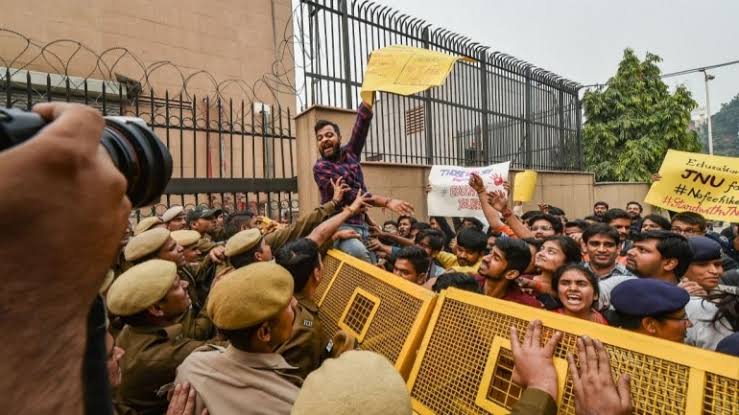
The JNU which is mostly in the news for wrong reasons made news again over protests over fee hike in accommodation, mess and other charges. The protests held Delhi for ransom and the rowdy behavior of the students within the campus and on roads has been condemned by everyone. While many justify the low fees and condemn the nominal fee hike, statistics prove that JNU is the most subsidized university in the country and its students are pampermed the most.
The student strength & courses: What do they teach at JNU?
Let’s go one step at a time. Do you know how many courses are there at JNU & what is the student strength? Here is how it looks.
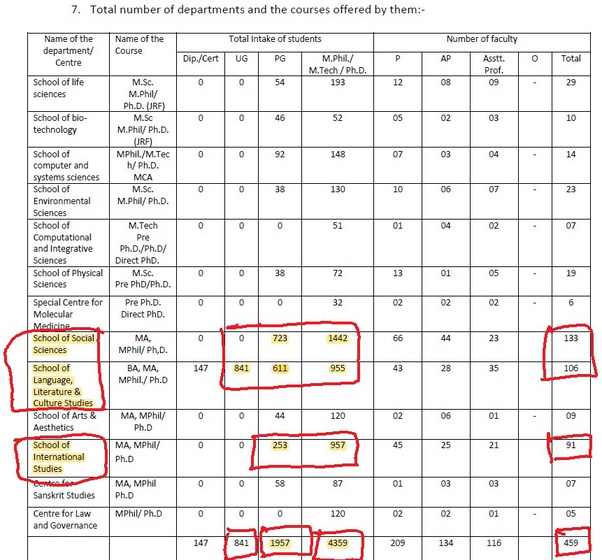
Now we see that there are a total of ~8000 students at JNU. Of this, the lion’s share of 57% students is of social sciences, language, literature & arts (4578 students) & International studies 15% ( 1210 students). So between the two categories, we have 72% of the campus covered.
There is another interesting statistic here. Almost 55% of the total student strength i.e. 4359 students are doing M.Phil. or Ph.D. At any campus across the world, the strength of students declines as we move from under-grad courses to post grad & there are very few who pursue doctorate level courses. This is also driven by financial compulsions as people need to get back to the earning workforce fast & get on to a career track. I couldn’t find specific information about why did JNU chose to have such high strength of M.Phil. & doctoral level students. Anyways we’ll use this number once again to derive some conclusions so keep this in mind.
Cost of running such University: Just how much does government spends on JNU?
Look at the Profit & Loss account of JNU for 2018. This is from the 600 page annual report, & this one page which should possibly be the first section on any annual report, is hiddnen somwhere in the middle. Probably this was not very important in the overall scheme of things. So what do we observe here :
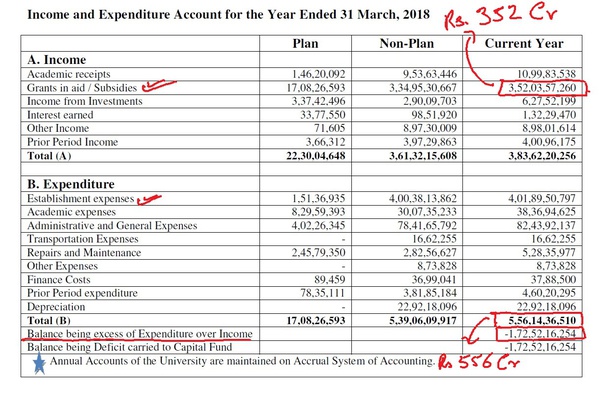
So JNU spends about Rs 556 crores per year on its functioning. This is aside of the fixed assets it has, the huge land base, the infra & building it owns which was built on government money at some point. I see that some depreciation is accounted for.
So what is the cost per student at JNU ? We can calculate. Rs 556 crore / 8000 students gives us Rs 6.95 lac per student annually. Although the university calculations somewhere quote this number as Rs 2.33 lac per student (Rs 170 crore/7304), this calculation is seriously flawed. The real numbers have to divide the entire university expenses by the number of students. There can be no university withoput students so all expenses eventually have to come from student body & other income.
Even if we exclude “other income” & count only the govt subsidy & grants, we have a total expense of Rs 352 crore over 8000 students. We can safely assume that each student consumes Rs 4.4 lacs of government subsidy at JNU every year. Shocking how public money can be misused at scale. What talent are we producing at this high cost subsidy ? This is competing with IITs & IIMs fee.
Research, publications & patents at JNU
Now the students would say that JNU is an academics focused institution & it should not be compared with commercial institutions. Fair point. I tried to dig in the kind of work & research papers JNU publishes. You would be surprised that for an institution which claims to be the center of academics on social sciences, the claims on the website seem pretty sketchy. Read for yourself as I quote from the website:
– Publications : The faculty of the University has been regularly publishing many research journal articles, books; contributed chapters in books; presented papers in national and international conferences/workshops and delivered several lectures outside the University.
– Research: JNU has been promoting research by students and faculty. Faculty members have been able to attract competitive research grants from many national and international funding agencies. Currently, more than 300 research projects are running in the University. Research grants are also received from DST, DBT, ICMR, CSIR, UGC, ICSSR, ICHR, ICCR, Ministries, European Union, European Commission, Ford Foundation, Welcome Trust etc. In addition to research projects, faculty members are also encouraged to undertake consultancy projects. University has also set up an Advanced Instrumentation Research facility where state of the art equipment have been installed to meet the requirements of many science schools/special centers. University has also set up an Intellectual Property Management (IPM) Cell to facilitate filing of patents and technology transfers.
As you can see, there is no specific mention of any numbers or concrete claims on research & publications, no names of journals or publications worth mentioning. Perhaps JNU doesn’t need to publish this info as nobody cares to read this. At-least not the students who study there or want to join JNU.
But there should be some patents at-least ? All that we find for patents is the below information:
Patents by faculty:
• R. Bhatnagar (2001-2002). A Process for the Preparation of Non-Toxic Anthrax Vaccine. Indian patent (1222/Del/2001) accepted. International PCT application (PCT/IN2002/00048; WO-03-048390A1, June 12, 2003) published. R. Bhatnagar (2001). A process for constitutively preparing anthrax protective antigen. Indian patent (1127/Del/2001) accepted. R. Bhatnagar (2001). An Anthrax Protective Antigen. Indian patent (1074/Del/2002) accepted.
• Aparna Dixit (2007). Anti-diabetic recombinant protein. Indian patent and International PCT applications filed. Aparna Dixit (2007). Recombinant vaccine against Aeromonas hydrophila. Indian Patent application filed.
• R. Bhatnagar (2008). An immunodominant B cell epitope based protein vaccine against Anthrax. Indian Patent application (2947/DEL/2008) filed. R. Bhatnagar (2008). A pharmaceutical composition of vaccine against Rabies…..its preparation thereof. Indian Patent (1449/DEL/2008) and International PCT (PCT/IN2008/000578) applications filed.
• K. J. Mukherjee (2006). A process for getting high yields of xylanases (patent application filed). K.J. Mukherjee (1999). A process for getting high yields of streptokinase. K.J. Mukherjee (2002). Process technology for production of human alpha interferon in E.coli Application No. 212080 (1276/Del/2002) Indian Patent Accepted.
• Santosh K. Kar, (2006). Method for Identification and/or Diagnosis of REM Sleep Loss from Blood Samples. Indian Patent. Date of Issue: 24 Oct 2006.
So barring some 4 names of Mr. Bhatnagar, Ms. Dixit, Mr Kar & Mr. Mukherjee, there are no patents by any other faculty. Number of patents by students ??? Try searching….I did not find any results. So much for the 57% students doing doctorate level courses.
You want to know the best claims about the research JNU publishes ? You’ll find that in the placement brochure (yes they have one, although very superficial & doesn’t disclose any statistics about past placements). Here is what you’ll see in the name of research at JNU:
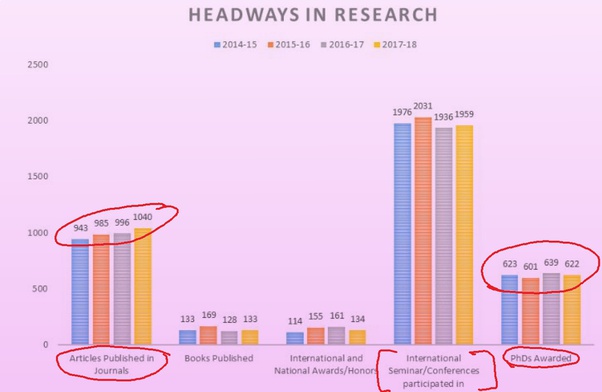
Some inferences from the data above:
1) With 4360 students in M.Phil. & Ph.D. courses, there are hardly 1000 research “articles” published in Journals. The university doesn’t name any notable journals while making such claims. This implies that there is just ONE “article” published for every 4.5 students each year. This when there are 600 plus Ph.D. s granted annually. Would you consider this any worthwhile research work ? May be JNU has more “liberal” standards for us to understand this.
2) There is huge participation in international conferences. So about 2000 international conferences are attended every year. Again, not sure what materializes in those conferences. Certainly not the research papers or patents.
Is the fee hike Justified ? Why punish the meritorious students?
Firstly, in view of the data above, it doesn’t appear that there is much focus on output or getting laurels for the nation at JNU. There is absolutely no data point to believe that is the case.
Now, let’s look at the “fee” the students pay to study at the university.
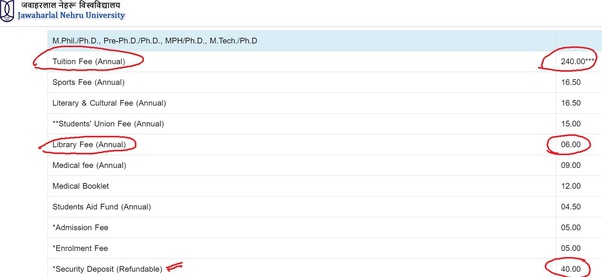
Let me clarify. The numbers you are looking at are not in thousands or lacs. These are what they are in INR. So Rs 240 is the entire tuition fee paid by JNU student. Aside, they pay a generous Rs 6 for library & Rs 40 as refundable security deposit. How was a university allowed to run with this fee structure & without any hike for decades is itself a research paper in the making. Of-course, nobody at JNU would have time to research on this. IIT Delhi which is located close by charges about Rs 2.25 plus lac annually & IIMs charge about Rs 5 to 10 lac per year. We don’t see any strikes at those places. Students know they need to jump into the job market, start their earning life & also repay the student loan that they carry. JNU is free of any such thoughts or troubles. Probably the reason why students have much time left to create new troubles of their own. Ideology or idle mind, you decide.
I don’t want to conclude any political thoughts here. But the data from official sources of the university help us infer a lot of ideas. JNU is a perfect example of bad socialism. If you give something for free, people have no incentive to work & earn. Why would anyone at JNU be in a hurry to find jobs or even publish research. In a nation where we’re are hardly able to educate our children thru primary schools, JNU stands tall as an example of socialist elitism at its best. This must stop. The students may have all the time for doctoral courses, the nation is certainly running out of patience & money to pay for these scholars.
Surprised that this social reform idea never came out from the university that claims to be the biggest study centre on social sciences ? Irony died a quite death !!
Analysing questions raised in defense of JNU protests
Some students have raised questions or tried to defend the protests. Let me try to address some of these questions:
Defense 1: There is a corruption of thousands of crores in public distribution system, so why target few hundred crore of JNU subsidy?
I think this is amusing argument. So both should stop. Firstly, this is an unfair comparison. National PDS system budget has to be compared with the national/state subsidy on ALL universities in India. I’m sure that amount also will run into thousands of crores. It is a complete wastage of resources in India for privileged few. Classic socialism downside where state resources are cornered by a powerful few.
Defense 2: JNU will have less patents as it is focused on social sciences. But it has contribution in social sector. It has provided various luminaries to the nation & many IAS officers. This is JNU contribution to society.
I’m surprised by this argument. Joining a govt service is not a contribution to the society. And they will join IAS with or without JNU. People join for their own good. This is just like saying – politicians are in politics for public welfare. Well, the country understands these arguments better now. Also how do we measure the “social work” of JNU. When research papers are hardly anything to talk about & nation still grappling with poverty, there has to be some metric to measure contribution vs subsidy. And this also applies to all institutes where fee is subsidized.
Finally, some students indicate that during M.Phil., they “contribute towards the research work by their professors & thus earn their education”. Well, has any one of them asked the professors what “research” they do because there are handful of papers published ? At least tell the country this when you protest. The idealism of “right to education” is hollow self-centered logic. This won’t fly. And social sciences study at Rs 4.5 lac per student ? This would put global schools to shame !!
Defense 3: When PSU banks can lend money to industrialists & write off lacs of crores, why is JNU being targeted?
Again a self-defeating logic. PSUs & nationalized banks are relics of the past. Many of them are dying a gradual death. Many exist since politics needs a free checkbook to write loans to loved ones in the name of socialism. So students want free education & politics wants free non-refundable loans. Common folks also want govt jobs and just sit on it till retirement. Not to mention the corruption. The country goes to dogs.
This socialism of the 70s is dead. Not because politicians have become saints. But because govts have run out of budgets. Ask Air India, PSU bank employees & others. Did someone tell you that the Soviet Union has collapsed ? And that China is the most ruthless form of capitalism that you can have in the world. How about a research paper on that ?
(Author is a Value Investor and Finance Mentor. The article is a compilation of a Twitter thread by the author. All images belong to the author)