Democratising the Telecom & IT Services
August 6, 2026
  • Read Ecopy
  • Circulation
  • Advertise
  • Careers
  • About Us
  • Contact Us
Android AppiPhone AppArattai
Organiser
  • ‌
  • Bharat
    • Assam
    • Bihar
    • Chhattisgarh
    • Jharkhand
    • Maharashtra
    • View All States
  • World
    • Asia
    • Europe
    • North America
    • South America
    • Africa
    • Australia
  • Editorial
  • International
  • Opinion
  • RSS @ 100
  • More
    • Op Sindoor
    • Analysis
    • Sports
    • Defence
    • Politics
    • Business
    • Economy
    • Culture
    • Special Report
    • Sci & Tech
    • Entertainment
    • G20
    • Azadi Ka Amrit Mahotsav
    • Vocal4Local
    • Web Stories
    • Education
    • Employment
    • Books
    • Interviews
    • Travel
    • Law
    • Health
    • Obituary
  • Subscribe
    • Subscribe Print Edition
    • Subscribe Ecopy
    • Read Ecopy
  • ‌
  • Bharat
    • Assam
    • Bihar
    • Chhattisgarh
    • Jharkhand
    • Maharashtra
    • View All States
  • World
    • Asia
    • Europe
    • North America
    • South America
    • Africa
    • Australia
  • Editorial
  • International
  • Opinion
  • RSS @ 100
  • More
    • Op Sindoor
    • Analysis
    • Sports
    • Defence
    • Politics
    • Business
    • Economy
    • Culture
    • Special Report
    • Sci & Tech
    • Entertainment
    • G20
    • Azadi Ka Amrit Mahotsav
    • Vocal4Local
    • Web Stories
    • Education
    • Employment
    • Books
    • Interviews
    • Travel
    • Law
    • Health
    • Obituary
  • Subscribe
    • Subscribe Print Edition
    • Subscribe Ecopy
    • Read Ecopy
Organiser
  • Home
  • Bharat
  • World
  • Operation Sindoor
  • Editorial
  • Analysis
  • Opinion
  • Culture
  • Defence
  • International Edition
  • RSS @ 100
  • Magazine
  • Read Ecopy
Home Bharat

Democratising the Telecom & IT Services

If India’s information and telephone services are today ubiquitous and affordable by the common man, the credit must go to Vajpayee jiThe passing away of Bharat Ratna Atal Behari Vajpayee ji need not be a matter of grief as death is inevitable for everyone but it should be an occasion when what he stood for; what he and how he achieved and what lessons we can draw from such a towering person, are thought over to build a prosperous, powerful, intellectual and ethical Bharat to be a Jagadguru once again

Archive ManagerArchive Manager
Dec 24, 2018, 05:19 pm IST
inBharat
Follow on Google News
Facebook
Twitter
WhatsAppTelegramEmail
If India’s information and telephone services are today ubiquitous and affordable by the common man, the credit must go to Vajpayee ji
The passing away of Bharat Ratna Atal Behari Vajpayee ji need not be a matter of grief as death is inevitable for everyone but it should be an occasion when what he stood for; what he and how he achieved and what lessons we can draw from such a towering person, are thought over to build a prosperous, powerful, intellectual and ethical Bharat to be a Jagadguru once again.
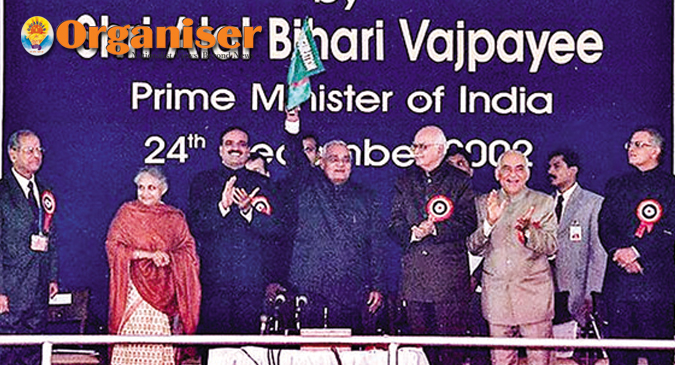
 
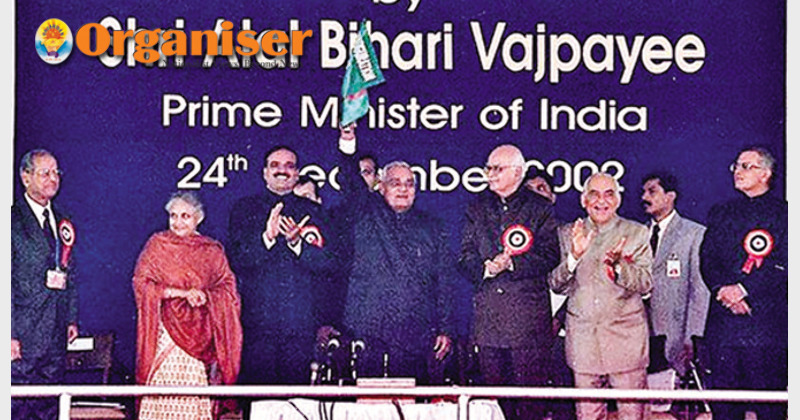
In this photo provided by DMRC dated Dec 24, 2002, the then prime minister Atal Bihari Vajpayee is seen flagging off the first-ever corridor of Delhi Metro, in New Delhi 
 
Sanghatan (consolidation), Sangharsh (struggle), Sanrachana (construction), Samarasata (harmony) and Sadbhavana (good will) characterise the life and struggle and achievements of Vajpayee ji. While there are several achievements of Atalji, I will particularly mention those in the Information Technology (IT) and Telecommunication sectors, where revolutionary reforms were daringly formulated and implemented by Vajpayee ji as Prime Minister (1998 to 2004). At the onset of elections to the Lok Sabha, since 1984, I had been preparing a memo as a policy document for incorporation in the election manifestos of every party in the country. A little mention of it was for the first time included in the Manifesto of the Congress Party in 1984 under Rajiv’s response. The Bharatiya Janata party (BJP) extensively included what I have been proposing in its election manifesto for the 1998 Lok Sabha elections. In the first week of May1998, Prime Minister Vajpayee ji decided to constitute Prime Minister’s National Task Force on Information Technology & Software.
Because of our struggle the telecom sector and IT services companies today earn Rs. 8,40,000 foREX per yearI was called by Advaniji to whom the task of constituting the Task Force was entrusted by Vajpayee ji. I suggested that Sri Chandra Babu Naidu should be the Chairman of this Task Force as I was already his IT Adviser in Andhra Pradesh and we were implementing path-breaking programmes utilising IT and Telecommunication networks. Advaniji said, “How can we make Naidu Chairman as he is the kingpin of our opposition, the United Front.” I submitted that I made it clear to Naiduji that I was in the TDP (Telecommunications Development Party) and not in the Telugu Desam Party. I was with him to promote total de-regulation of telecommunications, liberalisation, privatisation and extensive use of IT and software for purposes like e-governance and e-commerce and so on. Finally, Advaniji agreed. I got the consent of Sri Naidu and Advaniji got the consent of Vajpayiji. The NTF consisted of crusaders for liberalisation and end of monopoly in the telecom sector – Sri N Vital, Dr N. Seshagiri, Prof. Indiresan, besides myself and a few chosen others. The co-option of Chandra Babu Naidu of TDP into the Task Force was the beginning of his entry into the National Democratic Alliance (NDA) and partnership with the BJP in 1999 and 2004 elections to the Lok Sabha. The Task Force, overcoming the resistance of the vested interest in the Department of Telecom (DOT) and statists made 108 recommendations within a few months of its constitution. They were accepted within in a week of their presentation and issued as government policy. The highlights, all under the inspiration and commitment of Vajpayee ji are:
 
•  Unlimited number of licences for the provision of internet services in one or many cities or states
•  No licence fee at all; no revenue share
•  Use of wireless by service providers to pick up customers
•  Interconnection to the worldwide internet networks by licenced companies through VSAT (very small aperture terminals), earth stations of the communication satellite systems).
 
This meant the total by-pass of the telecom networks of both DOT and the cell telephone companies Telcos. The policy was commended as the democratisation of knowledge and universal affordability by even the poor. Vajpayee ji, both at the first and the last meeting of the Taskforce was very happy that his vision is reflected in the report. He particularly thanked us.
 
The second revolutionary decision of Vajpayiji was what has come to be known as National Telecom Policy- 1999. The NTP 1994 promulgated by Prime Minister PV Narasimha Rao brought private companies (P-Telcos) into the provision of mobile radio telephony imposed the most obnoxious condition of the licencees paying huge licence fees even before they constructed the network, got subscribers and revenues. They were bleeding. The loans that they took from banks for construction of the network could not be serviced. The price for the mobile telephony was fixed by the policy maker-licensor-operator DOT itself at Rs.16 per cent, the caller as well as the called party paying. The P-Telcos contrasted their license conditions with those of the Internet Service Providers (ISPs). They wanted to be bailed out. We suggested that those licence conditions should be modified by a new policy. Vajpayee ji immediately understood the logic. Today, we have 116 crore mobile telephones for a 130 crore population. And the prices have so come down that the poor, even beggars are able to afford telephone and other telecom services.
 
The third revolutionary reform that Vajpayee ji brought about was the removal of inequality in the competition between P-Telcos and the government’s DOT. The DOT is the policy maker, licensor and service provider; deprived of its privileges it was obstructing in several ways the growth of the P-Telcos and their services. The National Long Distance Dialling (NSD) and International Subscriber Dialling (ISD) were still the monopoly of the DOT. These require only 16% of the investment in the network but they produce two thirds of the revenues. In order to bring about out a level playing field between the P-Telcos and the DOTs telecom services we proposed and Vajpayeeji agreed that the DOT’s telecoms services should be constituted into a state owned company and that its STD and ISD monopoly should be ended.
 
If today India’s information and telephone services are ubiquitous and affordable by the common man, the credit must go to Vajpayee ji. I feel fulfilled that more than four decades of my long struggle from within and outside the DOT could democratise and “peoplesify” (this is the phrase I used instead of privatise) the telecom and information and software services companies are earning 120 billion (Rs. 8,40,000) per year in foreign exchange. They are providing jobs directly for 5 million graduates and indirectly for about three times more persons.
(The writer is Director of Center for Telecom Management & Studies)

Share
Tweet
SendShareSend
✮ Subscribe Organiser YouTube Channel. ✮
✮ Join Organiser's WhatsApp channel for Nationalist views beyond the news. ✮
Previous News

Incentivising Indigenous Research

Next News

A role model for principled politics

Related News

The Indian Silambam team, which won 29 medals at the International Open Championship in Malaysia, arrives in Chennai

Silambam Glory on Global Stage: Team India Clinches 29 Medals Ancient Martial Art wins applause at Int’l championship

Tamil Nadu: Hindu Munnani slams TVK Budget over Quaide Milleth award and Jerusalem subsidy

Former Bangladesh PM Sheikh Hasina

Former Bangladesh PM Sheikh Hasina at FCC Delhi: ‘Whatever fate awaits me, will return to my people’ – Full Speech

Central Sanskrit University Signs MoU with Thailand's Silpakorn University to Promote Sanskrit and Indian Knowledge System

Central Sanskrit University signs MoU with Thailand’s Silpakorn University to expand Sanskrit studies globally

Zuckerberg Apologises Over PM Modi Video, Meta Faces Fresh Scrutiny

Meta under fire over content manipulation: Mark Zuckerberg apologises over PM Modi video row, CSAM & deepfake lapses

The Amritsar arrests expose a troubling new face of proxy warfare, low-cost, digitally recruited and built around vulnerable young recruits (AI generated image)

Amritsar Arrests Expose the New Face of Proxy War: Petrol bombs, online handlers & vulnerable teen recruits

Load More

Latest News

The Indian Silambam team, which won 29 medals at the International Open Championship in Malaysia, arrives in Chennai

Silambam Glory on Global Stage: Team India Clinches 29 Medals Ancient Martial Art wins applause at Int’l championship

Tamil Nadu: Hindu Munnani slams TVK Budget over Quaide Milleth award and Jerusalem subsidy

Former Bangladesh PM Sheikh Hasina

Former Bangladesh PM Sheikh Hasina at FCC Delhi: ‘Whatever fate awaits me, will return to my people’ – Full Speech

Central Sanskrit University Signs MoU with Thailand's Silpakorn University to Promote Sanskrit and Indian Knowledge System

Central Sanskrit University signs MoU with Thailand’s Silpakorn University to expand Sanskrit studies globally

Zuckerberg Apologises Over PM Modi Video, Meta Faces Fresh Scrutiny

Meta under fire over content manipulation: Mark Zuckerberg apologises over PM Modi video row, CSAM & deepfake lapses

The Amritsar arrests expose a troubling new face of proxy warfare, low-cost, digitally recruited and built around vulnerable young recruits (AI generated image)

Amritsar Arrests Expose the New Face of Proxy War: Petrol bombs, online handlers & vulnerable teen recruits

CPM cadre convicted by Court

Keralam: CPM cadres get 16-year jail term for bid to murder RSS karyakartas in 2018 Panoor case

Tamil Nadu Finance Minister N. Marie Wilson presented the first Budget of the TVK government in Assembly on August 5, 2026

Tamil Nadu: TVK’s first Budget projects Rs 16,000 crore additional revenue, announces welfare push

India’s global crackdown on fugitives has intensified, with 274 offenders brought back from 36 countries since 2019 (AI generated image)

From Vijay Mallya to Tahawwur Rana: India’s global pursuit of fugitives brings 274 offenders back from 36 countries

SDPI National General Secretary Riyaz Parangipete

Karnataka Hate Speech Case: SDPI’s Riyaz Parangipete convicted in 11-year-old case, PFI links back in focus

Load More
  • Privacy
  • Terms
  • Cookie Policy
  • Refund and Cancellation
  • Delivery and Shipping

© Bharat Prakashan (Delhi) Limited.
Tech-enabled by Ananthapuri Technologies

  • Home
  • Search Organiser
  • Bharat
    • Assam
    • Bihar
    • Chhattisgarh
    • Jharkhand
    • Maharashtra
    • View All States
  • World
    • Asia
    • Africa
    • North America
    • South America
    • Europe
    • Australia
  • Editorial
  • Operation Sindoor
  • Opinion
  • Analysis
  • Defence
  • Culture
  • Sports
  • Business
  • RSS @ 100
  • Entertainment
  • More ..
    • Sci & Tech
    • Vocal4Local
    • Special Report
    • Education
    • Employment
    • Books
    • Interviews
    • Travel
    • Health
    • Politics
    • Law
    • Economy
    • Obituary
  • Subscribe Magazine
  • Read Ecopy
  • Advertise
  • Circulation
  • Careers
  • About Us
  • Contact Us
  • Policies & Terms
    • Privacy Policy
    • Cookie Policy
    • Refund and Cancellation
    • Terms of Use

© Bharat Prakashan (Delhi) Limited.
Tech-enabled by Ananthapuri Technologies