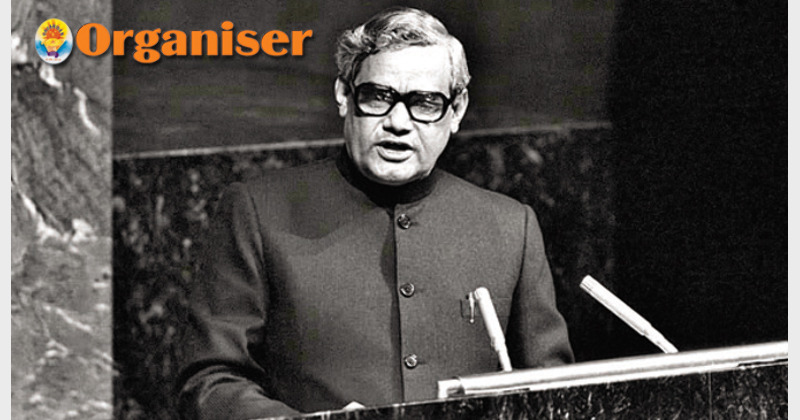
Through his assertive articulation and dynamic execution, Atal ji provided edifice for the new vibrant India that we are experiencing today
All Prime Ministers leave their mark on India’s foreign policy. Nehru is associated with India’s policy of non-alignment, Shastri for the pluck he demonstrated in the 1965 war with Pakistan, Indira Gandhi with the creation of Bangladesh, Manmohan Singh with the India-US nuclear deal, Modi with an exceptionally energetic foreign policy, rise of India’s stature abroad as an emerging power, projecting India’s leadership on energy issues such as the International Solar Alliance, wooing the diaspora as never before and leveraging the country’s civilisational assets to boost India’s global impact.
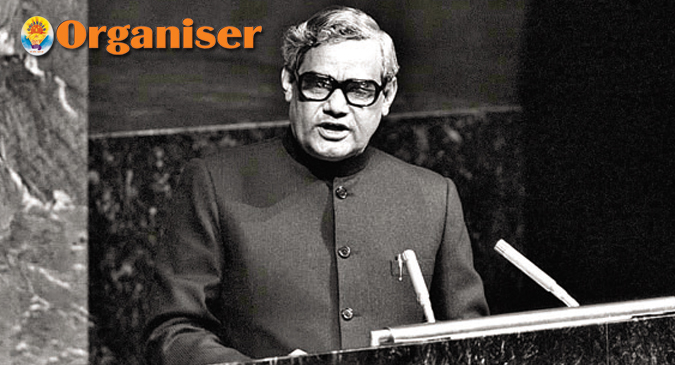
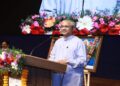
Atal Behari Vajpayee delivering speech at the UN General Assembly as Foreign Minister on October 4, 1977
Former Prime Minister Atal Behari Vajpayee’s outstanding contribution to India’s foreign policy was the bold step to go nuclear in 1998. India had begun developing its civilian nuclear capability in Nehru’s time. In 1974 it conducted a peaceful nuclear explosion (PNE) under Indira Gandhi’s watch but proceeded no further in developing and testing nuclear explosion technology. Led by the US international sanctions imposed on India for the PNE through cartels set up specifically to deny India access to nuclear and dual-use technologies. Negotiations for a Comprehensive Test Ban Treaty (CTBT) and the Fissile Missile Cut-Off Treaty (FMCT) were initiated essentially to freeze, roll-back and eventually eliminate India’s nuclear capability in line with America’s publicly declared policy. Even when France and China conducted nuclear tests while negotiations for the CTBT were being conducted, India missed a an opportunity to test. In the mid-90s Narasimha Rao made some preparations to conduct a nuclear weapon test but desisted under US pressure. Domestic voices in India also opposed testing for fear of economic sanctions at a time when India had begun a process of liberalising its economy and keenly sought foreign investment for its economic development. It is in this background that the importance of Vajpayee’s daring and audacious act to conduct a series of nuclear weapons tests in May 1998 should be seen. India’s acquisition of nuclear deterrence capability raised its international stature and changed its equation with the rest of the world, including with America with which the basis of an eventual strategic partnership was laid.
It is remarkable that following an act of defiance that rocked America’s decades old international non-proliferation crusade Vajpayee could remark that India and the US were “natural partners”, a phrase that has since been repeated by both India and American leaders and has figured in their joint statements. In the context of the non-aligned roots of India’s foreign policy, announcing that India and the US were natural partners indicated how much Indian thinking about America had changed. In a sense Modi’s remark in his address to the US Congress in June 2016 that India had overcome the hesitations of history in its relations with the US enunciated the same thought as Vajpayee’s in different words. It is under Vajpayee that the foundations of the India-US nuclear deal were laid, to begin with by the establishment of High Technology Control Group as a platform to examine how American export controls on the transfer of technologies to India could be eased and under what conditions. A dialogue of the Next Steps in Strategic Partnership (NSSP) was begun in which the issues of civilian nuclear and space cooperation were put on the agenda. Shri Vajpayee personal equation with President Bush was crucial in obtaining White House support and oversight for the NSSP process so that traditionally difficult State Department attitudes towards India on non-proliferation issues did not obstruct tangible progress.
Vajpayee had a vision of India’s national interest
Yet, Vajpayee protected India’s policy-making Independence even as the India-US relationship moved towards more convergence. Despite America’s blandishments and support form some circles to send troops to Iraq to assist in the post-war stabilisation of the country, Vajpayee handled the situation with finesse, maintaining the position that India would consider sending troops pursuant only to a UN resolution and under UN command, and obtaining all-party support for this position so that it appeared as a national decision and not merely that of the ruling government. A vital mistake was avoided.
Armed with nuclear weapons capability that closed the deterrence gap with its adversaries and a new equation with the US that affected perceptions about India’s widened foreign policy options, Vajpayee reached out to China to explore whether its assessment of future ties with India might have evolved and whether it was prepared to show increased openness about settling the outstanding boundary issue with India. During his visit to China in June 2003 the mechanism of the Special Representatives (SR) to explore the framework of a boundary settlement from the “political perspective of the overall bilateral relationship”, rather than legal and historical arguments to bolster respective claims, was established. The discussion on the Political Parameters and Guiding Principles for resolving the boundary issue was also initiated during Vajpayee’s prime ministership, though it was finalised under Manmohan Singh. A significant outcome of the visit was the indirect recognition by China of Sikkim as part of India, achieved through a Memorandum between India and China on expanding border trade. In the joint declaration issued on the occasion of the visit, India recognised the Tibetan Autonomous Region (TAR) as part of the territory of the People’s Republic of China, a seeming concession that elicited some critical comments. In actual fact, India had recognised Tibet as part of China way back in 1954 and therefore whatever the formulation used thereafter was a question of semantics. The 2003 formulation implicitly denied recognition of Tibet as a historical entity being a part of historical China, besides the nuance, it carried that the artificially drawn up frontiers of TAR were part of “Communist China” that had occupied Tibet in 1950.
To maintain a balance in our foreign policy Vajpayee nurtured our time-tested relations with Russia.
Pakistan is a hard nut to crack, and no Indian Prime Minister has found a way to do it. Vajpayee showed much goodwill to a perpetually hostile Pakistan for peace and stability in the sub-continent. His bus ride to Pakistan in 1999 was a remarkably bold move. Unfortunately, it was reciprocated by Kargil misadventure, which India repulsed decisively Vajpayee’s statesman-like vision induced him to invite the architect of Kargil, General Musharraf, to the Agra summit in 2001 but Pakistan responded with a terrorist attack on the Indian parliament in 2001, leading to India massing its troops on the Pakistani border. An imminent military conflict was averted through international diplomacy and Vajpayee’s strong commitment to peace even under the most trying conditions. Knowing that there was no alternative but to engage Pakistan, Vajpayee travelled to Islamabad in January 2004 when in the Islamabad Declaration Pakistan committed itself not to allow any territory under its control against any country. It seemed as if a breakthrough had been achieved, but then if this expectation was soon belied it spoke more of Pakistan’s perfidy than Vajpayee’s brave efforts to change the course of India-Pakistan relations.
Vajpayee had a vision of India’s national interest which he believed could be advanced through developing
friendship, nourishing existing ones and mitigating old enmities within a framework of peace.
(The writer is a distinguished career diplomat who retired as Foreign Secretary to Govt of India)