AstroSat unravels how hot stars evolve in Globular Clusters in the Milky Way
July 8, 2026
  • Read Ecopy
  • Circulation
  • Advertise
  • Careers
  • About Us
  • Contact Us
Android AppiPhone AppArattai
Organiser
  • ‌
  • Bharat
    • Assam
    • Bihar
    • Chhattisgarh
    • Jharkhand
    • Maharashtra
    • View All States
  • World
    • Asia
    • Europe
    • North America
    • South America
    • Africa
    • Australia
  • Editorial
  • International
  • Opinion
  • RSS @ 100
  • More
    • Op Sindoor
    • Analysis
    • Sports
    • Defence
    • Politics
    • Business
    • Economy
    • Culture
    • Special Report
    • Sci & Tech
    • Entertainment
    • G20
    • Azadi Ka Amrit Mahotsav
    • Vocal4Local
    • Web Stories
    • Education
    • Employment
    • Books
    • Interviews
    • Travel
    • Law
    • Health
    • Obituary
  • Subscribe
    • Subscribe Print Edition
    • Subscribe Ecopy
    • Read Ecopy
  • ‌
  • Bharat
    • Assam
    • Bihar
    • Chhattisgarh
    • Jharkhand
    • Maharashtra
    • View All States
  • World
    • Asia
    • Europe
    • North America
    • South America
    • Africa
    • Australia
  • Editorial
  • International
  • Opinion
  • RSS @ 100
  • More
    • Op Sindoor
    • Analysis
    • Sports
    • Defence
    • Politics
    • Business
    • Economy
    • Culture
    • Special Report
    • Sci & Tech
    • Entertainment
    • G20
    • Azadi Ka Amrit Mahotsav
    • Vocal4Local
    • Web Stories
    • Education
    • Employment
    • Books
    • Interviews
    • Travel
    • Law
    • Health
    • Obituary
  • Subscribe
    • Subscribe Print Edition
    • Subscribe Ecopy
    • Read Ecopy
Organiser
  • Home
  • Bharat
  • World
  • Operation Sindoor
  • Editorial
  • Analysis
  • Opinion
  • Culture
  • Defence
  • International Edition
  • RSS @ 100
  • Magazine
  • Read Ecopy
Home Bharat

AstroSat unravels how hot stars evolve in Globular Clusters in the Milky Way

AstroSat is India's first dedicated multi-wavelength space observatory launched by the Indian Space Research Organisation in 2015

Archive ManagerArchive Manager
Nov 29, 2018, 07:27 pm IST
in Bharat
Follow on Google News
FacebookTwitterWhatsAppTelegramEmail

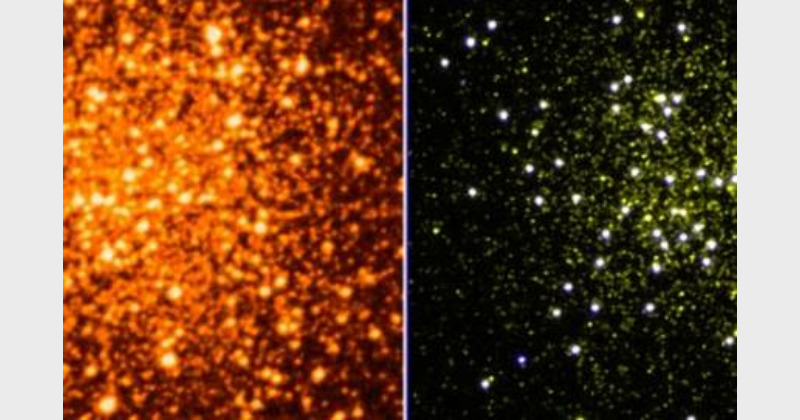
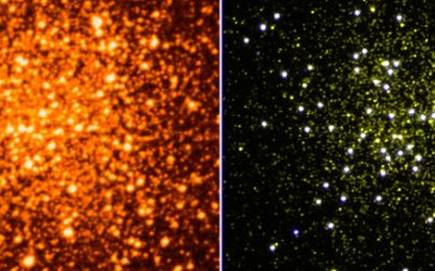
The picture of NGC 288 in the optical (left side; credit: ESO/DSS) shows numerous sun-like cooler stars and
it is hard to locate hot stars. The image of the same cluster in the ultraviolet (right side, taken by UVIT, yellow is
the near-UV and white is the far-UV image; credit: Snehalata Sahu) shows only hot stars as the cooler stars become undetectable
Niruj Mohan Ramanujam
Pune, November 29 (India Science Wire): Indian astronomers have peered deep into the Globular Cluster NGC 288, using the Ultraviolet Imaging Telescope (UVIT) on AstroSat to uncover the nature of special kinds of stars. The image of this cluster is the AstroSat Picture of the Month for November. AstroSat is India’s first dedicated multi-wavelength space observatory launched by the Indian Space Research Organisation in 2015.
 
Galaxies are made of innumerable stars, some of which are single, like our Sun while others are grouped together in clusters. Our Milky Way has over 150 Globular Clusters. These are clusters of hundreds of thousands of stars held together by their own gravity, packed into a size of only few tens of light years. They orbit the centre of the Milky Way as one unit. NGC 288, located around 30000 light years from the earth is one such Globular Cluster that was imaged by UVIT in three different ‘ultraviolet colours’.
 
“Stars are not unchanging objects. They are born, they evolve through various stages of their life, and then they die,” explains Snehalata Sahu, a Ph.D. student at Bangalore-based Indian Institute of Astrophysics and lead author of research paper on NGC 288 published in Monthly Notices of the Royal Astronomical Society.
 
Stars of different masses go through different paths in their evolution. As they do so, their intrinsic luminosity as well as their surface temperature (and hence colour) changes in different ways depending on their mass. Astronomers name different types of stars which are in various phases of their evolution, by their location in this luminosity versus temperature plot. This study has thrown up interesting results for two such kinds of stars, the Blue Horizontal Branch (BHB) stars and the Blue Straggler (BS) stars in the cluster NGC 288.
 
All stars in a Globular Cluster are born together, and are of the same age. They are also about the same distance from us. “Hotter stars are bluer and are bright in the ultraviolet (UV), where they are best studied,” said Professor Annapurni Subramaniam, a co-author of the paper.
 
UVIT has the unique capability of imaging a large field of view with high resolution. “This helped us not only image the entire cluster up to its outer most regions but also isolate every individual hot star even in the crowded centre of the cluster,” she added. This gave researchers advantage over previous ultraviolet studies of such clusters. They could measure near-UV and far-UV brightness of 115 HB stars, 68 BS stars and 2 Extreme HB (EHB) stars in NGC 288. Combining this data with already known optical properties of these stars, they could accurately model each of these UV-bright stars individually, and derive their temperatures as well.
 
“We first looked at the UV properties of the bluer HB stars and could easily distinguish between those stars cooler than 11500 degrees and those that are hotter,” said Sahu. “This change in stellar properties at 11500 degrees is due to atomic diffusion, which alters chemical make-up of outer layers of the star. We have now shown that this break can be easily identified from ultraviolet measurements of these stars and this method can now be used for other clusters as well.”
 
Professor Kameswara Rao, a co-author of the study, explained that the team could calculate the mass and size of the EHB stars as well. “We were able to identify these as sub-dwarf stars, about five times smaller than our Sun, but more than five times hotter. This was possible mainly because we could measure their ultraviolet properties”.

The location of stars within a globular cluster changes with time as heavier ones settle into the centre. Blue Straggler or BS stars are interesting in themselves. In crowded centres of Globular Clusters, some stars swallow matter from a companion star and sometimes two stars merge to form a new one too. Astronomers believe that BS stars are formed this way, and that’s why their ultraviolet properties are so different. By calculating the mass of each BS star from their ultraviolet data, and by studying their locations in the cluster, researchers could infer the nature of the motion of the stars within the cluster, otherwise known as its dynamical age.

 
“We have now shown that ultraviolet imaging of Globular Clusters is the easiest and clearest way to study the properties of some of these hot stars with peculiar properties. The superior resolution and large field of view of UVIT will prove crucial in understanding the evolution of these kinds of stars,” said Rao.
 
The study was conducted by Snehalata Sahu, Annapurni Subramaniam and Kameswara Rao from the Indian Institute of Astrophysics, along with Patrick Cote and Peter Stetson from the National Research Council of Canada.
 
AstroSat Pictures of the Month (APOM) is a joint initiative of the Public Outreach and Education Committee (POEC) of the Astronomical Society of India and AstroSat Training and Outreach Team. APOM helps in bringing higher energy sky seen by AstroSat closer to people through images. All APOMs are archived at http://astron-soc.in/outreach/all-apoms/

ShareTweetSendShareSend
✮ Subscribe Organiser YouTube Channel. ✮
✮ Join Organiser's WhatsApp channel for Nationalist views beyond the news. ✮
Previous News

?Nation expected to achieve 100% household electrification by December 31?: Union Power Minister R K Singh

Next News

PSLV-C43 successfully launches earth observation satellite HysIS and 30 foreign satellites

Related News

NIA Cracks Down on Cambodia Human Trafficking Racket

Cambodia-linked human trafficking, cyber slavery case: NIA raids six places in Bihar, UP, Delhi

ASI declares Telangana’s Palampet Shiva Temple, Andhra Pradesh’s Gottiprolu site monuments of national importance

Allahabad High Court opens the door to the Tejo Mahalaya inquiry; First step in reclaiming civilisational glory

Tibetan man self-immolates outside the UN, protesting the repressive policies of China & Xi Jinping

Tibetan man self-immolates outside UN: Protests against repressive Chinese policies & demands independence from Beijing

The Constitution remains the supreme legal framework governing equality, affirmative action, and executive power in Bharat

Religious Conversion in Tamil Nadu: Restoring the fundamental

Keralam: Tiruvananthapuram Corporation official attacked while stopping illegal waste dumping in Amayizhanjan Canal

Load More

Latest News

NIA Cracks Down on Cambodia Human Trafficking Racket

Cambodia-linked human trafficking, cyber slavery case: NIA raids six places in Bihar, UP, Delhi

ASI declares Telangana’s Palampet Shiva Temple, Andhra Pradesh’s Gottiprolu site monuments of national importance

Allahabad High Court opens the door to the Tejo Mahalaya inquiry; First step in reclaiming civilisational glory

Tibetan man self-immolates outside the UN, protesting the repressive policies of China & Xi Jinping

Tibetan man self-immolates outside UN: Protests against repressive Chinese policies & demands independence from Beijing

The Constitution remains the supreme legal framework governing equality, affirmative action, and executive power in Bharat

Religious Conversion in Tamil Nadu: Restoring the fundamental

Keralam: Tiruvananthapuram Corporation official attacked while stopping illegal waste dumping in Amayizhanjan Canal

RSS Sarsanghchalak Dr Mohan Bhagwat

Karnataka: Red zone declared in Belagavi as RSS Sarsanghchalak Mohan Bhagwat arrives for eight-day visit

From Left - Vikram Malkani (son of KR Malkani, former Editor, Organiser), former Editor R Balashankar, former Editor Seshadri Chari, RSS Sarkaryavah Dattatreya Hosabale, Daughter of Organiser's first Editor AR Nair - Vijaya Lakshmi, great- granddaughter of , AR Nair, Hon'ble Vice President of Bharat CP Radhakrishnan, Managing Editor, BPDL Arun Kumar Goyal, RSS Delhi Prant Sanghchalak Anil Agarwal, Daughter of Organiser's former Editor LK Advani - Pratibha Advani and Organiser Editor Prafulla Ketkar

80 Years of Organiser: Voice of the nation’s soul

Dr Syama Prasad Mookerjee

Inspiring Generation Z: The ideals of Dr Shyama Prasad Mookerjee

Prime Minister Narendra Modi and Indonesia President Prabowo Subianto

PM Modi addresses Indonesia Parliament; Malacca Strait, critical minerals, cultural diplomacy power strategic ties

Load More
  • Privacy
  • Terms
  • Cookie Policy
  • Refund and Cancellation
  • Delivery and Shipping

© Bharat Prakashan (Delhi) Limited.
Tech-enabled by Ananthapuri Technologies

  • Home
  • Search Organiser
  • Bharat
    • Assam
    • Bihar
    • Chhattisgarh
    • Jharkhand
    • Maharashtra
    • View All States
  • World
    • Asia
    • Africa
    • North America
    • South America
    • Europe
    • Australia
  • Editorial
  • Operation Sindoor
  • Opinion
  • Analysis
  • Defence
  • Culture
  • Sports
  • Business
  • RSS @ 100
  • Entertainment
  • More ..
    • Sci & Tech
    • Vocal4Local
    • Special Report
    • Education
    • Employment
    • Books
    • Interviews
    • Travel
    • Health
    • Politics
    • Law
    • Economy
    • Obituary
  • Subscribe Magazine
  • Read Ecopy
  • Advertise
  • Circulation
  • Careers
  • About Us
  • Contact Us
  • Policies & Terms
    • Privacy Policy
    • Cookie Policy
    • Refund and Cancellation
    • Terms of Use

© Bharat Prakashan (Delhi) Limited.
Tech-enabled by Ananthapuri Technologies