Standing at the crossroads of time, technology and tradition, we should venture to fashion a mindset that is both ecologically and economically viable. Bharatiya environmental wisdom can be our guiding light
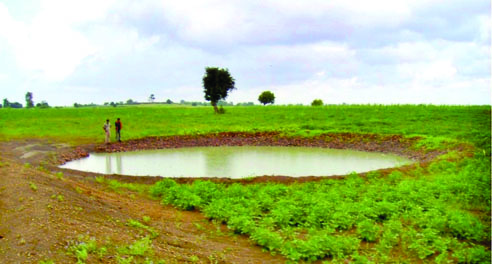
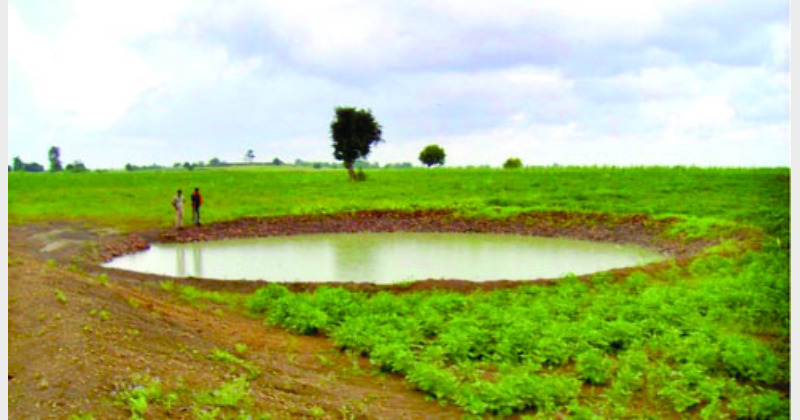
A basic need for all the industries that were established by Indians, to survive and flourish, is water. Until as recent as 150 years ago, rivers along with small water bodies catered to the water requirements of the whole country. These rivers were verily the nerves of the country feeding life sustaining water to all parts of the land.
The tanks were called Kere in Karnataka, Eri in Tamil Nadu and Cheruvu in Andhra Pradesh. In a chain, every Kere, Eri and Cheruvu, in every village, was linked to the other, right from the Western Ghats to the Bay of Bengal.
Rain waters were collected and stored in these local tanks as and when the rains fell. Once a tank was filled up, the overflow was channeled to the next in the natural gradient from the west coast to the east coast of India.
The water thus collected flowed through every village of the Carnatic region, from the slopes of the Western Ghats to the Bay of Bengal. This chain of tanks ensured that every village in this region got water irrespective of whether it had rained there or not.
Likewise, people all across India had ingeniously designed indigenous water harvesting systems for collecting water when it rained locally. Our ancestors had realised that such a step was very essential for a land that is predominantly monsoon dependent.
Various industries thrived since water was aplenty. But the plenty was timed. If Indians could be create ways to store it, then they could rest assured of continued supply throughout the year.
Local Water Bodies
The point to be noted here is that, it was not large scale storages in remote locations, across flowing rivers, for use across a large spread of geography far away from the rivers. It was a case of harvesting falling rain, locally. Not of damming flowing rivers. It was a case of harvesting locally in small scale in many places, for use in that locality.
Thus the harnessing had a small footprint, but put together all these small bodies were sufficient to look after the needs of the entire civilisation. There were 9 lakh such local water bodies for 6 lakh villages of India. i.e. 3 water bodies for 2 villages .
These rivers and local water bodies were the real rejuvenators. They were rejuvenated every year by the monsoons and they in turn rejuvenated Bharat through the rest of the year. Alas! These rivers and water bodies which are rejuvenators, themselves need rejuvenation. In the name of development, we have polluted, neglected and destroyed our local water bodies. As a civilised society, if we can restore what our ancestors had created for us, we can again be prosperous and harmonious for centuries to come. Once we rejuvenate these local water bodies, they will rejuvenate themselves and us, as a civilisation for centuries and millennia to come again.
Bhartiya Alternative
The industry and economic model that we follow in current times has led to much destruction of the Environment. The erstwhile industrial model of Bharat was akin to the natural feeding pattern of a free roaming elephant. Elephants roam in herds. They have a voracious appetite but they hardly destroy the forests they live in.
Elephant herds keep moving around in their habitat which is a wide area within the forest. They do not confine themselves to any one spot for long. Such strolling paths of the elephants are called Elephant Corridors.
Elephants eat extensively, tearing down a few branches from each tree as they move along through the wide span of their habitat. They do not eat intensively in one area alone. Also, as they pass by, they fertilize the forest ground with their large quantities of dung. Hence, by the time the elephants return to the same spot in their corridor, the vegetation gets enough time and nourishment to sprout back. The fodder is once again ready for the elephants. This is nature’s way of ensuring that the green cover of the forests is not destroyed due to the voracious appetite of the large herds of these huge creatures.
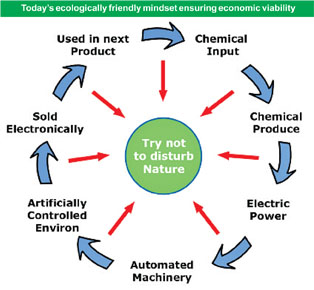
Whereas humans in the modern era, for their factories, manufacturing plants with large investments, exploit resources intensively in just one area, sucking dry its natural resources, in every sense of the word, irreversibly and irrecoverably!
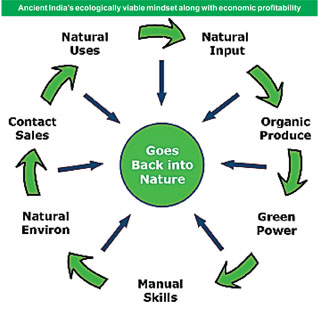
Even Nature, who managed to safeguard herself from the voracious appetite of the huge elephantine creatures, stands vulnerable in front of the rapacious greed of the small built humans. The ancient Indian model of widespread industry was an Extensive Industrial model. The balance between Economy and Ecology was maintained and sustained well through many footprints, which were but, small and spread out wide. There were many small sized industrial units spread all across the land, harvesting resources available locally and producing suitable products. Each unit produced its product end to end i.e right from taking in raw inputs to bringing out the crafted product.
These small units, akin to industrious ants, collectively were elephantine in strength. Colonial records of manufacture and trade from these small scale units put together were commendable and comparable to present times.
The extensive spread of small scale industries throughout the hinterland, with non-intensive style of harvesting from Nature, conserved the ecology and environment. A supporting wide spread network of tradesmen and merchants across towns and cities, with concerted aggregating of the produce, consolidated economy.
These two were the source and secret of Bharat’s sustained prosperity. Together, they produced and supplied enough for themselves and the world. Together they created an ECO-ECO Mindset throughout Bharat. Such a model is easily implementable in the present and near future too, with the present day advances achieved in communication and transportation. It will be a prudential use of these technological advancements to aggregate for trade, than for maintaining large footprints, centralised production setups.
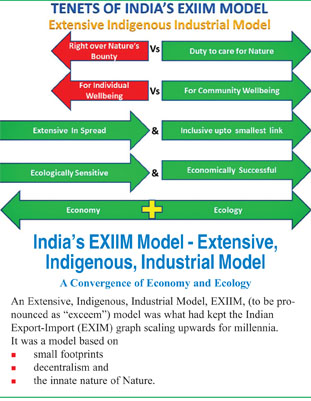
Focussing on only one side and not the other will cause both to fail. That is, both production and trade have to go hand in hand, driven by a philosophy of sustainable production driving what one can trade in. It should not be the other way round, where trade drives how much and what one should produce, for, this model is unbounded by greed.
This was the sustainable philosophy that our ancestors had held on to, which ensured self-restraint and contentment. Sadly, this is not the case today. We do not take with restraint from the environment. We are never content with how much we have taken from the environment. We have created and sustained the Greed in us more than the Environment around us.
In the traditional “Make the Indian Way”, “Ecological Viability” was the measure of the Return on Investment made by Nature, in the process of:
It was more than “Ecologically Viable” for they were allowing Nature to do her job and in the bargain were gaining health and wealth. In fact, the returns were therefore a lot more than just being “Economically Friendly” like for instance:
· Continuous green cover on land due to sustained cultivation of raw materials.
· All round development of villages as centres of manufacturing of the natural produce.
· All round physical health of the populace as they were kept fit with all the manual labour in Natural habitat, vis-à-vis just standing and monitoring machines in polluting and harmful factories.
· Positive benefits of a sustained green cover such as more rains, more water, cooler climate, more moisture, more flora, more fauna, more oxygen, less pollution, less Ozone depletion and the likes.
· Good cultural exchanges due to trade with far and near lands
It seems to have been sustainable for the ecology, economy as well as every entity in the economic and cultural chain.
Which Eco to choose Today?
In modern times, we find that the word “viability” has a connotation of more than “feasibility” or “practicality”. It has an additional association with “profitability”. In that, it denotes the returns obtained, over and above what has gone in. So, when one says “Economically viable”, what one actually wants to convey is that, one expects more than what one has ploughed in.
Economic viability actually goes many steps further. Not only does it connote a notion of profitability, viability is also driven by an underlying ethos of multiplicity wherein, the measure of profitability has to be at least many times more than what has gone in.
Likewise, the term “friendly”, functions more as an antonym of “enemy” than as a synonym of “gracious” or “benevolent”. In that, the term “friendly” is used to convey that one is trying one’s best to prevent or do as much less harm as possible in one’s pursuit of enriching oneself. It does not necessarily mean that one is really being benevolent or acting in other’s interest.
(The writers are the founders of Bharath Gyan)