Sanskrit in Madrasas: Shaping new Dara Shikohs
June 6, 2026
  • Read Ecopy
  • Circulation
  • Advertise
  • Careers
  • About Us
  • Contact Us
Android AppiPhone AppArattai
Organiser
  • ‌
  • Bharat
    • Assam
    • Bihar
    • Chhattisgarh
    • Jharkhand
    • Maharashtra
    • View All States
  • World
    • Asia
    • Europe
    • North America
    • South America
    • Africa
    • Australia
  • Editorial
  • International
  • Opinion
  • RSS @ 100
  • More
    • Op Sindoor
    • Analysis
    • Sports
    • Defence
    • Politics
    • Business
    • Economy
    • Culture
    • Special Report
    • Sci & Tech
    • Entertainment
    • G20
    • Azadi Ka Amrit Mahotsav
    • Vocal4Local
    • Web Stories
    • Education
    • Employment
    • Books
    • Interviews
    • Travel
    • Law
    • Health
    • Obituary
  • Subscribe
    • Subscribe Print Edition
    • Subscribe Ecopy
    • Read Ecopy
  • ‌
  • Bharat
    • Assam
    • Bihar
    • Chhattisgarh
    • Jharkhand
    • Maharashtra
    • View All States
  • World
    • Asia
    • Europe
    • North America
    • South America
    • Africa
    • Australia
  • Editorial
  • International
  • Opinion
  • RSS @ 100
  • More
    • Op Sindoor
    • Analysis
    • Sports
    • Defence
    • Politics
    • Business
    • Economy
    • Culture
    • Special Report
    • Sci & Tech
    • Entertainment
    • G20
    • Azadi Ka Amrit Mahotsav
    • Vocal4Local
    • Web Stories
    • Education
    • Employment
    • Books
    • Interviews
    • Travel
    • Law
    • Health
    • Obituary
  • Subscribe
    • Subscribe Print Edition
    • Subscribe Ecopy
    • Read Ecopy
Organiser
  • Home
  • Bharat
  • World
  • Operation Sindoor
  • Editorial
  • Analysis
  • Opinion
  • Culture
  • Defence
  • International Edition
  • RSS @ 100
  • Magazine
  • Read Ecopy
Home Bharat

Sanskrit in Madrasas: Shaping new Dara Shikohs

Will Sanskrit resonate in Madrasas? The very idea makes one sit up because traditionally Madrasas are identified with orthodox Islamic teaching that affords hardly any chance for students

Archive ManagerArchive Manager
Jan 9, 2018, 01:25 pm IST
in Bharat
Follow on Google News
FacebookTwitterWhatsAppTelegramEmail


Sanskrit in Madrasas would help students explore their

career in subjects like Yoga and Ayurveda, besides improving their cultural perspective

Ajay Bhardwaj

Will Sanskrit resonate in Madrasas?  The very idea makes one sit up because traditionally Madrasas are identified with orthodox Islamic teaching that affords hardly any chance for students to expose themselves to other streams of education.
Uttarakhand seems to be taking lead in the direction after the  Dehradun-based Madrasa Welfare Society mooted a proposal to introduce Sanskrit as a subject in Madrasas.
The move comes at a time when the UP government has already undertaken slew of measures  to bring about reforms in the Madrasa education system, including introduction of the NCERT books in the curriculum.
However, at a time when the number of Sanskrit readers has been dwindling, becoming a major cause of concern among Sanskrit scholars, the initiative of the Uttaranchal society has come in as a whiff of fresh air, reminiscent of the times when the Muslims would
fondly take to Sanskrit  to widen their horizons of knowledge, as much as to become conversant with the
culture of the land they had come to inhabit.  The 17th century Dara Shukoh, who translated Upanishads from Sanskrit to Persian, being an outstanding example of it.
The Madrasa welfare society last month sought the state government to appoint Sanskrit teachers for Madrasas which are ready to include Sanskrit in the curriculum.
If implemented, it could go a long way in dispelling misgivings about education in Madrasas and open new doors to cultural bonhomie in the state.
Not just that, it might become an example for Madrasas in other states to emulate to broaden the perspective of students who rarely get a chance to go beyond Persian or Arabic languages.

Chanting
Gayatri Mantra

In Mandsaur district of Madhya Pradesh, Hindu and Muslim kids recite ‘Gayatri Mantra’ under one roof in a madrasa. The recital of ‘Gayatri Mantra’ is a part of morning prayer in the madrasa. There are more than 100 Madrasas where basics of both Islam and Hinduism (Sanatan Dharma) are taught. Surprisingly, more than 55% of the students enrolled belong to the Hindu community.
A non-governmental organisation (NGO)—Nida Mahila Mandal, led by Talat Qureshi, runs these madrasas where 5,000
students are enrolled. 865
teachers, out of which 630 are Hindus, teach in the madrasas. “We have designed special books of 16 Sanskaras and Deeniyat for Hindu and Muslim students, respectively,” said a teacher.    n
 (Courtesy India.com)

Sibte Nabi, chairperson of the welfare society, which manages more than 200 Madrasas in Dehradun, Haridwar, Nainital and Udham Singh Nagar, in a letter to Chief Minister TS Rawat said, “All 207 Madrasas that we are
connected with, are welcoming the idea of including Sanskrit in their curriculum. We want the Madrasas educated students to be able to
pursue course in Ayurveda studies, which is currently impossible since our students do not have any
understanding of the language
integral to Ayurveda studies”.
Students are also interested in studying Yoga which has been gaining popularity these days, but they find themselves completely at sea in this.
He said shedding their orthodox Islamic mindset several students and their parents had expressed a desire to learn the ancient language in order to acquire working
knowledge.
The present initiative has been undertaken purely on the basis of suggestions and requests made by students and their parents, he added.
Sanskrit Not So Alien Sanskrit, in any case, is not an alien language to the Muslims as there are a number of Islamic scholars who are well-versed in Sanskrit
as well.

Hindus in
Madrasas

Moin-ul-Islam madrasa is perhaps the only Islamic institute which not only
encourages co-education but also teaches Sanskrit and Arabic languages to students of both Hindu and Muslim community.
More than 400 students, of which nearly 150 are Hindus, study in Moin-ul-Islam madrasa, located nearly nine kilometres from the heart of Agra city in Deoretha-I area. Opened in 1926, the madrasa started admitting Hindu children since 2005.
The students are fluent in reading and writing Arabic, Urdu, Hindi, English and Sanskrit. The madrasa, which has classes from I to VIII,
also teaches Computer, Mathematics, Science and Social Studies to students. As per school records, more than 60% of students are Hindus studying in classes VI to VIII.
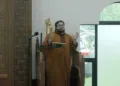
“We introduced Sanskrit last month after consulting religious scholars and others. The idea behind the initiative, was to embed wholesome knowledge, ethics and tolerant approach in life,” said principal of the madrasa Maulana Uzair Alam.
“Our students not only learn Arabic and Sanskrit to
understand the two religions, but also to outsmart the
students in terms of knowledge.
At present Sanskrit is being taught by three teachers, including one retired school principal from the Hindu
community. “In a week we take two-three classes of Sanskrit and teach them basics.    n
(Courtesy India.com)

Nabi said there were around 25,000 students enrolled in the Madrasas managed by the society. The Madrasas on their own were not able to engage  Sanskrit teachers because of the financial burden it would entail. So it would not be achieved without the assistance of the state government or may be that of the Central government under the Scheme to Provide Quality Education in Madrasas (SPQEM).
The Uttarakhand Madrasa Education Board, which manages the curriculum of Madrasas and provides facilities for improvement of infrastructure, has, however, not received any formal request for the purpose.
Akhlaq Ahmad Ansari, deputy registrar of the Board said, the proposal had not yet been received by the Board. “Maybe, it would come via Chief Minister’s office with
comments or recommendations”, he said.
Ansari clarified that there were already four languages listed for students in the Madrasas. Persian and Arabic for their basic studies, English and Hindi have been added to enable them to get space in the market.
He said besides languages the students were required to study other subjects as well. Yet in the given circumstances, maybe Sanskrit as an optional subject would be introduced if the students so desired.   

ShareTweetSendShareSend
✮ Subscribe Organiser YouTube Channel. ✮
✮ Join Organiser's WhatsApp channel for Nationalist views beyond the news. ✮
Previous News

Diplomacy : Diplomatic Strides

Next News

National Register of Citizens/ Assam : Sifting the Chaff

Related News

Police in AAP-Ruled state of Punjab lathi charge sit-in protesters

Punjab: ITI candidates seeking jobs lathi-charged outside PSPCL HQ; opposition slams AAP Govt over police action

From constables to DGP, India's police system follows a structured chain of command that governs law enforcement across the country

From Constable to DGP: Understanding India’s police hierarchy, powers & recruitment system

The terracotta dice that challenges historical assumptions and highlights India's millennia-old civilisational heritage

How a 4,500-year-old terracotta dice is reviving the debate on India’s civilisational continuity & Vedic heritage

The Porumamilla inscription and the ancient science behind a reservoir that survived 650 years

India’s 655-Year-Old Water Policy: The Porumamilla inscription that turned stone into a manual of hydrology

India’s Permanent Representative to the United Nations Ambassador Harish Parvathaneni

India slams Pakistan at UNSC for peddling false narratives on Jammu & Kashmir

Keralam: Pathanamthitta temple property occupied beyond lease period reclaimed by devotees

Load More

Latest News

Police in AAP-Ruled state of Punjab lathi charge sit-in protesters

Punjab: ITI candidates seeking jobs lathi-charged outside PSPCL HQ; opposition slams AAP Govt over police action

From constables to DGP, India's police system follows a structured chain of command that governs law enforcement across the country

From Constable to DGP: Understanding India’s police hierarchy, powers & recruitment system

The terracotta dice that challenges historical assumptions and highlights India's millennia-old civilisational heritage

How a 4,500-year-old terracotta dice is reviving the debate on India’s civilisational continuity & Vedic heritage

The Porumamilla inscription and the ancient science behind a reservoir that survived 650 years

India’s 655-Year-Old Water Policy: The Porumamilla inscription that turned stone into a manual of hydrology

India’s Permanent Representative to the United Nations Ambassador Harish Parvathaneni

India slams Pakistan at UNSC for peddling false narratives on Jammu & Kashmir

Keralam: Pathanamthitta temple property occupied beyond lease period reclaimed by devotees

A series of high-level engagements signals New Delhi's growing focus on building interoperable security networks across the Indo-Pacific

India strengthens Indo-Pacific security architecture with new defence and maritime partnerships

Prime Minister Narendra Modi

“Makes every Indian proud”: PM Modi hails India’s 7.7 per cent GDP growth in FY 2025-26

Once known for maoist violence, Minpa now leads healthcare revolution with telemedicine services in Sukma

From Maoist Stronghold to Healthcare Hub: How Chhattisgarh’s Minpa is transforming through telemedicine & development

Dr Surendra Jain, Joint General secretary, VHP

VHP Demands Audit of Waqf Properties Amid Encroachment Claims: “Land should go to rightful owner,” says Surendra Jain

Load More
  • Privacy
  • Terms
  • Cookie Policy
  • Refund and Cancellation
  • Delivery and Shipping

© Bharat Prakashan (Delhi) Limited.
Tech-enabled by Ananthapuri Technologies

  • Home
  • Search Organiser
  • Bharat
    • Assam
    • Bihar
    • Chhattisgarh
    • Jharkhand
    • Maharashtra
    • View All States
  • World
    • Asia
    • Africa
    • North America
    • South America
    • Europe
    • Australia
  • Editorial
  • Operation Sindoor
  • Opinion
  • Analysis
  • Defence
  • Culture
  • Sports
  • Business
  • RSS @ 100
  • Entertainment
  • More ..
    • Sci & Tech
    • Vocal4Local
    • Special Report
    • Education
    • Employment
    • Books
    • Interviews
    • Travel
    • Health
    • Politics
    • Law
    • Economy
    • Obituary
  • Subscribe Magazine
  • Read Ecopy
  • Advertise
  • Circulation
  • Careers
  • About Us
  • Contact Us
  • Policies & Terms
    • Privacy Policy
    • Cookie Policy
    • Refund and Cancellation
    • Terms of Use

© Bharat Prakashan (Delhi) Limited.
Tech-enabled by Ananthapuri Technologies