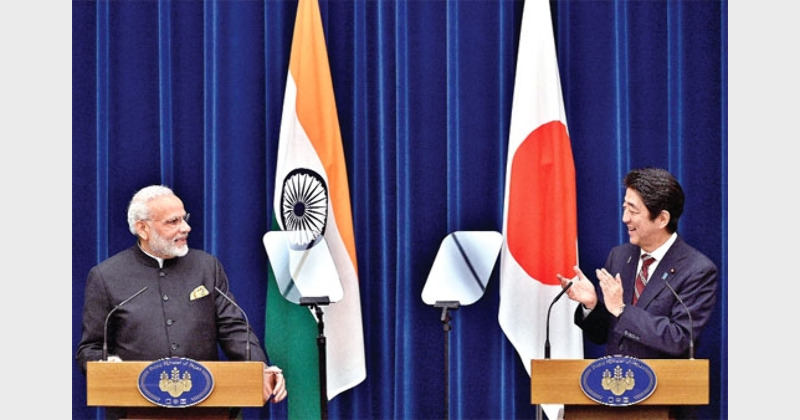
The Modi-Abe summit in Tokyo on November 11 was most timely. It provided an occasion not only to consolidate the strategic underpinnings of India-Japan ties but also appraise the impact of Donald Trump’s election on the Asia-Pacific region. In recent years, India-Japan relations have acquired growing strategic salience for both countries for several reasons. For India, Japan is above all a coveted
economic partner as it has the financial resources, technology and the political will under Abe to forge a strong
partnership with India and thus meaningfully promote the realisation of the Modi Government’s ambitious
development agenda.
A rising China has begun to unveil its expansionist ambitions in the
western Pacific, causing concern in the region and beyond. By laying claim to the Senkaku islands China has
provoked territorial tensions with Japan. China is seeking to assert its maritime sovereignty over large expanses of the South China Sea which could potentially interfere with
freedom of commerce and navigation through this zone, affecting India’s interests too as half our maritime trade traverses these waters. It is increasingly apparent that China is seeking political and economic hegemony in Asia by
challenging the US alliance system in the western Pacific. As part of that strategy it is seeking to relegate Japan to a secondary position in the region. Abe’s endeavour to restore Japan’s position in the Asia-Pacific region, along with a redefinition of the
country’s military role, counters China’s strategy. India’s strategically
strengthened ties with the US also impede China’s geopolitical goals. India has endorsed Abe’s Indo-Pacific concept which links the security of the two regions. The document outlining the India-US Joint Strategic Vision for the Asia-Pacific and Indian Ocean Regions signed during Obama’s visit to India in January 2015 affirms this
linkage. A natural corollary of this is the inclusion of Japan in the India-US Malabar naval exercises, making them trilateral, as also the elevation of the
trilateral India-US-Japan political
dialogue to ministerial level.
Even as the rationale of stronger India-Japan strategic ties has grown, the difficulties in negotiating a nuclear agreement between the two countries has held back the consummation of a veritable strategic partnership. Faced with a nuclear armed and assertive China, for Japan to have reservations about a nuclear India has made little strategic sense, when the thrust of Japan’s approach to India has been to boost India’s regional capacity to act as a bulwark against Chinese power play. The latest Modi-Abe summit has seen the conclusion of the India-Japan
civilian nuclear agreement despite the Japanese side making heavy weather of it by demanding that the two sides sign a supplementary note outlining their respective views and the
understandings on the issue of nuclear testing by India, with Japan reserving the right to suspend the agreement and contest any claim of damages sought by India as a consequence. The moot
question is whether India has departed from the template set in the 123 Agreement with the US and the waiver obtained from the IAEA. With the US we have already agreed to the “right to return” after an agreed process if we went in for nuclear testing. In reality, the prospect of India or the other
established nuclear powers testing nuclear weapons is so remote that for us to treat it as a make or break issue would make little practical sense. Nevertheless, the differences aired by both sides about the binding nature of the additional note signed by them was unnecessary, especially as the Japanese parliament is required to ratify the agreement. Curiously, the nuclear agreement finds a very low key
mention in the joint statement.
For the rest, the Modi-Abe summit, while producing no new major
initiative has nonetheless solidified the thrust of our strategic ties. The joint statement recognises the potential
synergy between India’s “Act East Policy,” and Japan’s “Free and Open Indo-Pacific Strategy” as well as its “Expanded Partnership for Quality Infrastructure,” through close
coordination, bilaterally and with other
partners for better regional integration. This seems to be a counter to China’s Belt and Road Initiative. The joint statement outlines various aspects of defence cooperation between the two countries- as was done in December 2015 when Abe visited India-with Modi conveying his appreciation for Japan's readiness to provide its state of the art defence platforms such as US-2 amphibian aircraft. No decision on its acquisition was, however, announced during the visit.
On the economic side, the two Prime Ministers noted that construction of the high speed Mumbai-Ahmedabad rail project will commence by 2018-end and that operations will start in 2023. As part of human resource development in the manufacturing sector in India, the India-Japan “Manufacturing Skill Transfer Promotion Programme” will train 30,000 persons over next 10 years with Japanese style manufacturing skills and practices through the
establishment of the Japan-India Institutes for Manufacturing (JIM) and the Japanese Endowed Courses (JEC) in engineering colleges designated by Japanese companies in India in
cooperation between the public and
private sectors.
At the geopolitical level, the two countries agreed to cooperate
bilaterally and trilaterally in Afghanistan and Iran, including, most significantly, in the development of infrastructure and connectivity for Chabahar, which suggests that India and Japan are ready to counter China’s Gwadar project. In view of China’s continued opposition to designating Masood Azhar as a
terrorist we could have hoped for a more clearly supportive statement from Japan this time.
Trump’s election and its implications for the US pivot towards Asia of which the trilateral India-US-Japan is an integral part has not been reflected in the joint statement which welcomes the holding of trilateral dialogue among Japan, India and the United States, and strengthened coordination and
cooperation in such areas as
maritime security and safety.
In the face of Chinese provocations on India’s NSG membership and on listing of Masood Azhar as a terrorist by the relevant UN Security Council committee, it was speculated whether the formulation on South China Sea in the joint statement would contain a
reference to the arbitral award against China under the United Nations Convention on the Law of the Sea (UNCLOS). In the event, the statement only stressed the importance of
resolving the South China Sea disputes by peaceful means, in accordance with universally recognised principles of international law including the
UNCLOS. In view of the softening of Philippines own position on the award and its overtures to China, as well as the ambivalence of other Southeast Asian countries affected by China’s claims, it would not have made sense to refer specifically to the award, though the joint statement calls for utmost respect for UNCLOS “which establishes the international legal order of the seas and oceans”. All in all, the Modi-Abe summit has carried forward the positive momentum in India-Japan ties.
(The writer is former Foreign Secretary, Government of India)