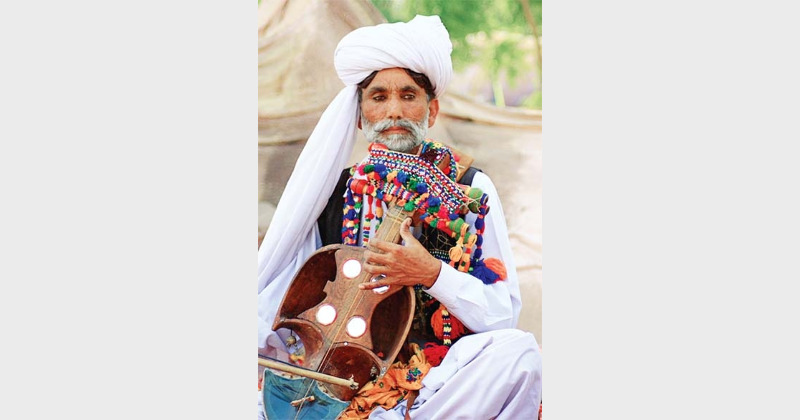
In our previous editions we have discussed about the ground situation, historical perspective and economic & strategic importance of the troubled region. In this part, we are focusing on the culture of Baluchistan which Pakistan is repressing and eliminating for its economic and strategic interests
Santosh Verma
In Baluchistan, land is vast and population very scattered. This is a very significant part with large reserves of natural resources. It is particularly rich in terms of art, culture and heritage. The first evidence of grain production in Neolithic age was found at Mehargarh which is located in Balochistan. The most important ports of the Harappan culture Sutkagendor, Sotkakoh and Balakot are in Balochistan today. Additionally Nausharo, Pirak Damb and Nindovari were some important settlements which were at the peak of their development at that time. The developed civilisation and culture in particular has continued its journey and it shows its proximity to Iran. Impact of Hakhmani rulers’ attacks and subsequent invasions of Alexander in this region is visible on its people and culture.
This region was the far west part of Great Nanda Empire and its successor Maurya Dynasty. Hinduism and Buddhism were the most popular
religions here at that time. In 642 AD, in the reign of Caliph Umar, Islam, as the religion of invaders, arrived in Baluchistan. Thus began the process of Islamisation. Islam was neo born
religion and strongly denounced all developments before its inceptions. So it made profound impact on the region and a great culture and historical
heritage have been forgotten over time.
Baluchistan today is spread over a vast area, small portion in parts of Iran and Afghanistan but the remaining large part was illegally occupied by Pakistan in March 1948. Occupied Baluchistan had population of 13 million in 2012 and Baluchistan constituted 7 per cent of the total population of Pakistan.
Baluchistan is essentially a tribal area and the languages spoken by tribes can be classified into three main parts, these are Baluchi, Brahui and small amounts of Pashto. Baluchi language originated in northwestern region of Baluchistan and is used by an estimated 7.5 million people. Baluchi speaking communities consist of Rind, Lasar, Marri, Jmot, Ahmdji, Bugti, Domki, Magsi, Kenajair, khosa, Rksani, Dasti, Umrani, Nowsherwani, Gicki, Buledi, Notaji, Sanjrani, Mirwani, Jhroji, Langov and Kidai. The Brahui language is also used by a large tribal group. Mainly spoken in the central part of Balochistan, Brahui is used by about 20 million people. This is considered by linguists as Dravidian language family and shows its similarities and relation with Deccani and South Indian languages and dialects. Brahui speaking important tribal groups are Raisani, Shahwani, Sarparah, Banguljirr, Mohammdshahi, Lehri, Bijenjo, Mohammadshahi, Jehari, Mengel, Kurd, Sasoli, Satakjai, Lango, Rodeni, Klmati, Jattak, Yagajehi and Kamberani .
Pashto language is spoken by comparatively small number of tribal groups in North and North Western Baluchistan. The most important of tribal communities which communicate in Pashto are Ghiljai Kakar Achakjai Tarin Mondokel Sehrani Looney and Kasi. Baluchi literature was recently available in oral form and has been published in printed form to a very small extent. The main part of Baluchi literature highlights the history and Poems on various concurrent issues and also Baluch life. It has great diversity in its nature and craft. The
stories and legends, romantic ballads and religious and didactic poetry show rich diversity in a comprehensive manner.
The majority of Baluchistan’s population
follows the Islamic faith, although a small number of Hindu and Christian communities exist here. Sunnis are in majority and dominant group of Islam here. Hazara tribal community which has a large number in hilly areas of Baluchistan adhere to Shia faith and for this they face persecution by state and non state actors. Terrorist organisations like Lashkar-e-Jhangvi and Jundullaha are the most dreadful and notorious for their persecution
activities against ethnic and religious minorities like Hazaras, Shias, Hindus and Christians in Baluchistan.
Although Islam was accepted by the tribal
communities in Baluchistan yet they preserve their tribal beliefs, character, and traditions of their belief systems. Islam emphasises Millat or Ummah which made up of the followers of Islam but in the Baluchistan’s tribal communities “existence of their allegiance to their tribes” may be considered as against Islamic beliefs by many Islamic Scholars. Along with the festivals of Islam the baluch
communities also have kept alive their pre-Islamic rituals. Dance and music dwells in the soul of the Baluch people and it does not affect them much if they are considered as anti-Islamic. Similar Baluch traditions and beliefs manifest themselves in food, lifestyle and costums and these powerful traditions have always been the flowing source of Baluch nationalism.
In Baluchistan, there are many historical
heritage and erudite, some of which are well known to the masses of India. The first two major shrines of Hindus in Baluchistan are located in Lasbela district and Hinglaj Devi temple & the Kali Mata Mandir in Kalat District. One of most prominent Shakti peeths of Mata Hinglaj is located at Hingol National Park in Lasbela district of Balochistan. The four-day pilgrimage is held every year in the month of April. The place is center of allegiance and devotion to the myriad people of India. There is located the historical Kali temple which was established by the Hindu kings in pre Islamic period.
Baluchistan is of importance in terms of both economics and handicrafts. The Baluch craftsmen have specialisation in making crafts by leather. Similarly, goat hair, wool work, earthern ware and many versatile goods are made by artisans here. Baloch women show their eminence in embroidery and zari work on clothes and they take this art to a very advanced level.
According to official data by the Pakistan Government, population of Pakistan occupied Baluchistan was 1.1 million in 1951 of which the small segment of 12.3 per cent was living in the cities. According to the 1998 data of census by Government of Pakistan, the population of Baluchistan was 6.5 million of which the share of the people residing in urban area was only 23.8 per cent of the total population.
Baluchistan is in a condition of lack of basic amenities and facilities such as education and health sanitation,
drinking water and electricity. According to the 1998 census, with an area of 3,47,000 kilometers, there are 22,000 settlements in Balochistan in which only 13, 000 schools are
available and how they fulfill the need for 1.3 million population, is a bizarre scene. The future of younger generation of Baluchistan are dumped in a
sombrous atmosphere, deliberately by Government of Pakistan so that people of Baluchistan, should never offer any
challenge to Punjabi Dominance in not only government but in education to civil and Military services and so on. Because of the quota system in armed forces and in the civil services, less than 2 per cent seats are available for the Baluch in civil services and similarly 1.5 per cent of their representation in the military, is at a very low level.
China-Pakistan Economic Corridor (CPEC) was built on the name of economic development of Pakistan and Baluchistan but this is a blatant truth that Baluchistan does not get any benefit from this. Rather they are exploitated and disgusted. The main chunk of benefits goes to Punjab as usual in Pakistan.
Pakistan also works on a dubious plan of Pashtunisation of Baluchistan, which is a plan to reduce the influence of the Baluch people in the issues of Baluchistan and its inspirations definitely came from China to enhance their control over these areas. According to various estimates, around 7 to 10 Lac Pashtuns settled in Baluchistan from Afghanistan and Pakistan’s Northern and North Western province, Khyber Pakhtunkhwa.
In Baluchistan, the Baluch society was described as anti-Islamic norms and their antiquity and their uniqueness is in a grave danger. Pakistan implemented the plans to paralyse Baluch nationalism by social and cultural repression and elimination of Baluch Independent
character for economic and strategic interests of itself.
(The writer is a Researcher on Pakistan related issues)