Nepal is going through another wave of instability. Prachanda who is going to occupy the Prime Minister’s post in a week’s time would face a lot of challenges
Dr Satish Kumar
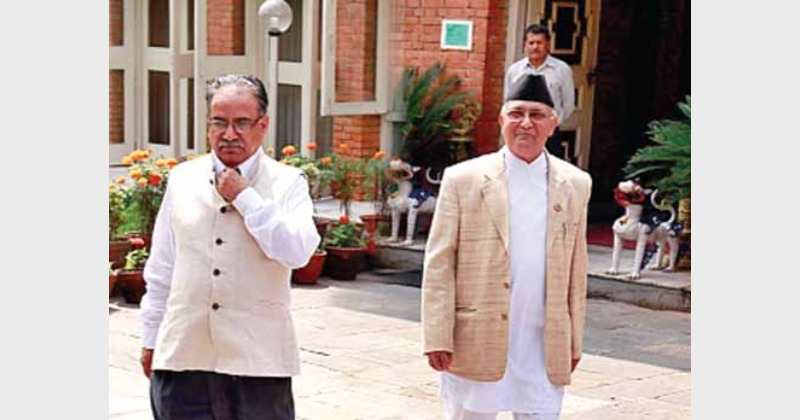
The instability in Nepal has exposed its deliberate attempt to blame Bharat for all its ills. Delivering a long speech, KP Sharma Oli informed Parliament that he had done his best in the short instinct of nine months. The high drama started by CPN (Maoist-Centre) leader, Pushpa Kamal Dahal aka ‘Prachanda’. He was eyeing for the Prime Minister's Chair. Prachanda schemed to remove Oli in May, 2016 but his plank was paused due to the interference of China. In between Prachanda established political chord with Nepali Congress and Madhesi rainbow parties. The legitimate blame he slapped against Oli was failure of Federal system in the last nine months. His regime sliced Nepal into different sections of ethnic barricades. That is why Prachanda had filed a no-confidence motion against the Oli government, accusing him of being ‘anti-federalist’ and ‘being close to those political forces that want to revive the monarchy’.
But the real reason for the CPN (Maoist-Centre)’s withdrawal of its support to the UML government was Oli’s refusal to implement a power-sharing deal with Dahal. In May, Oli had saved his government by promising to hand over power to Dahal after the budget was announced. But Oli denied having made any such agreement with Dahal, resulting in the CPN (Maoist-Centre)’s decision to pull out of the government by signing another power-sharing deal, this time with the NC.
Oli during his prolonged speech in Parliament tried to showcase himself as a leader who pioneered a new route of foreign policy of equidistance. He tried to vouch for Nepal-China relations, which started with a promising note. It has space and scope to challenge the Bharat centric foreign policy of China. The diatribe against Bharat was ill-founded and without any content. Prachanda who was running the systematic campaign against Bharat showed his restlessness to be Prime Minister of Nepal at any cost. Most of the leaders are suffering from the same syndrome of power. The blame game was a cover up exercise.
This instability will be a concern for Bharat. From the beginning itself, Bharat has never been keen to allow Nepal to drift away in political chaos. Chinese policy is altogether different. China had aligned with the Monarchy, Maoist and the Congress whichever suited its interest. On the other hand Bharat strained to help Nepal structure its institutional pillars. The Parliament, Judiciary and other allied institutions were not in pink. There is lingering doubt that in coming 18 months the new political set up will be sharing power for nine months each. It will further weaken the constitutional set up. The new election of the Constitutional Assembly is due after 18 months.
Now things of the Constitutional structures are in disarray. Prachanda will be the 24th Prime Minister of Nepal in 26 years. The power sharing with Congress will divide the period between the two leaders for nine months each. Prachanda will be sworn in the first spell. Prachanda first became Prime Minister in 2009 after his party secured a landslide victory in the first Constituent Assembly elections in 2008. But his tenure was short-lived, as he had to go out after failing to sack the army chief Rookmangud Katwal. The major constitutional question is to invite the new government according to number in the Constituent Assembly. Nepal has quite a few precedents of caretaker governments holding onto office for long. The international community, including Nepal’s neighbours, Bharat and China, has endorsed past without any reservation. Nepal elected its first Constituent Assembly in April 2008, but GP Koirala, the Prime Minister during the time of elections, continued to occupy office till mid-August. Madhav Nepal continued as “caretaker” PM for eight months, while Baburam Bhattarai held charge in that capacity for nine months.
Will Nepal’s Supreme Court show enough courage if it is asked to mediate in case of such an anomaly? In the past, the court had either vacillated or given contradictory verdicts when asked to mediate on constitutional issues. When Nepal’s first elected Parliament under the 1991 constitution was dissolved by then Prime Minister G P Koirala, after the motion of thanks to the king was defeated, the bench headed by the then Chief Justice Vishwanath Upadhyay upheld the dissolution as a “valid and constitutional exercise”. However, the same chief justice declared the dissolution of Nepal’s second parliament by PM Man Mohan Adhikari as unconstitutional and revived the house on the grounds that Adhikari was wrong in appropriating the right of parliament that was considering a no-trust motion.
Contradictory judicial verdicts and constitutional anomalies are big impediments in Nepal’s much-trumpeted journey to democracy. So are unprincipled political parties. For now, it seems that Nepal’s Constitution that came into force last year will die an unsung and quiet death. Soon, there will be demands for either a new constitution or the restoration of the 1991 constitution.
Prachanda proved his mettle as a blunt anti-Bharat. Promises in politics are unreliable. Oli ditched Prachanda and quite possible that Prachanda can do the same to Congress Leader. This ditching disturbs the political set up of Nepal. That might convert into anti-Bharat wave. Therefore, what is required is to initiate the fundamental issues of constitutional crisis. Madhesi communities are facing brunt for their legitimate demands. He has stepped in power gallery, but will he be fulfilling the promises which he has made. It is equally important to halt anti-Bharat diatribe. Stirring an anti-Bharat wave will generate fragmented sentiments of nationalist feelings which will be a dangerous trap. “The relations between Nepal and China and the relations between Nepal and India are unique which cannot be compared with one another,” he said, adding his efforts has reduced Nepal’s economic dependency on a single country. Nepal signed transport and transit treaty with China so that it could have access in both of its borders. Now the people of Nepal would not have to face the difficulty in future as it had at the time of border blockade, he said.
“Nepal should adopt equidistance in relations with its neighbours for the betterment of the country and the people. We respect the sensitivity of both our neighbours and we also expect the same from them. However, we cannot accept interference in our internal affairs, though we want good relations with our neighbours”, he added.
Prachanda will occupy the Prime Minister's post in a week’s time. But challenges before him are many. One of the major tasks would be to bring back the Maoists in the mainstream. The large scale killing during Jan Andolan Second is still a scar on the hearts and minds of Nepalese. He will also be facing heat to carry forward the agenda of equi-distance foreign policy. Dahal was in favour of absolving 1950 treaty with Bharat. These are some of the burning issues which he will be facing.
(The writer is Head of Centre for International
Relations, CUJ Ranchi)