Greater focus needs to be applied to promote the political, cultural and economic aspirations of the ethnically connected border populations astride the India Myanmar border. Not by guns alone can security be achieved
Maj Gen Dhruv C Katoch
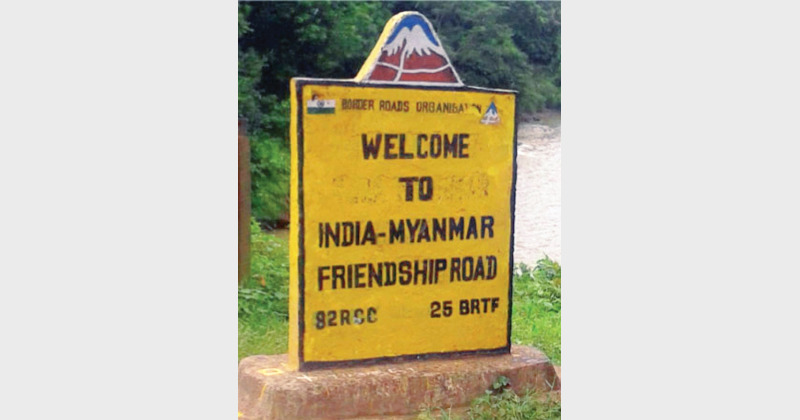
The 1,643 km-long international boundary separating India and Myanmar was formally delimited and demarcated on March 10, 1967, after New Delhi signed a border agreement with Naypyidaw. However, it remains an artificial line, dividing tribes such as the Singphos, Nagas, Kukis, Mizos etc., all of whom continue to maintain strong linkages with their kith and kin across the international divide. This remains an unfortunate historical legacy. To enable these tribes to maintain their age-old ties, a unique arrangement called the Free Movement Regime (FMR) remains in place, which permits the tribes residing along the border to travel 16 km across the border without visa restrictions.
The complicated nature of the terrain and human geography of the India-Myanmar border makes it vulnerable to a plethora of security challenges. Raging insurgencies on either side of the border have given rise to a host of insurgent groups. In India, multiple ethnic communities have participated in armed movements, with demands ranging from greater autonomy within India to outright secession. In Myanmar too, armed ethnic groups have been fighting against their government, with demands mirroring those of Indian armed groups. The transverse mountains, inhospitable terrain, surging rivers and dense forest canopy astride the border offer safe havens to the ethnic militias, which ipso facto control the region. Terrain difficulties enable anti-India rebel groups such as the NSCN-K, NSCN-IM, ULFA, PLA, (UNLF-M) and the like, to operate from the remote hills of western Burma. Their base camps are exceptionally mobile and their information networks remain very reliable, thus facilitating their continued resistance. The Burmese military (Tatmadaw) lacks the ability to disarm such groups in Myanmar, resulting in New Delhi’s expectations remaining unfulfilled. Money laundering, fake Indian currency notes (FICN), drug dealing, and illegal sales of light military equipment are common along the Indo-Burmese border because of the region’s flourishing underground economy and the poor living conditions of Tatmadaw soldiers and low-ranking officers. Indian insurgents take advantage of the FMR to cross over to Myanmar to receive training in arms, establish safe havens and re-enter India to carry out subversive attacks. The FMR provisions allowing tribal people to carry head loads, also facilitates smuggling of arms and narcotics from across the border.
The border areas of India and Myanmar are thus deeply connected, not only through common ethnic linkages, but also through a nexus of criminal activities. There is high traffic in illegal drugs and small arms, due to its proximity to the ill-famed ‘Golden Triangle’, overlapping the mountains of Thailand, Burma, Laos and Vietnam. Indian and Burmese armed ethnic groups join hands to smuggle drugs and guns through Myanmar into India and beyond. Poverty, absence of law enforcement and rule of law, and lack of employment opportunities pave the way for the youth to join armed groups, resort to drug and small arms smuggling and illegal trafficking in women and children.
Inadequate understanding of the issues involved leads to interventions which are unlikely to resolve the problems faced. Guarding the Myanmar border with an ever-increasing border force is a reactive policy and is unlikely to cause a material change to the ground situation. The inhospitable terrain and lack of lateral communications make physical detection and prevention of movement of small groups across the border virtually impossible, regardless of the number of troops deployed for the task. Fencing of the border is also retrograde as the terrain offers many opportunities to overcome such obstacles without detection. Maintenance and guarding of the fence would also eat away large number of troops and resources. This would be a double whammy as despite the huge expenditure incurred by the Centre on the maintenance and upkeep of such forces, their likelihood of preventing illegal activities would still be doubtful.
As per recent press reports, the guarding of the India-Myanmar border is proposed to be handed over to the Indo-Tibetan Border Police (ITBP). A few years ago, similar reports indicated that Border Security Force (BSF) would be given this role. With this, the issue of guarding borders with friendly countries is once again on centre stage, but the solutions offered appear hackneyed and stereotyped. Border guarding is not just about placing an ever-increasing quantum of troops on the border. It also relates to capability development to deliver on set parameters so that the envisaged threat is minimised if not eliminated in its entirety. Should the ITBP or the BSF be given this task, it would involve the raising about 45 to 50 additional battalions to guard the border. This would involve, at conservative estimates, an expenditure of approx. Rs 10,000 crore annually at present prices for maintenance of the force, besides the initial cost of raising which would be many times this figure.
To annually expend national treasure on such a scale and yet not be certain of preventing the cross border movements of the handful of militants that operate in the North East does not speak of sagacity. More importantly, besides alienating the border people, it would have in all likelihood adversely impact on the budding Indo-Myanmar relationship. It must be understood that India does not face a military threat from Myanmar, as in the case of our borders with Pakistan and China. Nor does India face a threat of migrants streaming into the country from Myanmar, as it does from Bangladesh. The additional forces deployed on the border would essentially be required to control the cross flow of traffic, especially the movement of armed militant groups. The Maginot Line mentality is unlikely to achieve that aim and in all probability would worsen the present security situation, rendering waste the vast sums that would be required for the purpose.
At present, the Indo-Myanmar border is guarded by the Assam Rifles, which have 15 battalions deployed for the purpose. This is in conformity with the recommendations of the Group of Ministers report of 2002, post the Kargil conflict, wherein Assam Rifles were given the responsibility to guard this border. These battalions are also integrated into the security grid of the Army, deployed in the counter insurgency role in the affected states. This arrangement offers tremendous advantages and should not be disturbed. If required, a few additional battalions of the Assam Rifles could be raised. Over the years, the Assam Rifles have built up a formidable reputation and rapport with the local people and they remain the best option to guard these borders. Why disturb an arrangement that has worked so well? Far better to maintain the status quo.
Conflict resolution lies in integrating India’s armed rebel groups into the political and economic system of the country. An infusion of funds into area development could lead to improved economic opportunities for the youth, which could wean them away from insurgent groups and from indulging in criminal activities. The Look East policy of the previous government visualised such possibilities, but its implementation was tardy. With the BJP-led NDA government now in power, and with the renewed thrust being given by the Prime Minister himself to the ‘Act East Policy’, things are bound to change. On the security front, better state level policing and creation of a strong intelligence network within the states of North-East India would give far better returns than the mindless manning of borders with friendly countries. Greater focus needs to be applied to promote the political, cultural and economic aspirations of the ethnically connected border populations astride the India-Myanmar border. Not by guns alone can security be achieved.
(The writer is former Director of (CLAWS) Centre for Land Warfare Studies )