Intro: China’s 2nd railway line in Tibet, close to Indian border in Sikkim, is a step to enhance mobility of its military in the remote and strategic Himalayan region.
The latest expansion of Chinese rail network up to Shigatse (the second largest city of Tibet) near Indian border is the penultimate step towards achieving the Chinese goal of integrating its defence war machine right up to the last mile of its South Asian frontiers, especially with India.
It was an interesting coincidence that in the morning of 15th August when the new Indian Prime Minister Narendra Modi was launching a new India of his vision from the ramparts of the Red Fort in New Delhi, China was launching the latest leg of its most unique and ambitious railway dream in its most celebrated colony Tibet.
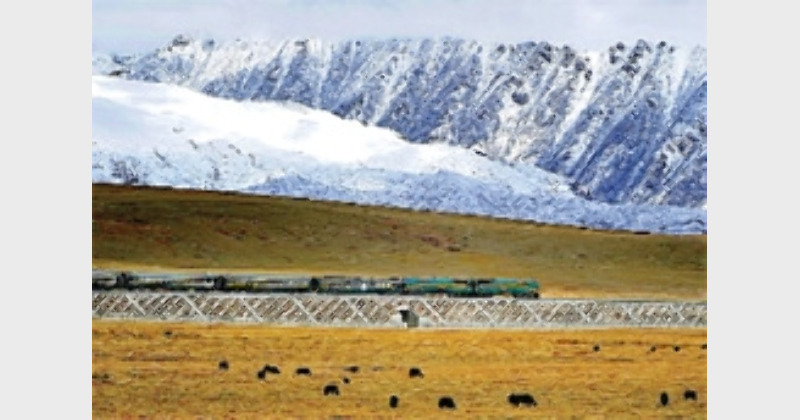
At 9am the first passenger train from the Tibetan capital city of Lhasa was flagged off on its 254 km long maiden journey to Shigatse, the second largest city of Tibet. Completed before schedule in just one month short of four years, and at a cost of 10.8 billion Yuan (about US $ 1.7 bn or INR 10,600 crore) this engineering marvel of China has been, rightfully, branded as “the closest stretch of railway to the sky” by the official Chinese media. It profusely quoted some officially sponsored Tibetans and Chinese business officials in Tibet who expressed happiness that this newly added railway stretch will make the journey of local Tibetans and tourists easier and comfortable; will help the local economy to expand and; will be a great relief for transporting minerals to the mainland at a much higher speed and in bigger quantities.
| The first passenger train from the Tibetan capital city of Lhasa to Shigatse, completed before schedule in just one month short of four years, and at a cost of 10.8 billion Yuan (about US $ 1.7 bn or INR 10,600 crore). |
However, some other facts were left to be discovered by those who have reasons to be worried over the impact of the ongoing ambitious 'Go West' development campaign in Tibet. The Central Tibetan Administration (CTA), an euphemism for the Tibetan 'Government-in-Exile' from Dharam-sala in India, has said that this further expansion of Chinese railway network in Tibet will threaten the unique cultural identity of Tibetans as it will fasten the ongoing process of population transfer from China to Tibet. “The mass influx of Chinese migrants into Tibet has also led to illegal land grabs by unscrupulous Chinese businessmen and authorities already”, it said.
But worries of India's defence and security establishment are far deeper and serious. Since Shigatse is very close to Indian borders, India is now discovering that this newly extended Chinese rail head has now made it much easier for the Chinese war machinery to move and deploy its heaviest war machinery and personnel more quickly and easily than ever in the 63 year long history of Chinese presence in Tibet. Indian defence planners are now more than ever wary of China's next plan of further forking of its 2300 km long Xining-Gormo-Lhasa-Shigatse rail line right up to Indian borders.
Now see the contrast on the Indian side of Himalayas. Thanks to the perpetual indifference of Indian government and policy makers during past six decades, not a single Indian border post is supported by all-weather or all-year network of roads or railheads. So much so that India has yet to provide its first all weather road up to any Indian post along its entire 3488 km border with Tibet-China from Damchok in Ladakh to the Anjan areas of Arunachal. In sharp contrast to this, the Chinese army is served by a non-stop highway along this entire length which also covers borders with Nepal and Bhutan in addition to India. Going by the last count, China's total road network in the TAR region alone of occupied Tibet has crossed 58,000 km mark.
While the next scheduled (2016-2020) 400 km long Lhasa-Nyingtri railway will bring the Chinese rail network eye to eye with Indian borders along Arunachal Pradesh, the simultaneous expansion of Shigatse line upto Yatung and Nyelam will bring the Chinese military engine knocking on the doors of Sikkim and Bhutan by 2020. All these rail heads would get directly linked to each of Chinese central cities including Beijing, Shanghai and Chengdu via Shigatse and Lhasa.
The implication of this Chinese steel noose around South Asia can be judged from this simple fact that Indian and international security experts have yet to estimate how many undeclared side rail tunnels along the 1200 km long Gormo-Lhasa line (completed in 2006) can be used as parking silos for PLA's rail mounted mobile missile launchers?
With the Chinese railway network in recent years crossing the 67,000 km mark, the early 20th Century idea of Sun Yatsen of developing a 100,000 mile long rail network to support the dream of Middle Kingdom appears to be coming true. Beijing's plans of constructing three more similar (larger than Gormo-Shigatse line) rail projects in Tibet are bound to further stoke the Chinese hunger for stamping its supremacy over South Asia. Already okayed in principle by the central planners in 2001, these three lines, namely Lanzhou-Nagchu-Lhasa (2126 km), Dali-Nyingtri-Lhasa (1594 km) and Chengdu-Nagchu-Lhasa (1927 km) are expected to be executed by 2038 at a current estimated cost of over $ 50 bn (about Rs. 300,000 crore).
Any doubts about the economic viability of this gigantic project? Here are a few facts. Going by the published estimates of Chinese geologists, Tibet holds big enough potential of minerals which can self-finance all these projects. According to one such estimate the value of exploitable gold, silver, copper, uranium, zinc, lead, borax and many other minerals in Tibet's TAR region in near future goes beyond US $ 96 billion. Currently active mines of Copper, Gold and Silver alone in and around Shigatse region will generate enough revenue in coming 5 to 6 years to recover the cost of this rail section. If estimates of world environmentalists and Dalai Lama's establishment in Dharamsala are to be believed, China had extracted and exported timber worth US $ 56 billion between the periods (1959-1985) from occupied Tibet. Only after the Chinese geologists had assured their bosses in Beijing that the Xining-Gormo-Lhasa belt was rich in minerals like copper, iron, lead, borax and zinc etc was this railway plan undertaken. It is estimated that the over 600 new mining sites, developed along this route since the commencement of railway traffic in 2006, have already paid back the initial investment of US $ 4 billion on this rail line.
If the railway ambitions of China in Tibet were not enough, Nepal and Pakistan's over enthusiasm to bring the Chinese railway network right up to Kathmandu and Gwadar naval port respectively is bound to present a new challenge of unimaginable dimensions before India in coming years. One hopes that the new Indian government under Mr Modi's leadership will demonstrate its grit and capability to meet this challenge.
-Vijay Kranti (The writer is a senior media professional with specialisation in Tibet and Indo-China issues)