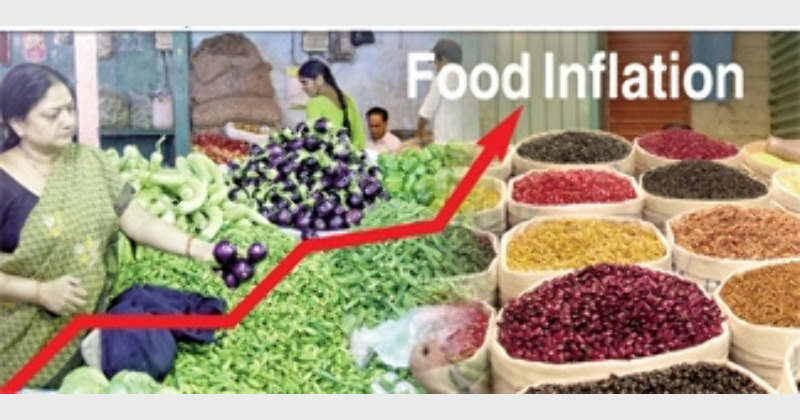
Food Inflation: 'Achey Din Ayenge' by Combating Inflation!
The election campaign of Prime Minister Narendra Modi was centered on economic doldrums and relief from the same. Congress after having remained in power for a decade has failed in managing the economy effectively. Result- downfall in manufacturing, joblessness, foreign payment crisis and resulting weakening of rupee, inflation- especially food inflation, and rise in poverty and hunger has left everyone gloomy. People are struggling hard to meet their daily needs, and the common man is worried for not being able to manage even two meals.
The congress led- UPA government was unable to control inflation. Conveniently they’d put the blame on either monsoon or international forces. The only institution which had taken to fighting against inflation was Reserve Bank of India (RBI) and that too by a single instrument namely interest rates. Though high interest rates were impeding growth; RBI remained reluctant to take any risk of reducing interest rates in view of ongoing hyper inflation. If we take note of the inflation data, we find that whereas food prices increased by 50 per cent between 2010-11 and 2013-14; the prices of energy and factory made products increased by much less proportion. Increase in food prices was basically due to mismatch between demand and supply of food products. However inefficiencies in distribution and economic mismanagement were no less responsible for the same.
Shortage of warehousing and cold storage
Inefficient storage has been the major reason for wastage of food products in India. It is ironical that where the nation was suffering from shortage of food grains, large quantity of food grain was found rotting in government stores. Due to insufficient and inefficient storage facilities and financial backing, farmers are forced to sell off their produce at throw away prices at the time of harvest. Taking advantage of the same, companies hoard agricultural produce after procuring the same at minimum prices; and then later they sell it at exorbitantly high prices. It is notable that where farmers do not get even rupee 1,400 per quintal for wheat, big companies sell wheat flour ranging between rupees 25 and rupee 40 per kilogram.
Food products rot due to lack of warehousing. According to its own admission, Planning Commission says that the country needs rupees 7,685 crores to build chain of warehouses and cold storages, and this is no big spend when compared to the worth of food that is wasted in its absence. It is surprising and unfortunate that even after 66 years of Independence the governments have been indifferent towards such a major problem. Even more unfortunate is the fact that previous government (The UPA) tried to cover its inefficiencies by arguing for FDI in retail trade on the pretext that it would help overcoming deficiencies in warehousing.
Inflation also caused by commodity exchanges
In the name of reforms in agricultural marketing, agricultural products are also subject to online future trading in commodity exchanges just as shares. This is now a proven fact that future trading in commodity exchanges is a significant cause of increasing prices of food products. It is notable that under pressure government has imposed ban on future trading in wheat, rice and couple of pulses. Though government maintains that future trading helps farmers to fetch good price for their produce, however, the continuation of future trading in other food items is only serving the interest of hoarders, mostly big companies. In fact, future trading in commodities on the line of share market is an alarm bell for the people of this country. We have to put effective restrictions on speculative activities. We cannot put the majority population's life at stake for speculators who are not even 0.1 per cent of the total population.
Imperative to increase food production
Growing demand on one hand and declining production on the other has led to food inflation. For neglecting this issue for long the government has been significantly contributing to the agricultural crisis. Notable is the fact that agriculture which used to get 20 to 25 per cent of the share of central government budget previously; is getting nearly 1.4 per cent now. Per capita availability of food grains has actually declined from 510 grams per day in 1990-91 to hardly 427 grams in 2011-12. Continuous neglect of agriculture and declining availability of agricultural land due to diversion of cultivable land in the name of urbanisation or industrialistion have been the major causes for the ailing agriculture sector. Sometimes it is argued that we can take care of deficiency of food products by imports; however, this option is no longer practical these days. In the last few years the USA, European countries and many other food surplus countries have started diverting their land for producing bio fuel plants. As a result food prices are rising fast globally. Even Food and Agriculture Organisation (FAO) has been warning regarding this food crisis.
Deficit budgets
Whenever the government spends more than its revenue, resulting deficit in the budget causes borrowing from RBI if the government is not able to borrow from the public to bridge the same. RBI lends to the government by printing more currency notes. According to the RBI data, currency held with the public was only rupees 7,67,500 crore in 2009-10, which increased to rupees 12,48,300 crore by 2013-14 (that is, 63 per cent increase in the last 4 years). This has affected inflation directly. According to Fiscal Responsibility and Budget Management (FRBM) Act government resolved to keep fiscal deficit limited to 2.5 per cent of GDP. Belying its own resolve, government has been making budgets with fiscal deficit around 5 per cent of GDP or even higher than that. Government has been trying to cover up its inability to curb unemployment and inflation by spending heavily on subsidies and other populist schemes such as Mahatma Gandhi National Rural Employment Guarantee (MNREGA) Act. This tendency has actually been fueling fiscal deficit, causing increase in money supply and resulting in heavy inflation.
How to combat inflation?
Perhaps it is a general opinion that there is not going to be any big reprieve from inflation in near future. However, the new government will have to think that if in the long run prices, especially food prices, have to be kept under check, it will have to end neglecting for agriculture industry and make concrete efforts for agricultural development. Welfare of the masses should guide the public policy and not populism. And the Government will have to keep fiscal deficit under check by restricting wasteful expenditure so that there is no additional creation of currency.
-Dr. Ashwani Mahajan (The writer is Associate Professor, PGDAV College, University of Delhi, ([email protected])