General parity in reservation
October 15, 2026
  • Read Ecopy
  • Circulation
  • Advertise
  • Careers
  • About Us
  • Contact Us
Android AppiPhone AppArattai
Organiser
  • ‌
  • Bharat
    • Assam
    • Bihar
    • Chhattisgarh
    • Jharkhand
    • Maharashtra
    • View All States
  • World
    • Asia
    • Europe
    • North America
    • South America
    • Africa
    • Australia
  • Editorial
  • International
  • Opinion
  • RSS @ 100
  • More
    • World Hindu Congress 2026
    • Op Sindoor
    • Analysis
    • Sports
    • Defence
    • Politics
    • Business
    • Economy
    • Culture
    • Special Report
    • Sci & Tech
    • Entertainment
    • G20
    • Azadi Ka Amrit Mahotsav
    • Vocal4Local
    • Web Stories
    • Education
    • Employment
    • Books
    • Interviews
    • Travel
    • Law
    • Health
    • Obituary
  • Subscribe
    • Subscribe Print Copy
    • Subscribe & Read Ecopy
  • ‌
  • Bharat
    • Assam
    • Bihar
    • Chhattisgarh
    • Jharkhand
    • Maharashtra
    • View All States
  • World
    • Asia
    • Europe
    • North America
    • South America
    • Africa
    • Australia
  • Editorial
  • International
  • Opinion
  • RSS @ 100
  • More
    • World Hindu Congress 2026
    • Op Sindoor
    • Analysis
    • Sports
    • Defence
    • Politics
    • Business
    • Economy
    • Culture
    • Special Report
    • Sci & Tech
    • Entertainment
    • G20
    • Azadi Ka Amrit Mahotsav
    • Vocal4Local
    • Web Stories
    • Education
    • Employment
    • Books
    • Interviews
    • Travel
    • Law
    • Health
    • Obituary
  • Subscribe
    • Subscribe Print Copy
    • Subscribe & Read Ecopy
Organiser
  • Home
  • Bharat
  • World
  • Operation Sindoor
  • Editorial
  • Analysis
  • Opinion
  • Culture
  • Defence
  • International Edition
  • RSS @ 100
  • Magazine
  • Read Ecopy
Home General

General parity in reservation

Archive ManagerArchive Manager
Apr 19, 2014, 12:00 am IST
inGeneral
Facebook
Twitter
WhatsAppTelegramEmail

MV Kamath


There is an ancient saying in India that goes like this: Ahalya Draupadi Sita Tara Mandodari thatha panchakanyam smare nityam mahapathaka nashanam.

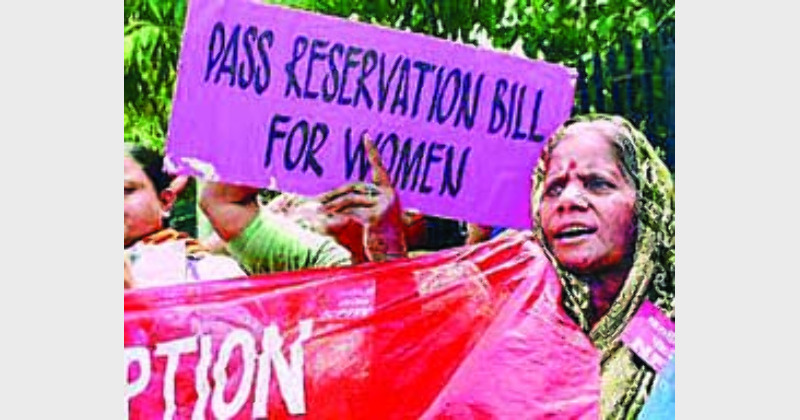
It doesn’t need translation to be understood, does it? But how many sinners remember the line or are even aware of it, let alone as a matter of habit recite it, not necessarily to assuage their mahapathakas (great sins) but as a life long prayer? One suspects hardly any. It shows the hypocrisy of the Indian male. He will invoke Laxmi and Saraswati, Durga and the Parameshwari, but when it comes to real life empowerment of women, he ducks the issue. That is all what can be said of the lapse of the 15th Lok Sabha and with it the historic Women’s Reservation Bill.

The Bill, as many may not remember, was first introduced way back in 1996 during the regime of the United Front Government led by former Prime Minister Deve Gowda. Eighteen years have passed by and the Bill continues to remain on the shelf. If passed it would have changed the face of electoral politics in the country.

What is amusing is that successive governments in the past have introduced the Bill and credit should go to Deve Gowda of the United Front Government, Atal Behari Vajpayee of the National Democratic Government and even Dr Manmohan Singh of the United Progressive Alliance but once it comes to voting, male MPs seem to get into mental imbroglio. All kinds of suggestions are presented, ending up in the Bill being shelved. As far back as 1931 a resolution on Equal Rights and obligations of all citizens without bar on sex was passed. During the first post Independent general election as many as 66 women contested the election to the Parliament but only 22 got elected to the Lok Sabha.

In the First Lok Sabha there were only 22 women constituting 4.4 per cent of the House. It increased marginally over the years except in the Sixth Lok Sabha when the House had only 19 women Members. In the 13th Lok Sabha there were 49 women Members constituting 9.02 per cent. In the 14th Lok Sabha, the strength went up to 51 Members or 9.51 per cent of the total. It was only in the Rajya Sabha that the percentage went up above 10 per cent from the year 1976 to 2006. In 2008 the percentage was 9.5 with 23 women Members. Women representation in the State Legislatures has been even more dismal. At present the average percentage of elected women in State Assemblies is 6.94 per cent, the highest being in Haryana and the lowest being 1.34 in Karnataka. States like Arunachal Pradesh, Manipur, Mizoram, Nagaland and Union Territory of Pudducherry have no women representation whatsoever.

Looking at the larger picture, the number of women elected as a percentage of number of women contestants is deplorably low showing a poor voter mentality. Except in the sixth (27 per cent) and the eight General Elections when the percentage was 25.92, in most of the other elections the percentage varied between 6.67 to 19.58.

What is significant and even remarkable is that in the elections to Panchayat and Municipalities the picture is entirely different. It comes as a surprise that in elections to these local bodies more than one million women have been elected every five years. In 2006 as many as 9,75,116 women were elected to Gram Panchayats, 58,094 women to Panchayats at intermediate levels and 5,779 women to panchayats at district levels. It is an encouraging trend and the results are truly astounding. Before reservations the percentage of elected women in this area was merely 4.5 per cent.

Gandhiji prophetically said “as long as the women in India do not take part in public life, there can be no salvation for the country.” It is worth mentioning that way back in 1920 Smt Sarojini Naidu and Ms Margaret Cousins led a group of women to demand equal rights of representation for the fair sex in the Indian provincial legislatures. Almost a century later women have still to get equality of

opportunities as legislators.

(The writer is a senior journalist and former Editor of Illustrated Weekly)

Share
Tweet
SendShareSend
✮ Subscribe Organiser YouTube Channel. ✮
✮ Join Organiser's WhatsApp channel for Nationalist views beyond the news. ✮
Previous News

Vajpayeeji was a perfect captain

Next News

A case for a Ministry of PSUs

Related News

BMS-NODE urges Government to protect Indian IT professionals affected by US green card and PERM developments

Elon Musk’s Starlink restrictions disrupt Ukraine’s drone operations against Russia, exposing risks of private satellite dependence

Musk’s Starlink imposed unannounced speed restrictions, disrupting Ukraine’s counterattacks on Russia; Kyiv flags risks

LTCG

LTCG Tax Cuts Hope Revived: Positive signals from government bring fresh hope for investors; Sensex hails it

Maa Skandamata

Navratri 2026 Day 5: Worshipping Maa Skandamata, divine Mother of Bhagwan Skanda & emblem of courage

Representative Image

Digital India’s ‘Maha-Utsav’: Why deferring the UPI charge is a masterstroke for the Indian Economy

AI-generated Image

Changing Culture of Protest in India: Why democratic movements must uphold constitutional values and public trust

Load More

Latest News

BMS-NODE urges Government to protect Indian IT professionals affected by US green card and PERM developments

Elon Musk’s Starlink restrictions disrupt Ukraine’s drone operations against Russia, exposing risks of private satellite dependence

Musk’s Starlink imposed unannounced speed restrictions, disrupting Ukraine’s counterattacks on Russia; Kyiv flags risks

LTCG

LTCG Tax Cuts Hope Revived: Positive signals from government bring fresh hope for investors; Sensex hails it

Maa Skandamata

Navratri 2026 Day 5: Worshipping Maa Skandamata, divine Mother of Bhagwan Skanda & emblem of courage

Representative Image

Digital India’s ‘Maha-Utsav’: Why deferring the UPI charge is a masterstroke for the Indian Economy

AI-generated Image

Changing Culture of Protest in India: Why democratic movements must uphold constitutional values and public trust

Dattopant Thengadi

Dattopant Thengadi: A life of national dedication, organisational service, and enduring ideas

Representative Image

Digital Colonialism or Sovereign Choice? The Starlink debate India cannot ignore

Cheruvayal Raman, ‘Paddy Man of Wayanad’, Passes Away; Padma Shri Awardee Preserved 63 Traditional Rice Varieties

Cheruvayal Raman, ‘Paddy Man of Wayanad’, Passes Away; Padma Shri Awardee Preserved 63 Traditional Rice Varieties

Saudi Supreme Court sets aside Anojan Sivarasa’s death sentence; VHP flags selective approach to religious sentiments

Load More
  • Privacy
  • Terms
  • Cookie Policy
  • Refund and Cancellation
  • Delivery and Shipping

© Bharat Prakashan (Delhi) Limited.
Tech-enabled by Ananthapuri Technologies

  • Home
  • Search Organiser
  • Bharat
    • Assam
    • Bihar
    • Chhattisgarh
    • Jharkhand
    • Maharashtra
    • View All States
  • World
    • Asia
    • Africa
    • North America
    • South America
    • Europe
    • Australia
  • Editorial
  • Operation Sindoor
  • Opinion
  • Analysis
  • Defence
  • Culture
  • Sports
  • Business
  • RSS @ 100
  • Entertainment
  • More ..
    • Sci & Tech
    • Vocal4Local
    • Special Report
    • Education
    • Employment
    • Books
    • Interviews
    • Travel
    • Health
    • Politics
    • Law
    • Economy
    • Obituary
  • Subscribe Magazine
  • Read Ecopy
  • Advertise
  • Circulation
  • Careers
  • About Us
  • Contact Us
  • Policies & Terms
    • Privacy Policy
    • Cookie Policy
    • Refund and Cancellation
    • Terms of Use

© Bharat Prakashan (Delhi) Limited.
Tech-enabled by Ananthapuri Technologies