Himalayan Misadventure: II
August 13, 2026
  • Read Ecopy
  • Circulation
  • Advertise
  • Careers
  • About Us
  • Contact Us
Android AppiPhone AppArattai
Organiser
  • ‌
  • Bharat
    • Assam
    • Bihar
    • Chhattisgarh
    • Jharkhand
    • Maharashtra
    • View All States
  • World
    • Asia
    • Europe
    • North America
    • South America
    • Africa
    • Australia
  • Editorial
  • International
  • Opinion
  • RSS @ 100
  • More
    • Op Sindoor
    • Analysis
    • Sports
    • Defence
    • Politics
    • Business
    • Economy
    • Culture
    • Special Report
    • Sci & Tech
    • Entertainment
    • G20
    • Azadi Ka Amrit Mahotsav
    • Vocal4Local
    • Web Stories
    • Education
    • Employment
    • Books
    • Interviews
    • Travel
    • Law
    • Health
    • Obituary
  • Subscribe
    • Subscribe Print Edition
    • Subscribe Ecopy
    • Read Ecopy
  • ‌
  • Bharat
    • Assam
    • Bihar
    • Chhattisgarh
    • Jharkhand
    • Maharashtra
    • View All States
  • World
    • Asia
    • Europe
    • North America
    • South America
    • Africa
    • Australia
  • Editorial
  • International
  • Opinion
  • RSS @ 100
  • More
    • Op Sindoor
    • Analysis
    • Sports
    • Defence
    • Politics
    • Business
    • Economy
    • Culture
    • Special Report
    • Sci & Tech
    • Entertainment
    • G20
    • Azadi Ka Amrit Mahotsav
    • Vocal4Local
    • Web Stories
    • Education
    • Employment
    • Books
    • Interviews
    • Travel
    • Law
    • Health
    • Obituary
  • Subscribe
    • Subscribe Print Edition
    • Subscribe Ecopy
    • Read Ecopy
Organiser
  • Home
  • Bharat
  • World
  • Operation Sindoor
  • Editorial
  • Analysis
  • Opinion
  • Culture
  • Defence
  • International Edition
  • RSS @ 100
  • Magazine
  • Read Ecopy
Home General

Himalayan Misadventure: II

Archive ManagerArchive Manager
Apr 16, 2014, 12:00 am IST
inGeneral
Follow on Google News
Facebook
Twitter
WhatsAppTelegramEmail

 Rajnikant Puranik


An Australian journalist, Neville Maxwell, created turbulence by targeting Nehru’s China Policy and its impact on the India –China war 1962. But most of the shocking revelations reported the Hendersm Brooks- Bhagat Report are already in the book Foundations of Misery in the chapter “Himalayan Blunder” published months back by Rajnikant Puranaik. We are giving stunning facts about the war given by the author in his book as a series:

Till 1954, the Indian maps showed the Ladakh-Tibet borders as “Boundary Undefined”. However, after July 1954, the Indian maps were changed unilaterally by India, at the instance of Nehru, and started showing clear borders that included Aksai Chin.

The McMahon Line

In 1913-1914, Shimla Convention, the McMahon Line was not the main, but the subsidiary issue of the Shimla Convention. The main issue was Inner/Outer Tibet.

The Indo-Tibet border in the North-east—the McMahon Line—was discussed and finalised between British-India and Tibet, as it concerned the border of the Outer Tibet which was to be under the Dalai Lama. China was not involved in it—perhaps it was not invited—although when Ivan Chen of China initialled the draft Convention on April 27, 2014, he also initialled the annexed map showing the boundaries of the Inner and the Outer Tibet that included the southern boundary of the Outer Tibet that came to be known as the McMahon Line. However, two days later, on April 29, 2014, on account of differences with Tibet on the dividing line between the Outer and the Inner Tibet, China repudiated Ivan Chen’s action and refused to proceed with full signature—which alone would have made it binding upon them.

At that time, China did not bother about the McMahon Line or raised any objections on it, mainly because the Convention was actually about Outer and Inner Tibet, and not about the boundary between India and Outer Tibet. Even if China did not sign the Convention, can the fact that China did not object to the McMahon Line then be construed to mean it was later stopped from raising objections to it? Perhaps—it depends upon the interpretation.

Incidentally, the text of the draft Convention or that of the final Convention did not specifically and explicitly talk about the Indo-Tibetan border or the McMahon Line at all; the Line was shown only in the annexed map. Article IX of the Convention stated: “For the purpose of the present Convention the borders of Tibet, and the boundary between Outer and Inner Tibet, shall be shown in red and blue respectively on the map attached hereto.”

Britain and Tibet signed the Convention on July 3, 1914. China did not sign it. The new Anglo-Tibetan Trade Regulation, giving considerable rights to Britain, was also signed on July 3, 1914, and it remained in force—independent India inherited the rights—till it was replaced by the Panchsheel in 1954.

Through the McMahon Line, McMahon had effectively advanced the borders of British-India added 50,000 odd square miles of territory, further north that was till then administered by Tibet, including Tawang, that had the famous Tibetan-Buddhist monastery. Tawang was on the trade-route and British desired control over it. Though reluctant, Tibet agreed to the give-away as a bargain for its rights on the Outer Tibet, which was the main subject of the Convention.Later, the Tibetans claimed they had most reluctantly agreed for Tawang and other areas, which till then were theirs, as part of British-India. Since China had refused to sign the Convention, the Tibetans had a right on Outer/Inner Tibet, Tawang and such other areas relinquished by them.

Incidentally, soon after independence, when the Indian Government wrote to the Tibetan Government informing them that as the successor government to the British, the British rights and obligations under their treaties with Tibet would rest with the independent Indian Government-Tibetan Government responded by asking for return of the territories on its boundary acquired by the British, including Ladakh, Bhutan, Sikkim, Darjeeling and so on.

But, of course, with India having agreed to Tibet being a part of China, and not an independent nation, a doubt was implicitly cast upon the validity of such treaties, which were agreed to by Tibet, but not by China. India effectively did a self-goal through its Tibet policy. Dalai Lama in fact made a statement to the effect that to deny the independent sovereign status of Tibet at the time of the Shimla Convention of 1914 when the McMahon Line was agreed upon deny the validity of the McMahon Line itself. The McMahon Line was marked on a map by a pen, but till 1954, it was not surveyed and demarcated on the ground. The Indian maps showed it as a dashed/broken-line. However, after July 1954, the Indian maps began showing it as a solid line indicating it was well-demarcated—at the instance of Nehru!

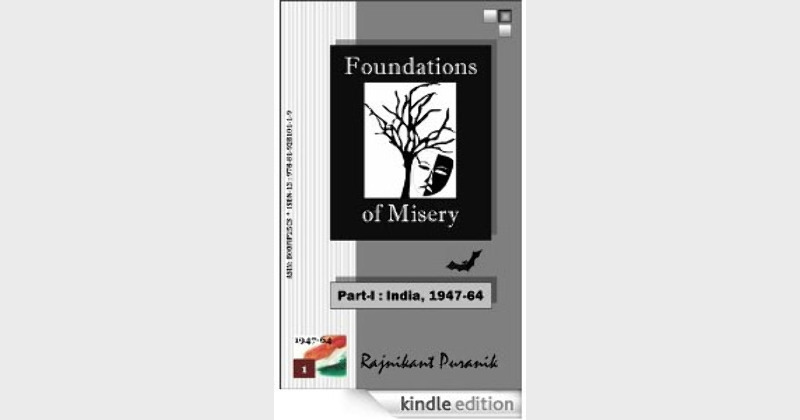
(The writer is author of Foundations of Misery, Part-1: India, 1947-64)
Share
Tweet
SendShareSend
✮ Subscribe Organiser YouTube Channel. ✮
✮ Join Organiser's WhatsApp channel for Nationalist views beyond the news. ✮
Previous News

Omar’s hanging out

Next News

Religious fanaticism destructs cultural heritage

Related News

Delhi commission for women puts Newslaundry under scanner over sexual harassment allegations, ICC & POSH compliance

CPIM Ditches Athapookalam for Pork Fest: Kerala Left Sells Meat on Hindu Pitru Paksha to Celebrate Onam| Karkidaka Vavu

CPIM Ditches Athapookalam for Pork Fest: Kerala Left Sells Meat on Hindu Pitru Paksha to Celebrate Onam| Karkidaka Vavu

80th Independence Day: Know the right way to fold and store the Tiranga with respect

New York, New Jersey proclaim August 15 as India’s Independence Day; Honours freedom struggle, democracy & diaspora

Prof. V. Kamakoti, Director of IIT Madras

Priyanka Gandhi’s ‘Gau Mutra Expert’ Remark: Over 14,000 sign petition against her jibe at IIT Madras Director Kamakoti

Rajmata Ahilyabai Holkar

Rajmata Ahilyabai Holkar Death Anniversary: Remembering the ascetic queen who rebuilt India’s heritage

Load More

Latest News

Delhi commission for women puts Newslaundry under scanner over sexual harassment allegations, ICC & POSH compliance

CPIM Ditches Athapookalam for Pork Fest: Kerala Left Sells Meat on Hindu Pitru Paksha to Celebrate Onam| Karkidaka Vavu

CPIM Ditches Athapookalam for Pork Fest: Kerala Left Sells Meat on Hindu Pitru Paksha to Celebrate Onam| Karkidaka Vavu

80th Independence Day: Know the right way to fold and store the Tiranga with respect

New York, New Jersey proclaim August 15 as India’s Independence Day; Honours freedom struggle, democracy & diaspora

Prof. V. Kamakoti, Director of IIT Madras

Priyanka Gandhi’s ‘Gau Mutra Expert’ Remark: Over 14,000 sign petition against her jibe at IIT Madras Director Kamakoti

Rajmata Ahilyabai Holkar

Rajmata Ahilyabai Holkar Death Anniversary: Remembering the ascetic queen who rebuilt India’s heritage

Tamil Nadu: TVK govt passes resolution opposing proposed delimitation, seeks permanent freeze of Lok Sabha seats at 543

Red Fort Attack: UN report links AQIS to Delhi Blast; Warns expanding Al Qaeda terror network in Indian subcontinent

Protesting students in Jharkhand

Jharkhand Students Protest: JMM-Congress govt books 600 students over allegations of violence during Assembly Gherao

Nearly 700 devotees, including 16 members of the Baiga tribal community, joined the BJP MLA Bhawna Bohra-led Kanwar Yatra

Madhya Pradesh: Bohra-led Kanwar Yatra gathers momentum as nearly 700 devotees & 16 Baiga Tribals join pilgrimage

Load More
  • Privacy
  • Terms
  • Cookie Policy
  • Refund and Cancellation
  • Delivery and Shipping

© Bharat Prakashan (Delhi) Limited.
Tech-enabled by Ananthapuri Technologies

  • Home
  • Search Organiser
  • Bharat
    • Assam
    • Bihar
    • Chhattisgarh
    • Jharkhand
    • Maharashtra
    • View All States
  • World
    • Asia
    • Africa
    • North America
    • South America
    • Europe
    • Australia
  • Editorial
  • Operation Sindoor
  • Opinion
  • Analysis
  • Defence
  • Culture
  • Sports
  • Business
  • RSS @ 100
  • Entertainment
  • More ..
    • Sci & Tech
    • Vocal4Local
    • Special Report
    • Education
    • Employment
    • Books
    • Interviews
    • Travel
    • Health
    • Politics
    • Law
    • Economy
    • Obituary
  • Subscribe Magazine
  • Read Ecopy
  • Advertise
  • Circulation
  • Careers
  • About Us
  • Contact Us
  • Policies & Terms
    • Privacy Policy
    • Cookie Policy
    • Refund and Cancellation
    • Terms of Use

© Bharat Prakashan (Delhi) Limited.
Tech-enabled by Ananthapuri Technologies