History of Kas’mira (Kashmir): Brigadier (Retd) Rattan Kaul; Gyan Publishing House, Pp 359, Rs 1,050.00
Arvind Kumar
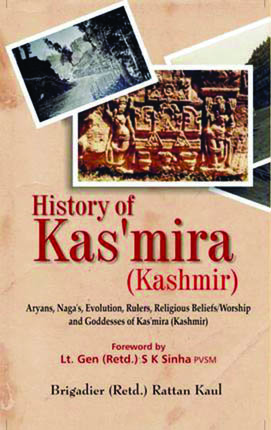 At a time when anti-nationals along with the foreign player are trying to distort the history of Kashmir Valley of Jammu-Kashmir, the release of the book of this kind cannot be timelier. The book is written by Brigadier (Retd) Rattan Kaul, a born Kashmiri who served Kashmir through Indian Army. Who else could be more suitable to write this book? The foreword by Lt. Gen. (retd) S. K. Sinha is most appropriate as one who has been associated with Kashmir from October 27, 1947, when the Indian Army went to rescue the people of Kashmir from the brutal invasion launched by Pakistan.
One of the two parts of the book covers the history of Kashmir Valley from earliest time of Aryan-Immigration to the Dogra rule of Maharaj Hari Singh. Second part of the book examines the philosophy and religious beliefs of the people.
About the need for this book author rightly adds further “Today our Gen X has been denied knowledge about our past, our heritage and all that our elders wanted us to know. This is a ten years research and writing effort to fulfill this need.”
This book covers the history of Kashmir Valley starting from Aryans-immigration to Dogra rule including historical coverage from “Nilamat Puranam” the famous Purana that deals with the Valley of Kashmir in respect of its creation, its original inhabitants-Nagas and Brahmins, their style of living, religion, customs, festivals and topography. From here writer points “Analysis of Nilmat Puranam, oldest scripture of Aryan Sarswat Brahmins of Kas’mira, indicates conclusively that Nagas were original inhabitants of Kashmir.”
Similarly, the author, at many points, refers toRajatarangini. While discussing Rajatarangini, there is a critical examination by the author that is worth noting. Author also narrates the genesis ofGotras of Kashmir Valley.
One cannot stop to read thoroughly after starting the chapter of ‘Ancient, Hindu rule and Advent of Islam’ and ‘Mogul, Afghan and Sikh Rule’. Step by step decay of Kashmir’s culture and heritage is smoothly visible in these two chapters.
The most engaging is the chapter on ‘Dogra Rule’ where connections to the present set up become visible. This notes all the events till signing of instrument of accession by Maharaja Hari Singh.
Sixth to tenth chapters cover ancient culture, beliefs and traditions of Kashmir Valley of Jammu-Kashmir. These chapters are devoted to Goddess Bhadrakali, Goddess Sharda and Kul Devis of Kashmir Valley of Jammu-Kashmir. After reading these chapters Indian reader would feel strong attachment to the Kashmir Valley of Jammu-Kashmir.
Writer has referred many pictorial proofs time and again. Some of the pictures are of ‘hard to find’ nature. By and large, book settles all the queries.
One should take other references into consideration while reading about Sharkaracharya’s coming to Kashmir and Ashoka’s rule. According to the author of this book Ashoka had not visited Kashmir and Srinagar was not named by him. It is true that Kalhan does mention Ashoka in verse 102, but if Ashoka had indeed founded the place, he would have dealt with it in detail, which he has not.
For a serious and curious reader, most appreciable is the use of various sources like; Nilamat Purana of Kashmir, Rajtarngini, Baharistan-i-Shahi, Archaeological Surveys of Kashmir, etc. Along with these sources, author has laboriously gone through traditions of Buddhist-Chinese notices and popular Bardic of Kashmir history and narrates the stories that would make even a lay reader to sit up and think.
Brigadier Kaul has done extensive research and written 5,000 years of Kashmir History. Although he is not a historian by profession but this book has better informative flavour than many books written by many settled historians.
The students of history, culture and religious philosophies and who have interest to know about Jammu & Kashmir can immensely be benefitted from this book. Readers would find this book much more informative than many other books on Kashmir as this book answers almost every query a curious can have.
People who say Kashmir was never the part of India are advised to read this book. So, when novelist Arundhati Roy claims that Kashmir was never an integral part of India she is completely off the mark. It would do well to her if she reads this book and brushes up her knowledge about the Jammu-Kashmir.
Caste vs Democracy in India
Caste and democracy in India, A Perspective from below, Dr. Vivek Kumar, Gyan Books Pvt. Pp 346, Rs 990.00
Guru Prakash
Kumar’s book can be the most exhaustively researched contemporary treatise on the discourse of caste and its impact on the sustenance of democracy and its institutions. It is a journey of brilliantly articulated propositions based on the author’s experience as an academic and a hard hitting political commentator.
The book is admittedly based on two essential premises i.e. the first claim is that social scientists have only partially understood the realities entrenched in the institution of Jati (caste), and second due to lack of understanding of Jati, they have propagated a distorted picture of the relationship between caste and democracy. To the reviewer, the author has appropriately testified the propositions through a series of historical evidences and relying upon scientific data and statistics from reliable sources.
The book is divided into five comprehensive parts dealing with different dimensions of caste and its relationship with democracy. The first part of the book is carefully dedicated solely to the philosophy, history and sociology behind the institution of caste in India. It contains detailed essays on the role and significance of castes in Indian societies. The author has responsibly outlined the relevance of caste and Hindu social order. The reader may find a deliberate deviation from the mainstream discourse on understanding the position of castes in the religious structure.
Like mentioned earlier, Kumar has substantiated his hypothesis with reliable set of empirical data. There is a rather interesting analysis available in the book where the author has tried to merge the two dominant narratives on caste by Ambedkar and Lohia. The second part of the book categorically deals with caste mobilisation and democracy. Emphasis is laid on growth, pattern and development of a social movement from the below. Kumar has rightly chosen Uttar Pradesh (the fourth largest democracy of the world) for decoding the caste mobilisation and its growing assertiveness in State politics with large scale repercussions on national politics as well. The author has displayed academic objectivity in analysing the role of BSP in the politics of State. He has gone through great lengths of realising the benefits of popular schemes initiated by the then Government to justly criticising the populist moves of erecting statues in name of social justice and emancipation. The next part of the book includes the writings on democracy and independent agenda for youth. The author has indeed offered a fresh perspective on the problems of youth in the age of globalisation. An extra incentive for the author was his constant interface with the young scholars and budding intellectuals in his institution. He has argued for the effective channelisation of the energy and utilisation of talent of the youth by the provision of adequate infrastructure by the state.
The chapter on the Dalit Youths: construction of different personality comes handy for understanding the rather unexplored but signification section of the Indian demographics. The author has provided the examples of Babasaheb Ambedkar Namdeo Dhasal and Raja Dhale who organised themselves with the view to fight for social justice at a very young age. The next section of the book deals with the question of democracy and the issue of representation. By this part, the reader would be forced to concur with the observations of the author, through meticulously drawing an analogy between the social deprivation of the individual and his share in the representative democracy, Kumar has successfully captured the essence behind the creation of this book. The final part of the book culminates with the findings of the author on democracy and development of the socially disadvantaged class. He has also briefly but excellently dealt with the point on corruption and its structural location in the Indian society.
In the concluding chapter of the book, Kumar has raised an important issue of the reformist role of Buddhism in the case of Dalits and their development, wherein he has rightly observed that even after a considerable level of historical mistreatment Dalits did not convert to other religion or establish a new sect in India.
The author has dispassionately recorded his observations, encounters and experiences and also has successfully substantiated it with data, footnotes and authorities. None of the proposition can be labelled as unexamined.