Dr R Balashankar
How Ancient Europeans Saw the World – Vision, Patterns, and the Shaping of the Mind in Prehistoric Times by Peter S Wells, Princeton University, Princeton University Press, Pp 285 (HB), $35.00.
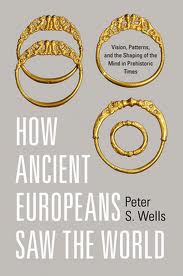 LONG long ago, before Europe became Christian, under the influence of Rome, it had a history. A history long forgotten by its own people, totally subsumed by the more recent, recorded accounts. And that deep buried story of the land now called Europe has been told by Peter S. Wells in How Ancient Europeans Saw the World – Vision, Patterns, and the Shaping of the Mind in Prehistoric Times. In today’s literate world, people tend to connect the status of a society with the rate of literacy. It is a ‘development’ indicator. But it was not in the far past. As recently as seventeenth century, only some twenty per cent of Europe was literate. “By 500 BC, many communities in temperate Europe had been exposed to writing through contact with societies in the Mediterranean world, yet none of them created or adopted a system of writing for their own use, except for the legends on coins and a few other inscriptions at the very end of the Iron Age. They managed their systems of communication in ways other than writing”, says Wells. People of the Bronze Age and Iron Age were physically empowered like us, grew crops and vegetables, made pottery for preparing and serving food, wore ornaments of metals, glass and other material, crafted their tools and weapons and buried or cremated their dead, he says by way of introduction.
He elaborates his theory on the basis of archaeological findings. There is this very amazing chapter of fibulae much like our modern day safety pins. Several types of fibulae have been found in archaeological remains, some even with piece of cloth stuck in them. Their style changed rapidly through the Bronze and Iron Ages and are considered an important source of chronological arrangement of history.
The weapons and tools tell another story of how the communities lived, hunted, fought and forged relationships. Wells with diagrams gives a close picture of the various metal weapons, unearthed. Graves have always been a major anthropological source for history. By looking at the objects at burial sites, one can spin a whole account of the community that lived because since time immemorial the dead have always been honoured and worshipped by civilizations all over the globe. It is true of Europe too. “Significant numbers of objects were deposited in pits in the ground, in bodies of water, and in fires. These three media of deposition share with graves the removal of objects from the view of the living, unlike the open-air deposits, which seem to have been intended to create displays that might remain visible for extended periods of time.”
After giving an extensive tour of temperate Europe in the pre-Roman era, using sketches, drawings and pictures of archaeological evidences, Peter Wells makes a point—Europe already had a thriving well-developed civilization and settlement. It is not as though civilization came because of the Romans. “The lesson for European history is that the “Roman conquest” of parts of temperate Europe was not as all-changing as most history books would suggest. It resulted in a temporary occupation by Roman forces of conquered European provinces, but it did not change all aspects of cultural tradition or ways of crafting and seeing, nor did it last more than a couple of centuries.”
Emphasizing on the importance of studying the objects for understanding history, he says “Our response to designs and patterns have been shaped by at least four millennia of human creativity and experience. By understanding how and why our predecessors used particular shape and decorative designs for their pottery, personal ornaments, and other objects, we gain a deeper understanding of the world we live in and our responses to it.”
When we read the pre-Roman history of Europe, we realise how similar the ancient societies were. The rituals, the practices and the lifestyle. Only in India the civilization has continued unbroken despite the many conquests and foreign rule. Christianity changed the face of the West and Islam a huge part of Asia. So much so that people of those respective nations have forgotten that they have a deep and valuable history. Peter S Wells has attempted to fill that lacunae, to tell Europeans their own ancestry, a past they should be proud of. It is evident that Wells is constantly conscious of the fact that he is writing for a modern ‘literate’ person to who words are more important than visuals. He has explained every single object, without going on jargons. An interesting history of Europe. Peter S Wells is Professor of anthropology at the University of Minnesota and has authored several books.
(Princeton University Press, 41, William Street, Princeton, New Jersey 08540)