Dr R Balashankar
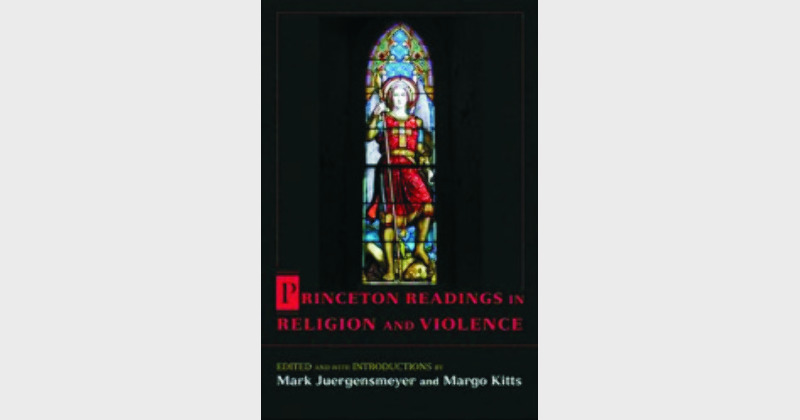
Princeton Readings in Religion and Violence, edited and with introductions by Mark Juergensmeyer and Margo Kitts, Princeton University Press, Pp 235 (PB), £16.95
 The increased terrorist activity in the name of religion has raised a pertinent question: Does any religion promote and sanction violence? Islamists say that their religion promises bliss and heaven for those who fight and kill and get killed in defence of their religion. Hence the centuries of violence against those whom they see as kafir is a religious struggle, jihad. But in a modern, secular world that is constantly attempting to live in peace and cooperation, this attitude strikes a jarring note. Especially because the victims of this so-called holy war are people who live outside this ideology.
In a highly interesting volume, Princeton Readings in Religion and Violence presents a compilation of writings culled out from various sources. It covers all major religions – Hinduism, Christianity, Judaism, Buddhism, Islam and Taoism. The book has been edited by Mark Juergensmeyer and Margo Kitts. The writings have been placed under two major sections – ‘Religious Justifications for Violence’ and ‘Understanding the Religious Role in Violence.’ “War is common to the religious imagination – and it is more than imagined. Some of the most dramatic moments in the histories of religious traditions take place on a battlefield. The literature of virtually all religious traditions is filled with warfare—whether it is the great conflicts of the Hindu epics, the Ramayana and Mahabharata; the wars between Buddhist and Tamil kings in the Sri Lankan Pali Chronicles; the great adventures of Japanese and Chinese warriors; the biblical images of warfare in the books of Exodus, Deuteronomy, and elsewhere; or the great battles at the beginnings of the Islamic tradition, wherein military forces were commanded by the Prophet.”
In the Introduction to Part I of the book, the editors highlight how religion and warfare have been tied together throughout history. “Early texts of most religious traditions have justified warfare when it was deemed necessary to protect the framework of morality that lies beneath a righteous social order.” And contexualising it to the present trend of violence, they say “…the new religious radicals do not affirm the status quo or see current authorities as legitimate upholders of moral social order. Instead, they imagine themselves to be righteous defenders of an alternative order…their justifications for the use of violence for a religious cause are not defenses of an existing sociopolitical order, for they see the secular state as deeply flawed.”
The Hindu texts discussed are Bhagavad Gita and Arthashastra. “The Arthashasstra does not encourage kings to warfare indiscriminately. In fact, it says nothing about the decision to go to war in the first place. It assumes that this critical moral determination is part of the responsibilities given to a king as an upholder of rajdharma—the righteousness of public life.” From the Gita the editors give extensive translations which seem self-explanatory. There are sections violence in the Hebrew Bible, the Qur’an, the Jewish idea of warfare.
The second part of the book offers the perspective of scholars on this subject. Tracing back to the origin of this study, the volume offers select writings. Karl Marx, Sigmund Freud and Rene Girard, Ashish Nandy are among the names. Most of them discuss the connection between violence and religion in the context of the sacrifices offered to their gods. Girard, literary theorist believes that in many sacrificial act, two aspects are involved – that is a sacred obligation to be ignored only at great peril and at other times it is a sort of criminal activity entailing perils of equal gravity. “The function of sacrifice is to quell violence within the community and to prevent conflicts from erupting. Yet, societies like our own, which do not, strictly speaking, practice sacrificial rites, seem to get along without them. Violence undoubtedly exists within our society, but not to such an extent that the society itself is threatened with extinction.”
Marx in the extract given in the volume rejects religion, declaring man as the supreme being. Ashish Nandy discusses Sikh terrorism, in the context of a plane hijack. “His conclusions are several, but include the observation that the concept of terrorism has become reified in Western imagination, so that it precludes local idiom and blinds us to the ambivalence evident in these encounters from the 1980s.”
According to Mark Juergensmeyer and Margo Kitts, “These two aspects of religious violence—sacrifice and warfare—are often interconnected, in part because two forms of sacred killing are strikingly similar. They are both about destruction, of course, but they are about destroying life with a positive intention. Participants in religious sacrifice and cosmic war envision the creation of conditions in which more life and better life will flourish. Whether they are victims or destroyers in this cosmic process, they see their participation as linking them to something greater than ordinary life.”
A conclusion like this almost tends to sanctify all killings, ideological, communal, religious and social, as they all claim purity of intent and optimistic of a better life. Violence in society cannot be explained or accepted in religious context. It is at best a façade. Still, the book offers chewable insight into the world of violence and religion. Mark Juergensmeyer is professor of sociology and global studies, affiliate professor of religious studies and director of the Orfalea Centre for Global and International Studies at the University of California. Margo Kitts is associate professor of humanities at Hawaii Pacific University. Both have authored books on religious violence and terrorism.
(Princeton University Press, 41, William Street, Pricneton, New Jersey 08540)