The centenary year of the war-cry: Vande Mataram
By Saroj Kr. Mitra
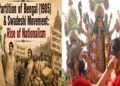
On August 7, 1905 thousands of students marched in a procession to protest against the proposal made by Lord Curzon, the Governor General of British India on July 19 at Simla to partition Bengal Presidency. Someone shouted Vande Mataram, thousand voices responded with a roaring sound Vande Mataram, Vande Mataram.
The procession culminated at the Town Hall where due to surging crowd two more meetings were being held simultaneously. Resolution on boycott of foreign goods and products were being passed and everyone took the vow to adopt swadeshi. The air was reverberating with the cry of Vande Mataram. Vande Mataram became the war-cry.
Bankim predicted that the song would raise a storm in India. Vande Mataram was written by Bankim Chandra Chatterjee in 1875 and appeared in his famous novel Ananda Math, depicting Sanyasi revolt which was published serially in the periodical Banga Darshan in 1882. Composing the tune by himself, Rabindranath Tagore sang Vande Mataram in 1896.
Aurobindo'sarticles on Bankim as a maker of modern India appeared in the Indu Prakash, published from Bombay, did not contain anything on Vande Mataram. But wrote Aurobindo in 1907, ?It was thirty two years ago that Bankim wrote his great song and few listened …. in a fated moment somebody sang Vande Mataram. The mantra had been given and in a single day whole lot of people had been converted to the religion of patriotism. The mother had revealed herself.?
How could a song even if a mantra create revolution? Swami Vivekananda'sthunderous call, ?Arise, Awake and Stop not till the goal is reached? and ?you are a sacrificial offering at the altar of the mother (India)?, etc. inspired the youngmen. Despite all such exhortations mass awakening was not there.
The resonance created by shouting Vande Mataram filled the air. Mahakali became Bharatmata. Even Muslim leaders like Liaqat Hussain did not hesitate to sing Vande Mataram.
The mantra to be effective needed yantra and tantra as per the tantric cult.
The frenzied awakening accompanied by militant action was witnessed from 1905 onwards. Certainly the earlier actions blossomed forth into a mass movement in 1905. Youngmen with revolver in one hand and Geeta in another ventured to kill English officers and embraced the gallows shouting Vande Mataram.
Thus, it is essential to look back at the earlier incidents, which caused the sprouting of the seed of revolution. After returning from Europe in 1901, Vivekanand told Sakharam Ganesh Deoskar in Calcutta that there would be a revolution. Vivekanand stated,… ?I have travelled all over India for organising revolution, manufacturing guns, etc. I have made friendship with Sir Hiram Maxim, But India is in putrefaction. So I want a band of workers who would, as brahmacharis, educate the people and revitalise the country.? Sir Maxim was a disciple of Swamiji in London and was inventor of the machine gun. Sakharam Deoskar was the linkman between the militant organisation, established by Pandurang Khankhoje spread across western India, including Nagpur and the revolutionaries of Bengal particularly those who established the Anusilan Samiti, the most organised militant organisation since 1902. Deoskar exposed the economic exploitation of India by the Britishers in his famous book Desar Katha. Along with Nivedita and Aurobindo, he was associated with Yugantar, the paper preaching militant nationalism.
The first national song written by Satyendranath Tagore (first Indian ICS) was recited by Rajnarayan Basu, the great grand maternal uncle of Aurobindo, in 1868 during the second Hindu Mela in Calcutta. Before singing Rajnarayan spoke……?! See in my mind the noble and puissant Hindu nation rousing herself after sleep and rushing headlong towards progress with divine prowess?….. Bankim Chandra Chatterjee was full of praise for this song, which he wanted to be sung everywhere in India. Others in the Tagore family including young Rabindranath too wrote series of songs extolling mother India, which were being sung in the Hindu melas from 1867 to 1880. The main architect of Hindu mela, Nabagopal Mitra, who established, National Gymnasium, National Store, National Paper, etc. for which he was called National Mitra, (Analogy of which was found at Pune where Ganesh Basudeo Joshi or Kaka Joshi founded Sarbajanik Sabha in 1870 and was called as Sarbajanik Kaka) wrote… ?The Hindus are destined to be a religious Nation?.
Tilak introduced mass Ganapati festival in 1893 and mass Shivaji festival in 1895 in Maharastra, which inspired Chafekar brothers to kill Rand, Mr Ayerest, the English officers and Dravid brothers the police agents in 1898 at Pune. Hanging of Chafekar brothers inspired young Savarkar in his village at Bhagur near Nasik to take a vow before the family deity Durga at the dead of night to overthrow British regime.
Wrote Aurobindo in 1907, ?It was thirty-two years ago that Bankim wrote his great song and few listened … in a fated moment somebody sang Vande Mataram. The mantra had been given and in a single day a whole lot of people had been converted to the religion of patriotism. The mother had revealed herself.?
In a temple at Lahore, Swami Dayananda along with other Aryasamajis took the vow to reject foreign clothes in 1879.
Thus, the dormant national feeling somehow suppressed brust forth in 1905 due to a series of programme of actions like, boycott, swadeshi, picketing, strike, etc. Surendranath Banerjee who resigned his ICS earlier declared ?Swadeshi? is Vande Mataram in action?.
In 1906, Bepin Chandra Pal who belonged to Brahmo Samaj where idol worship was prohibited, accepted worshipping of Kali as idealtry and not idolatry. Thousands of people assembled at the temple at Kalighat shouting Vande Mataram where the most innovative function ever held anywhere in India was conducted before the Goddess Mahakali. In front of a huge fire in the form of homa with citation of mantras by the priests people approached the Goddess and took the pledge to wipe out her distress. The resonance created by shouting Vande Mataram filled the air. Mahakali became Bharatmata. Even Muslim leaders like Liaqat Hussain, etc. did not hegitate to sing Vande Mataram.
At Barisal in April 1906, during the provincial conference of the Congress, top leaders were beaten by police for singing Vande Mataram, which was banned by the order of Lt. Governor Fuller.
S.N. Banerjee was fined Rs. 400 too. A boy of ten, Chitranjan Guha, was chased by the police for shouting Vande Mataram. The boy ran out and fell in a pond while police went on beating the boy who shouted Vande Mataram with every stroke of the lathi. This scene was portrayed in a canvas and exhibited throughout Bengal, which created unprecedented sensation. Chidambaram Pillai conducted a protest meeting at Madras where Vande Mataram was sung and telegrams codemning the police was sent to the Secretary of State in London. Circulars issued by Caryle, the chief secretary of Bengal followed by Risley banning singing of Vande Mataram provoked students to defy it. In 1907 young Hedgewar encouraged his schoolmates to greet the Inspector of schools with shout of Vande Mataram when the later visited city school for which several students were detained at police station and Hedgewar faced expulsion.
Bepin Pal and Aurobindo published the newspaper, Bandemataram from Calcutta which severely criticised the moderate leaders of the Congress for following the policy of mendicancy. Thus in the Calcutta Congress of 1906 the President Dadabhai Naoroji had to give a call, ?Agitate, agitate, agitate.?
Vande Mataram changed the tone and tenure of the freedom movement. According to Radhakumud Mukheriee, Bankim was inspired by a hymn of Rigveda where Rishi Angiras prayed before a deity called Samiana or Samajnama the name as per Sayanacharya symbolises the national, collective and political consciousness. The Rig Veda describes the mantra with which this deity of democracy is to be worshipped by its votaries, the mantra of complete inner union of their heart and mind, their hopes and aspirations and in national policy. In 1911 the partition of Bengal was anulled.
But due to Congress'ssupport to the Khilafat movement in 1920, nationalist Muslims were being isolated and the communal minded Muslims dictated terms to Congress for which it agreed to cutdown the song Vande Mataram. The party, which agreed to cutdown Vande Mataram finally agreed to vivisect Mother India in 1947 to enjoy power and pelf.
(The writer is all India co-convenor of SJM and can be contacted at Keshav Bhawan, Kolkata-700 006.)