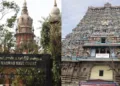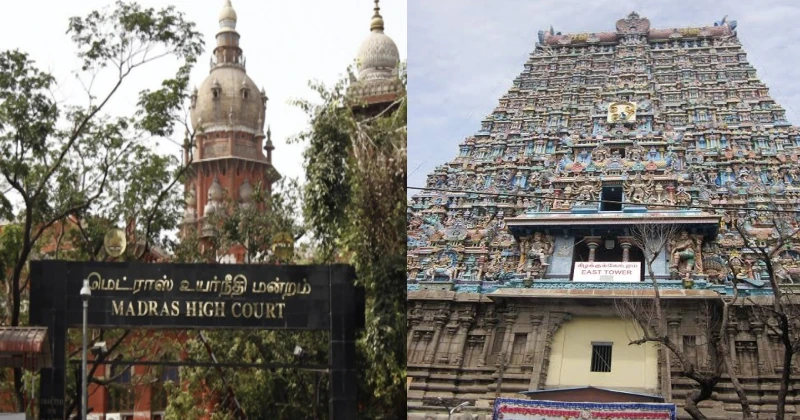
MADURAI: The Madurai Bench of the Madras High Court has declined to direct that Tamil spiritual mantras and hymns be recited on an equal footing with Sanskrit during the forthcoming Kudamuzhukku of the historic Meenakshi Sundareswarar Temple, holding that such a ritual arrangement cannot be created through a writ petition in the absence of an enabling law.
Justice C. Saravanan delivered the common order on September 3 in W.P.(MD) Nos. 11386 and 12387 of 2026 concerning the temple’s Kudamuzhukku scheduled for September 17.
One petitioner sought directions for Tamil spiritual mantras and hymns to be used alongside Sanskrit “equally” at the Yaga Salai, Karuvarai and Gopura Vimanam. The connected petition sought permission for the petitioner to personally perform Tamil Velvi Kundam rituals during the consecration ceremonies.
The Court, however, drew an important distinction between permitting Tamil devotional recitation and judicially mandating parity in the performance of established temple rituals.
The temple administration stated that it was not opposed to Tamil hymns and that Othuvars have traditionally been engaged for Tamil devotional recitation. It pointed out that during earlier Kudamuzhukku ceremonies, Sivachariyars performed Veda Parayanam and Yagasala poojas, while Othuvars recited the Panniru Thirumurai, Abirami Anthathi, Chokalinga Venba and other Tamil devotional compositions. Similar arrangements are contemplated for the forthcoming ceremony.
Against this background, the Court rejected the proposition that a private person could claim, as an enforceable right under Article 226, permission to independently conduct Velvi rituals or compel the temple administration to deploy Tamil and Sanskrit equally at every ritual location.
Justice Saravanan stressed that a writ court exists to implement and declare the law and “not to make the law”. Unless the Legislature or delegated legislation creates such an entitlement, the petitioner could not obtain a new ritual right through judicial directions.
The judgment also placed the controversy within the larger unresolved conundrums surrounding Agamic temples in Tamil Nadu. The Court noted that the exercise of determining which temples are governed by particular Agamas is continuing pursuant to earlier proceedings and that related questions remain before the Supreme Court. A separate committee constituted pursuant to an earlier Division Bench order is also examining issues connected with recitation of Tamil hymns.
Both petitions were ultimately dismissed.
Crucially, the judgment cannot be read as a prohibition on Tamil hymns at Meenakshi Temple. The Court itself recorded that Tamil spiritual hymns through Othuvars are already part of temple practice. What it rejected was the demand to judicially prescribe an equal Tamil-Sanskrit formula within particular rituals, and an individual claim to officiate at the sacred-fire ceremonies.
The ruling assumes wider significance amid recurring attempts to place Tamil and Sanskrit traditions in adversarial political compartments. The judgment instead places the emphasis on law, established temple practice, Agamic questions and the limits of judicial power in restructuring forms of worship.