The Vande Mataram controversy has turned into a fresh test for the Congress-led Opposition’s ability to keep its allies on the same page.
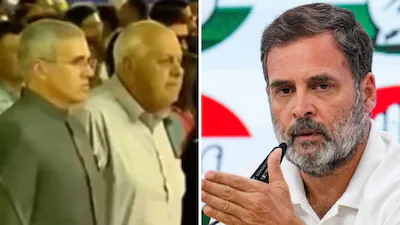
Omar Abdullah and former Jammu & Kashmir chief minister Farooq Abdullah stood at attention as the complete six-stanza version of Vande Mataram was played at Jammu & Kashmir’s first international film festival on September 8.
The move may have been routine at the event, but Congress clearly did not see it that way. Instead of standing by its alliance partner, the party issued a public reminder to Omar Abdullah that it prefers the version of the national song consisting of its first two stanzas.
The sharp response has once again exposed the ideological differences within the INDIA bloc, particularly on issues involving nationalism, secularism and cultural symbols.
‘We would like our allies…’: Congress
Congress general secretary KC Venugopal responded to the video on X, saying the full version of Vande Mataram does not sit comfortably with what the party describes as India’s “syncretic and pluralist ethos”.
Venugopal invoked several prominent freedom fighters and leaders, including Mahatma Gandhi, Jawaharlal Nehru, Sardar Vallabhbhai Patel, Subhash Chandra Bose, Rajendra Prasad, Acharya Narendra Dev, Maulana Abul Kalam Azad, Sarojini Naidu and J B Kripalani, while also referring to Rabindranath Tagore’s influence.
He said Congress wanted its allies to respect the judgment of these leaders and stand with the version of the song that was adopted during the freedom movement.
Congress argued that limiting the rendition was a deliberate decision to prevent the song from being “communalised” and said maintaining that approach was important to preserve the secular and inclusive character of the Republic.
Omar Abdullah chooses not to escalate the dispute
Omar Abdullah, however, did not appear interested in turning the disagreement into an open confrontation with Congress.
When questioned about the controversy, the J&K chief minister sought to play down the differences and pointed out that Congress had already clarified its own position.
Abdullah also said that the full version had been accommodated during their event and indicated that political parties and the public were still adjusting to the inclusion of Vande Mataram in official Jammu & Kashmir protocols.
His response: “We are also adjusting”, appeared aimed at keeping the disagreement from developing into a larger political fight.
Congress and National Conference are allies in J&K
The disagreement is significant because Congress and Omar Abdullah’s Jammu & Kashmir National Conference (JKNC) are allies both within the broader INDIA bloc and in the political arrangement in Jammu & Kashmir.
Congress provides outside legislative support to the Omar Abdullah-led government in the Union Territory.
Yet the Vande Mataram controversy has now placed the two parties on opposite sides of a politically sensitive question.
The National Conference leadership’s decision to stand through the complete rendition, followed by Congress publicly asking its ally to follow a different version, highlights the ideological space between the two parties.
Another crack in the Opposition alliance?
The latest controversy comes at a time when differences among INDIA bloc constituents have increasingly become visible on issues beyond their common opposition to the BJP.
For Congress, the Vande Mataram issue is tied to its interpretation of India’s secular and pluralistic traditions. For its allies, however, the question of how the national song should be rendered may not necessarily carry the same political implications.
What is Congress’s stand on Vande Mataram?
Vande Mataram, once embraced by the Congress as one of the defining slogans of India’s freedom struggle, has now become a source of political discomfort for the party. Congress’s position has gradually shifted over the years, with the party increasingly insisting on restricting official renditions to the first two stanzas.
Many accuse Congress of minority appeasement, arguing that a song that once served as a rallying cry against British rule is now being selectively accepted by the party for political reasons. Congress, however, maintains that its position is based on the historical decision to use a version that it believes better reflects India’s pluralistic and secular character.
The political criticism against Congress centres on a simple question: if the complete composition was not always treated as problematic, why has the party become increasingly cautious about it now?
Six stanzas add another headache for Congress
The Omar Abdullah episode is particularly awkward for Congress because the person at the centre of the latest controversy is not a political opponent but an ally whose government it supports.
While Abdullah has tried to lower the temperature by saying that everyone is “adjusting”, Congress’s public statement makes clear that the disagreement is not merely procedural.
It reflects a bigger difference over how national symbols should be presented and whether historical compromises made by Congress-era freedom fighters should continue to determine their use today.