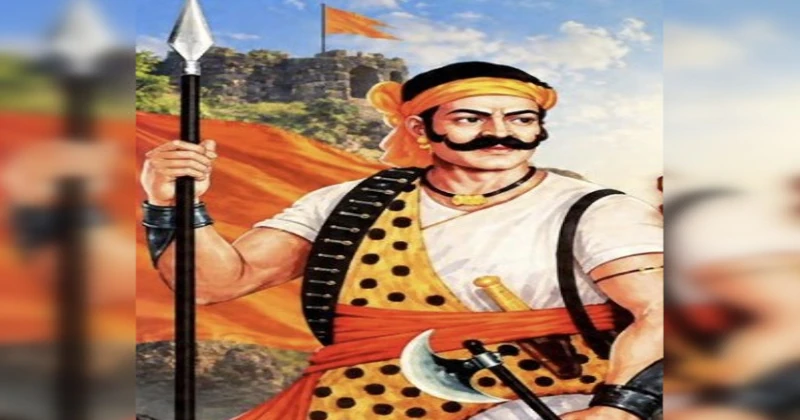
New Delhi: Long before the freedom struggle became a nationwide movement, Maharashtra witnessed the fierce resistance of a revolutionary who refused to accept British domination. Umaji Naik, remembered as Vishw Krantiveer Raje Umaji Naik, was born on September 7 1791 and emerged as one of the earliest Indian revolutionaries to wage an armed struggle against the East India Company.
On his birth anniversary, Umaji Naik’s story stands as a reminder of a resistance that began not in the corridors of power, but among communities whose livelihoods and traditional rights were disrupted by colonial rule.
Born into the Ramoshi community, Umaji Naik belonged to a people who had served under Maratha rule as night patrolmen, guards and protectors of forts and territories. Their traditional responsibilities came with certain rights, including the collection of taxes from specified villages.
The defeat of the Maratha Empire and the establishment of British control changed that arrangement. The Ramoshis lost their traditional privileges and were subsequently subjected to colonial suspicion and stigma. For Umaji Naik, this was not a reason to surrender it was a call to resist.
7 सितंबर / जन्मदिन
उमाजी नाइकउमाजी नाइक को सम्मानजनक रूप से विष्ट क्रांतिवीर राजे उमाजी नाइक के रूप में भी जाना जाता है (7 सितंबर 1791 – 3 फरवरी 1832) एक भारतीय क्रांतिकारी थे जिन्होंने 1826 से 1832 के आसपास भारत में ब्रिटिश शासन को चुनौती दी थी। वे भारत के सबसे पहले… pic.twitter.com/3c2O6XzmMN
— Rashtra Sevika Samiti Delhi Prant (@sevikasamiti) September 6, 2026
He raised an Army against the East India Company
Following the fall of Maratha power, Umaji Naik assembled a small fighting force and took up arms against the British. By 1826, he had gone a step further and declared himself king. From his bases in the hills and rugged terrain around Satara, Khandala, Borghat and other parts of Maharashtra, he continued to challenge British authority.
Umaji’s rebellion was not confined to symbolic opposition. His forces targeted British establishments and those who actively supported colonial rule. He is remembered for attacking the police station at Jejuri and for seizing British government funds.
But the money he acquired was not simply kept as war booty. According to accounts of his rebellion, Umaji distributed resources among the poor, earning considerable popular support. For a colonial administration struggling to impose its authority across the region, Umaji Naik became a serious threat.
The British tried negotiation when force failed
The intensity of Umaji Naik’s resistance eventually forced the British to consider negotiation.
When the East India Company failed to bring him under control, an agreement was reached under which Umaji was reportedly given 120 bighas of land, while assurances were made regarding government employment for members of the Ramoshi community.
Umaji temporarily halted his armed campaign. But the truce did not last. The British ultimately turned their attention back to capturing the revolutionary who had repeatedly slipped beyond their control.
A Rs 10,000 reward for his capture
The colonial government announced a massive Rs 10,000 reward for information leading to Umaji Naik’s capture. The East India Company appointed officer Macintosh to pursue him. British officers, including Captain Wid, Livingston and Lukaan, were involved in efforts to track down and arrest the rebel leader.
For years, Umaji had used the difficult terrain of the Western Ghats to his advantage. Hills, forests and remote settlements became the landscape of his resistance. He even issued his own postage stamps carrying the words, “Umaji Raja Naik, Mukkam Dongar.” It was a striking assertion of sovereignty in the face of a colonial power determined to eliminate him.
Betrayal finally led to his capture
After years of resistance, Umaji Naik was ultimately betrayed. Kalu and Nana Kulkarni reportedly helped the British capture him. On December 15 1831, Umaji was taken into custody at Avels near Mulshi in Pune and handed over to the colonial authorities.
The British interrogated and tried him before sentencing him to death. On February 3 1832, Umaji Naik was executed by the East India Company in Pune.
But even in death, the British sought to send a message. His body was reportedly left hanging from a peepal tree for three days, in an attempt to spread fear among the people and crush the spirit of rebellion.
A rebel the British could not erase
Umaji Naik was only 40 when the British executed him. Yet the struggle he led represented something far larger than one man’s rebellion. His resistance emerged from a collision between colonial expansion and communities whose traditional rights, livelihoods and status were being dismantled under British rule.
He challenged the East India Company at a time when British power was expanding rapidly across India and resistance was often met with brutal repression.
His life also exposes the deeply coercive character of colonial rule: when armed resistance could not be crushed immediately, the British attempted negotiation; when negotiation failed, they pursued the rebel through an extensive military and police operation; and when Umaji was finally captured, his execution was turned into a spectacle of intimidation.
Remembering Umaji Naik
Every September 7, Umaji Naik’s birth anniversary offers an opportunity to remember one of the early faces of armed resistance to British rule. He did not wait for a nationwide freedom movement to emerge. He fought when British authority was still consolidating itself across large parts of India.
From the hills of Maharashtra, Umaji Naik challenged the East India Company, built his own force, declared himself king, attacked colonial establishments and continued his resistance despite overwhelming odds. The British could eventually capture and execute him. But they could not erase the rebellion he came to represent.