New Delhi: The systematic governance failures in non-BJP-ruled states continue to be starkly exposed through a string of structural and administrative crises, where basic public infrastructure is collapsing under the weight of political apathy. From crumbling school buildings that pose active safety hazards to students to the blatant non-existence or utter neglect of basic sanitation facilities like functional toilets, these incidents reflect a deep-seated administrative collapse. While these opposition-led administrations focus on freebie politics and ideological rhetoric, their fundamental failure to deliver baseline civil infrastructure highlights a complete disregard for citizen welfare and public safety.
This report, through 31 incidents, exposes a pervasive and systemic administrative failure across non-BJP-ruled states such as Kerala, Karnataka, Punjab, and Jharkhand, where basic school infrastructure is crumbling due to years of official apathy and unfulfilled promises. Across these regions, students are routinely subjected to hazardous conditions-ranging from collapsing roofs, unsafe structural pillars, and overcrowded classrooms to an utter lack of basic amenities like clean drinking water and functional toilets, forcing children to study in open fields or exposed verandahs.
Wayanad School Mass Food Poisoning Outbreak
The gross administrative apathy of Kerala’s state machinery was laid bare on June 6, 2026, when nearly 150 young students at Mar Baselios Aided Upper Primary School in Koilady, Wayanad, suffered from severe vomiting and high fever over a three-day period. The criminal negligence of the local authorities left 38 children in critical condition, forcing hospitalisation at Bathery Taluk Hospital, where an emergency ward had to be set up. Instead of proactively maintaining basic health standards and food-water safety in state-managed institutions, the health department merely shut the school down for a week as a hasty cover-up.
Over 1,000 Kerala Schools Deemed Unsafe Hazards
In October 2025, official data presented in the Kerala Assembly exposed the state’s appalling infrastructure deficit, declaring a staggering 1,157 schools unfit and structurally dangerous for holding classes. An overwhelming majority of these-875 government-run schools-lay neglected, with regions like Kollam, Alappuzha, and Thiruvananthapuram turning into ticking time bombs for innocent children. Despite the routine PR rhetoric surrounding Kerala’s education sector, these crumbling buildings lack basic fitness certificates, revealing that structural safety and annual maintenance have been completely abandoned by the ruling administration.
Tribal Girls Forced into Single-Toilet Hotbed as Hostel Risks Collapse
The systemic neglect of marginalised communities came to light in October 2025 at Wayanad’s Asramam Government Tribal Residential High School, where 127 tribal girl students were crammed into three tiny classrooms with access to just one single toilet. This inhumane situation persisted for months after the PWD warned the hostel structure was on the verge of total collapse. Despite funds worth Rs23 lakh being sanctioned for basic electrification of an alternative space, administrative inefficiency delayed the project indefinitely, forcing young girls from the Adiya and Paniya communities to bear the brunt of pure state apathy.
Miraculous Escape for 71 Children as Centenary School Roof Collapses
In Thrissur’s Thiruvilwamala, 71 pre-primary students barely escaped fatal injuries on October 23, 2024, when roof tiles and a heavy false ceiling collapsed at the Government LP School minutes before classes commenced. The century-old, dilapidated structure had been left to rot without structural upgrades, despite being located right inside the constituency of then-Minister K. Radhakrishnan. Adding insult to injury, this 300-student campus does not even possess a proper source of clean drinking water, laying bare how basic amenities are withheld while governance remains missing on the ground.
Unused Rs 2 Crore Building Stands Idle as 150-Year-Old School Roof Caves In
The absolute incompetence of state planning was highlighted on July 20, 2025, in Karthikappally, Alappuzha, when the tiled roof of the 150-year-old Government UP School collapsed following heavy rain. While children were luckily spared because the building had previously failed basic fitness tests, the real scandal lies in the fact that a newly constructed Rs 2 crore KIIFB-funded block with 14 classrooms sat completely locked and unused due to pending electrical work. The administration’s failure to complete basic wiring exposed hundreds of students to unnecessary safety risks in an ancient, crumbling setup.
Pathanamthitta Exposed with 56 Uncertified and Unsafe School Structures
A devastating infrastructure audit in August 2025 revealed that 56 school buildings across Pathanamthitta district lacked mandatory fitness certificates, with 17 marked for immediate demolition due to extreme structural vulnerability. Rather than repairing or rebuilding public assets in a timely manner, local authorities allowed nearly 2,000 public structures across the state to deteriorate into hazardous ruins. This widespread negligence highlights a complete administrative breakdown, leaving educational infrastructure to rot until public outrage forces temporary reactive measures.
13-Year-Old Class 8 Student Tragically Electrocuted on School Roof
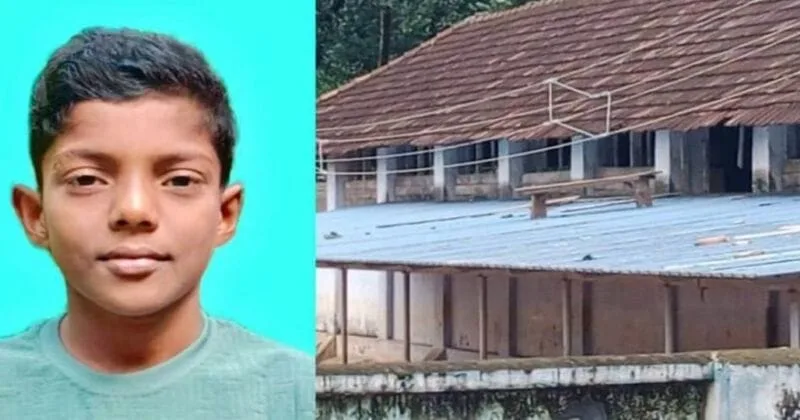
On July 17, 2025, a tragic loss of life occurred at a government-aided Boys School in Thevalakkara, Kollam, when 13-year-old Mithun Manu was electrocuted to death by a sagging live electric wire over the school building. The student had climbed to the roof to retrieve his shoe when he contacted the low-hanging power line, exposing the severe campus hazards permitted by school administrators. Though public fury forced the suspension of the headmistress and a token financial payout, this tragic loss of a young life highlights how state institutions fail to maintain even basic electrical safety protocols on school premises.
Dozens Hospitalised in Kasaragod Mid-Day Meal Food Poisoning
In yet another failure of fundamental oversight, over 35 students from Alampady Higher Secondary School in Kasaragod were hospitalised on November 21, 2024, after consuming tainted milk served under the state mid-day meal scheme. Children began violently vomiting upon returning home and had to be rushed to multiple district hospitals for emergency medical care. The incident underscores a recurring pattern of compromise on basic food safety and quality control standards in welfare programs meant to feed vulnerable school children.
Tragic Death of Class 4 Student in Tumakuru Under Unsafe Structure
On August 18, 2026, a Class 4 student named Dhanush died on the spot in Belagihalli village, Tumakuru, after an unanchored concrete pillar crashed directly onto his head while playing near his school. The poorly constructed structure-built without proper foundations or iron reinforcement- gave way under minimal strain, leaving two other young children injured. This tragic fatality stands as an indictment of local governance, showing how an utter lack of safety inspections and oversight on public structures continues to claim young lives.
Over 8,000 Government Classrooms Crumbling Across North Karnataka
Educational infrastructure in North Karnataka has reached a state of utter crisis, with over 8,000 classrooms in government schools declared structurally damaged and requiring urgent repairs. Districts like Raichur and Koppal face massive infrastructure failures, housing thousands of dilapidated and dangerous structures that require immediate demolition. Despite urgent requisitions from local divisions for hundreds of crores to rebuild unsafe facilities, state fund allocations remain a mere fraction of what is needed, trapping young students in crumbling, unsafe classrooms daily.
Severe Teacher Shortage Exposes Governance Failure in Karnataka
A damning NITI Aayog report revealed on May 12, 2026, that Karnataka’s public education system is facing a massive crisis, with 38,163 teacher positions left completely vacant against a sanctioned strength of 1,78,935 across 41,088 government primary schools. Over 77 per cent of this staggering 22 per cent overall vacancy rate is concentrated in basic primary and upper-primary levels, directly jeopardising the foundational education of rural youth. Despite high-decibel political announcements promising the immediate recruitment of 15,000 teachers, the actual hiring process has been completely stalled by administrative inaction and state lethargy, leaving thousands of classrooms understaffed.
140 Children Crammed in Two Dilapidated Rooms at Raichur School
The grim reality of Karnataka’s public infrastructure was laid bare on July 18, 2026, at Benchaladoddi Government Primary School in Raichur, where 140 young students from Classes 1 to 5 are crammed into just two crumbling classrooms. The 30-year-old facility presents an extreme safety hazard, featuring decaying concrete slabs, exposed iron reinforcement, and a fractured ceiling that threatens total structural collapse. With no functional sanitation facilities on site, young students are forced into open defecation, while authorities continue to turn a blind eye to persistent community pleas for basic infrastructure repair.
Gross Negligence Causes Main Gate Collapse at Bagalkot School
Defective construction and chronic maintenance failure caused a dangerous main gate collapse at Balakundi Government Higher Primary School in Bagalkot, injuring four young students and a school attendant as children arrived for classes. A third-grade student, Nayanakumari, suffered severe facial injuries and had to be rushed to a private hospital for emergency medical intervention. Despite residents repeatedly warning officials that the gate had already collapsed twice within a single year, state authorities failed to carry out basic safety repairs, directly leading to this preventable disaster.
353 Students Left with Single Toilet Facility in Davangere
At Karnataka Public School in Mayakonda, Davangere, 353 students-including 185 young girls—are forced to share a single, cramped toilet facility consisting of just four units, causing severe logistical distress and long wait times. The basic hygiene crisis forces young boys to relieve themselves outdoors, while young girls endure constant delays and unsanitary conditions due to complete official indifference. Built in 1949, the crumbling campus lacks standard student desks, benches, and clean drinking water sources, while parents live in constant fear that the cracked walls and unmaintained roof could collapse on their children at any moment.
Hundreds of Karnataka Government Schools Lack Fundamental Water and Sanitation
State disclosures from December 12, 2025, revealed widespread infrastructure neglect across Karnataka, confirming that 170 government schools completely lack toilet facilities while 61 institutions do not even have access to drinking water. While the state government attempts to paper over these gaps with public relations initiatives like the “water bell” campaign, deeper data exposes a shocking lack of basic gender-segregated sanitation, with 701 schools lacking separate girls’ toilets and 2,039 missing boys’ toilets. This stark reality exposes a deep gap between official administrative claims and the actual state of basic public infrastructure on the ground.
Concrete Ceiling Collapses During Class Hours in Gadag District
On June 23, 2025, a heavy section of an ageing concrete ceiling collapsed inside a Class 6 classroom during school hours at a Government Higher Primary School in Gadag district, Karnataka. The sudden structural failure severely injured two young students and left teacher M.D. Onti with serious head trauma, requiring immediate medical care at a private facility. The incident exposed severely degraded concrete structures and unmaintained roofing across the campus, prompting intense public backlash against local education officials for allowing active classes to run under dangerous, uninspected ceilings.
120 Punjab Students Forced to Study Outdoors Under Open Skies
The failure of local infrastructure management was exposed on February 22, 2026, at the Government Primary School in Basti Hazur Singh, Fazilka, where 120 primary students have been forced to sit outdoors under open skies due to a complete lack of functioning roofs. Established in 1972, the school’s subterranean classroom structures are prone to chronic waterlogging and severe structural decay, rendering them completely uninhabitable. Even though an official inspection panel formally declared the property unsafe and issued a hazard certificate, renovation efforts remain completely paralysed due to a lack of state funding allocations.
Unsafe Conditions Threaten 287 Children at Ludhiana “Smart” School
Despite high-profile claims of modernising education through the “Smart School” initiative, the Government Primary Smart School in Jagraon, Ludhiana, was exposed on May 11, 2026, for running classes directly adjacent to three structurally unsafe, condemned rooms. In addition to the structural hazard posed to 287 students, the campus lacks proper water filtration, forcing children to consume untreated tap water directly. The absence of basic fire safety compliance, decaying boundary walls, and unaddressed site encroachments further highlight a failure of basic administrative oversight.
Government-Run Hostel Evacuated Following Severe Structural Damage
On October 7, 2025, local authorities were forced to order the immediate evacuation of 28 underprivileged students from the Netaji Subhash Chander Bose Avasiya Vidyalaya hostel in Jamalpur, Ludhiana, after declaring the state-run building entirely unfit for human habitation. The facility exhibited advanced structural decay, leaking roof structures, broken windows, unhygienic washroom facilities, and a complete absence of functioning lighting or ceiling fans. Located several kilometres away from the primary school campus, the poor living conditions forced vulnerable students to commute along hazardous highways or pay out-of-pocket transport costs before the facility was finally shut down.
Tragic Roof Collapse Kills Teacher During Renovation in Ludhiana
Administrative failure and lax safety oversight led to a tragic fatality at the Government Senior Secondary School in Baddowal, Ludhiana, when the staff room roof collapsed during ongoing renovation work. The collapse claimed the life of 45-year-old teacher Ravinder Kaur and caused injuries to three other female educators who were trapped under the heavy debris inside the facility. Following public outrage over the fatal safety lapse, state authorities sealed the building premises, launched a magisterial probe, and initiated legal proceedings against the private contractor responsible for the execution of the site work.
Jalandhar Students Stranded in Panchayat Hall After Roof Collapse
Administrative apathy in Punjab left 31 young students from Sidhupur, Jalandhar, stranded in a single village panchayat hall for over a year after heavy flood damage and a verandah roof collapse destroyed their primary school building on December 8, 2024. Despite a paltry Rs2 lakh repair grant being sanctioned by the Education Department, bureaucratic bottlenecks delayed funds, forcing Anganwadi, pre-primary, and primary classes to merge under one roof. The complete neglect of school kitchens and basic structures in non-BJP states continues to undermine foundational learning while official promises remain unfulfilled.
Monsoon Rains Unmask Collapsing School Buildings in Amritsar
Persistent rainfall across Amritsar in July 2025 exposed the shocking state of public infrastructure, with 12 to 15 government school buildings categorised as unsafe structures needing urgent demolition or major repairs. At the Government Primary Smart School in Subhash Colony, Sultanwind, severe roof leaks, seepage, and structural risks forced authorities to evacuate students to a local gurdwara to conduct basic classes. This reliance on community spaces highlights the state administration’s ongoing failure to maintain safe educational facilities for school children.
Chatra Children Forced to Study Under Trees in Lightning-Prone Belt
In Jamua village, Chatra district, Jharkhand, over 100 students from Classes I to VIII were forced to sit outdoors under trees on June 27, 2025, due to the severe structural collapse risks of their government middle school. Chatra is a known high-risk lightning area, recording nearly 35 fatal strikes annually, making outdoor schooling a dangerous hazard for young students. While state officials issue routine assurances of impending construction, local children are left vulnerable to severe weather conditions due to chronic administrative delay.
130 Jharkhand Students Forced Under Banyan Tree as School Dilapidates
At Government Middle School Savdih in Ranchi, 130 students across multiple grades were forced to sit under a banyan tree and in open verandahs on May 13, 2026, after every classroom was declared structurally unsafe. With only a single usable room left on campus-repurposed as an administrative office and mid-day meal store-the school routinely shuts down completely during monsoon rains. The total decay of basic sanitation facilities on site has severely impacted female student attendance, illustrating deep-seated neglect in the state’s education administration.
Tragic Collapse of Unsafe Government Building Claims Life in Ranchi
Gross negligence surrounding condemned state infrastructure turned fatal on July 18, 2025, when a portion of a dilapidated government school building in Piska More, Ranchi, collapsed, killing one person and injuring four others. Although classes had been halted due to structural safety hazards, local authorities failed to secure or demolish the unsafe property, allowing vulnerable street vendors to seek shelter inside before the roof caved in. This failure to enforce basic structural safety protocols directly led to preventable casualties on public premises.
Jamshedpur College Students Forced to Wear Helmets in Falling Classrooms
In a stark symbol of public infrastructure decay, college students at Jamshedpur Workers College in Mango staged protests on March 7, 2024, after falling concrete chunks from 70-year-old ceilings forced them to consider wearing helmets during lectures. Multiple classrooms and examination halls suffered partial structural collapses, forcing college authorities to lock down unsafe areas. Despite urgent pleas from college administration for structural repair funds, state higher education departments failed to release necessary grants, putting student safety at daily risk.
Crumbling Jhili School Building Pushes 27 Children Outdoors
At Navprathmik Vidyalaya Jhili in Jharkhand, 27 primary students were driven out of their classrooms on July 30, 2026, as falling plaster, cracked walls, and persistent roof leaks rendered the 2002-era building unviable. Rainwater routinely floods the interior, forcing local administrators to arrange temporary relocations into alternative government spaces. The rapid deterioration of a relatively modern facility underscores poor construction quality and a lack of routine structural maintenance by state departments.
Demolition Without Sanitation Alternative Triggers Crisis for Chatra Girls
In an act of administrative thoughtlessness, authorities at a Plus Two High School in Chatra, Jharkhand, demolished the campus toilet facility on November 6, 2023, without providing any alternative sanitation infrastructure. The resulting crisis forced young female students to restrict their basic consumption of food and water before school to avoid the indignity of lacking facilities during class hours. This callous disregard for basic hygiene highlights a major failure in upholding fundamental dignity for female students in state-run institutions.
Shimla Audit Uncovers Shocking Lack of Drinking Water and Toilets in 81 % Schools
A comprehensive social audit of 444 government schools across Shimla district, Himachal Pradesh, revealed widespread infrastructural decay on August 19, 2026, with 81% of institutions lacking clean drinking water access. The report further exposed that 47% of schools suffered from inadequate classroom capacity, 78% lacked basic student furniture, and nearly a quarter functioned without operational toilets for girls. Despite the administration’s claims regarding rural development, 79% of these schools remain entirely disconnected from motorable road networks.
Poisoned Mid-Day Meal Hospitalises 35 Children in Himachal Pradesh
On August 19, 2026, at least 35 primary children at Government Primary School Badi in Manali, Himachal Pradesh, suffered from severe food poisoning after consuming contaminated kheer served under the mid-day meal scheme. Several young students collapsed and lost consciousness upon returning home, requiring emergency treatment at the Patlikul Community Health Centre. The incident underscores a recurring failure in food safety monitoring and clean water provision across state-run child welfare programs.
24 Sirmaur Students Forced into Dilapidated Hazard for Eight Years
Despite explicit administrative directions issued by the SDM in 2023 to vacate the premises, 24 young children at Government Primary School Danthal in Sangrah, Himachal Pradesh, continued studying inside a severely damaged building on August 2, 2025. The structure features deep wall fissures, collapsing ceiling plaster, ruined kitchen space, and rainwater inundation across classrooms. After eight years of complete state inaction, frustrated parents were forced to boycott classes during heavy rains to protect their children from potential building collapse and landslides.
The recurring collapse of basic infrastructure, pervasive sanitation failures, and blatant administrative apathy across these non-BJP-ruled states expose a systemic governance failure that directly jeopardises the safety and future of innocent children. While these opposition-led governments remain preoccupied with populist rhetoric, freebie politics, and shielding themselves from accountability, their complete failure to deliver fundamental amenities-such as safe school buildings, clean drinking water, and basic toilets-reflects a callous disregard for human life and public welfare. True development requires structural integrity, law, and administrative discipline, virtues that continue to remain missing under these misgoverned state regimes.